South Texas uranium production has entered a new era with the official commencement of operations at the Burke Hollow project in Bee County. As of April 2026, this site stands as the first new in-situ recovery (ISR) uranium mine to come online in the United States in over a decade. Developed by Uranium Energy Corp (UEC), the project represents a significant shift in the domestic energy landscape, moving the needle on energy independence while providing a massive boost to the local Coastal Bend economy.
The timing of this launch is critical. As the global demand for carbon-free baseload power accelerates, driven largely by the massive energy requirements of AI data centers and the electrification of the industrial sector, the necessity for a stable domestic uranium supply has never been more apparent. For South Texas, a region already deeply familiar with the cycles of the energy industry through shale energy and oil and gas news, the resurgence of uranium mining offers a complementary pillar of economic stability.
Strategic South Texas uranium production
The Burke Hollow project is not merely a single mining site; it is the cornerstone of a sophisticated regional extraction strategy known as the hub-and-spoke model. Under this configuration, the Hobson Central Processing Plant serves as the central hub. Located in Karnes County, the Hobson facility is a world-class infrastructure asset licensed to process up to 4 million pounds of uranium per year.
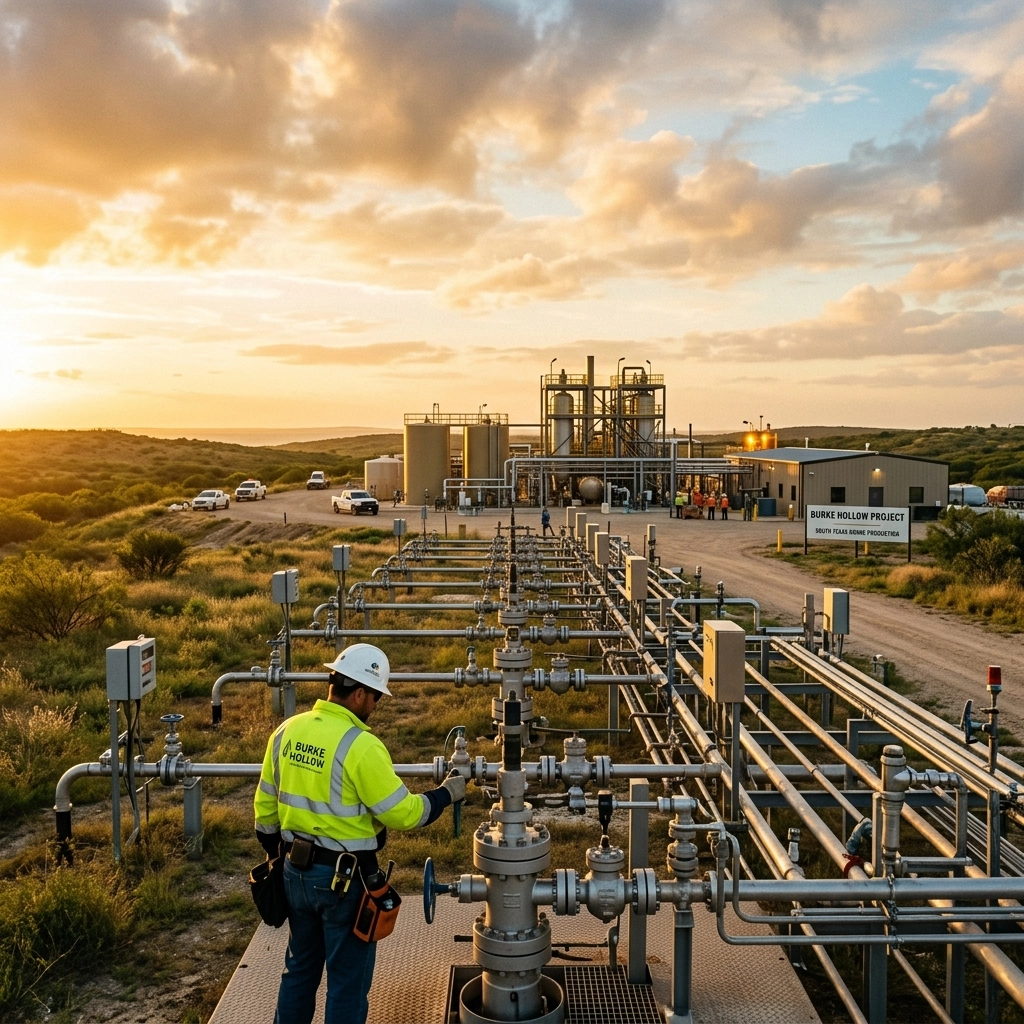
Burke Hollow acts as one of the major spokes in this wheel. The project covers approximately 20,000 acres in Bee County, an area that has been under careful exploration and permitting since its initial discovery in 2012. According to recent technical reports, the site holds 6.155 million pounds of U3O8 in measured and indicated resources, with an additional 4.883 million pounds in the inferred category. Remarkably, only about half of the permitted acreage has been fully explored, suggesting that the production lifespan of this site could extend well beyond initial projections.
The use of in-situ recovery (ISR) technology at Burke Hollow is a testament to the evolution of the industry. Unlike traditional open-pit or underground mining, ISR involves circulating oxygenated groundwater through the ore body to dissolve the uranium. This solution is then pumped to the surface and transported to the Hobson plant for final processing into yellowcake. This method is widely regarded as the most environmentally friendly form of mining, as it leaves the surrounding rock formations intact and requires significantly less surface disturbance.

Economic impacts of South Texas uranium production
The revitalization of the Texas Uranium Belt brings more than just energy; it brings a wealth of opportunity for local communities that have historically relied on the volatility of the oil and gas markets. The launch of Burke Hollow is expected to generate hundreds of high-quality jobs, ranging from geological and environmental engineering to specialized logistics and site management. Unlike some sectors of the energy economy that are prone to rapid boom-and-bust cycles, the long-term nature of uranium contracts and the steady demand for nuclear fuel provide a more predictable employment horizon.
A particularly vital aspect of this development is the opportunity it creates for the local supply chain. South Texas is home to a robust network of Hispanic-owned businesses that have spent decades supporting the regional energy sector. These companies: specializing in everything from heavy equipment maintenance and civil engineering to environmental monitoring and transportation: are perfectly positioned to pivot their expertise toward the uranium industry.
The integration of these local firms into the Burke Hollow supply chain strengthens the regional economy and ensures that the wealth generated from these natural resources stays within the Coastal Bend. As the project ramps up to its expected production of 2 million pounds of U3O8 per year, the ripple effect on local retail, housing, and public services in Beeville and the surrounding areas will be substantial.
National security and South Texas uranium production
Beyond the local borders of Bee County, the Burke Hollow project is a matter of national energy policy. For years, the United States has been heavily dependent on uranium imports, often from geopolitically sensitive regions. The Department of Energy and the White House have recently signaled a renewed focus on securing the domestic nuclear fuel cycle to ensure the reliability of the American power grid.
The startup of Burke Hollow is a direct response to this strategic imperative. By producing uranium domestically, Texas is helping to insulate the U.S. power sector from international supply chain disruptions. This move is consistent with the broader goals of energy security that have long been championed by the Texas Railroad Commission and other state leadership. Governor Greg Abbott has previously noted that developments like Burke Hollow solidify Texas as a global leader in the energy spectrum, providing the fuel necessary to power the next generation of American innovation.
The intersection of nuclear energy and traditional hydrocarbons is also worth noting. Many of the technological advancements seen in shale energy: such as precision drilling and advanced data analytics: have found a home in the uranium sector. As the industry moves toward more efficient extraction methods, the cross-pollination of talent between the oil and gas sector and the uranium sector will likely increase, creating a more versatile and resilient workforce in South Texas.
Technical infrastructure and long-term sustainability
The Hobson Central Processing Plant is the key to making South Texas uranium production viable on a global scale. As the spoke projects like Burke Hollow, Palangana, and Goliad feed into the Hobson hub, the efficiency of the operation increases. This centralized processing allows for better environmental oversight and lower operational costs per pound of uranium produced.
In the current regulatory environment, the Texas Commission on Environmental Quality (TCEQ) maintains rigorous standards for ISR operations. The successful permitting and launch of Burke Hollow demonstrate that high-yield energy production and environmental stewardship are not mutually exclusive. The project’s adherence to stringent groundwater protection protocols ensures that the local agricultural and water resources in Bee County remain protected throughout the life of the mine.
Furthermore, the data-driven approach utilized at Burke Hollow mirrors the trends seen across the broader energy industry. From real-time monitoring of injection wells to advanced 3D modeling of the ore body, the project is a showcase of modern mining technology. This focus on precision not only maximizes resource recovery but also minimizes the operational footprint, a priority for both the company and the local community.
A community-centric energy future
As we look toward the remainder of 2026 and beyond, the success of Burke Hollow will likely serve as a blueprint for future mineral development in the United States. It highlights a path forward where local economic needs, national security priorities, and technological innovation converge. For the residents of the Coastal Bend, the mine represents more than just a site on a map; it is a promise of continued relevance in the global energy story.
The Energy Network Media Group remains committed to tracking these developments as they unfold. Whether it is the latest oil and gas news or the resurgence of the domestic nuclear industry, the goal is to provide the analytical depth required to understand how these projects impact our daily lives and our long-term economic health. The launch of Burke Hollow is a win for Bee County, a win for Texas, and a significant step forward for American energy independence.
The development of the Texas Uranium Belt is a reminder that the energy transition is not about moving away from our natural resources, but about utilizing them more intelligently. By leveraging existing infrastructure like the Hobson plant and the deep expertise of the Texas workforce, the state is proving once again that it can adapt to meet the challenges of the 21st-century energy market. As Burke Hollow continues its ramp-up, the eyes of the industry will be on South Texas, watching a historic resource base come back to life to power the future.