Executive Summary
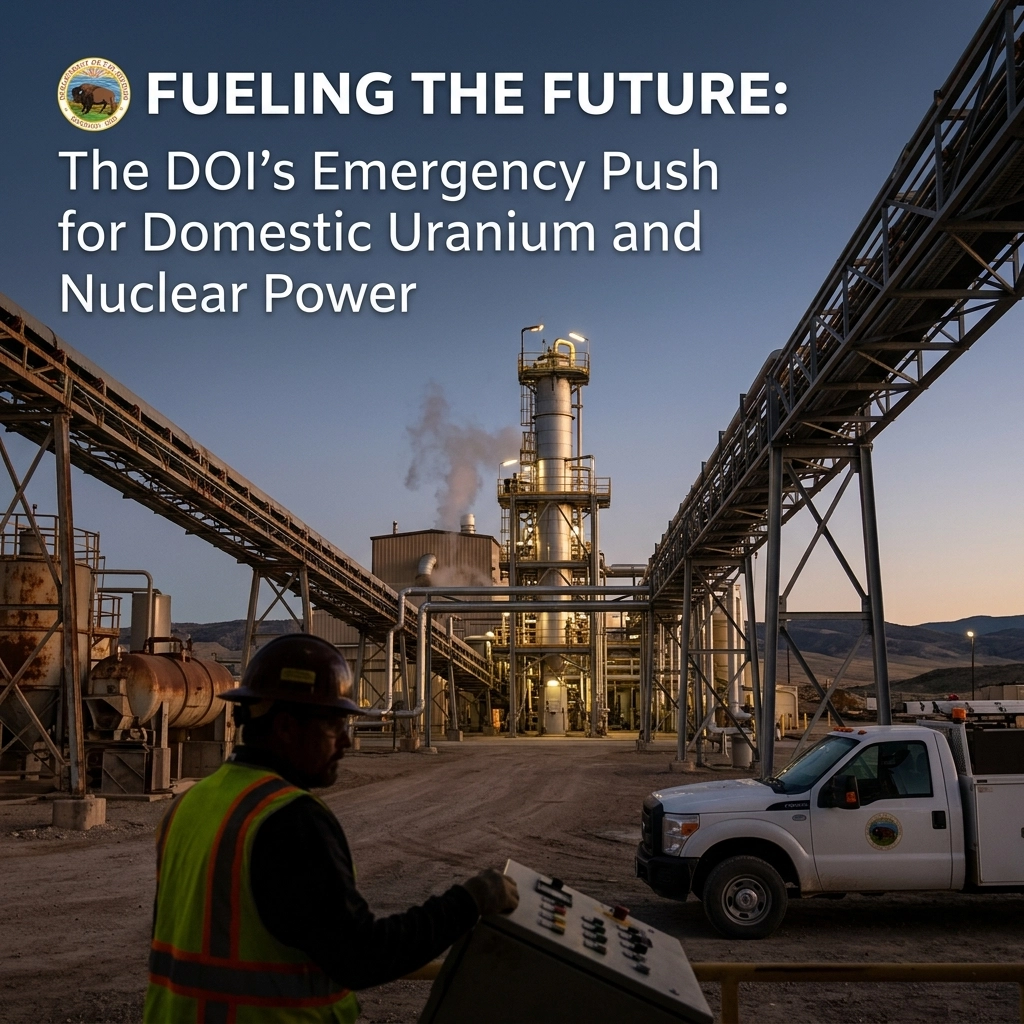
Since the declaration of a national energy emergency on January 20, 2025, the Department of the Interior (DOI) has fundamentally restructured its approach to domestic mineral extraction and nuclear infrastructure. Under the leadership of Secretary Doug Burgum, the DOI has utilized Secretarial Order 3417 to implement emergency procedures that bypass traditional, multi-year permitting timelines. The recent approval of the Velvet-Wood uranium and vanadium mine in Utah: granted just 11 days after the formal application: signals a shift toward a defense-first energy strategy. This movement is not merely about mining; it is a calculated response to the soaring baseload power requirements of the artificial intelligence sector and a strategic pivot to eliminate reliance on imported nuclear fuel from adversarial nations.
The National Energy Emergency: Breaking the Regulatory Logjam
The United States energy landscape reached a critical inflection point in early 2025. For decades, the domestic nuclear industry operated on a paradoxical foundation: while providing nearly 20% of the nation’s carbon-free electricity, the fuel powering these reactors was almost entirely sourced from abroad. According to 2023 data, the U.S. relied on imports for 99% of its uranium concentrate, with a significant portion originating from Russia, Kazakhstan, and Uzbekistan.
To address this vulnerability, the current administration’s national energy emergency declaration provided the DOI with the legal leverage to categorize energy projects as essential to national security. Secretary Doug Burgum’s April 2025 directives established alternative arrangements for compliance with the National Environmental Policy Act (NEPA) and the Endangered Species Act (ESA). These are not permanent repeals of environmental oversight but rather streamlined, high-velocity review processes designed to move projects from proposal to production in a fraction of the historical timeframe.
By reclassifying uranium as a critical asset under an emergency framework, the DOI has effectively moved nuclear fuel production from the periphery of environmental bureaucracy to the center of the national security agenda.
The Velvet-Wood Precedent: From Years to Days
The Velvet-Wood project in San Juan County, Utah, serves as the primary case study for this new era of DOI activity. Owned by Anfield Energy, the project involves the underground mining of both uranium and vanadium. Traditionally, a project of this nature would undergo years of environmental impact statements and public comment periods. However, under the new emergency procedures, the DOI issued final approval in May 2025, a mere 11 days after the application was finalized.
The project’s design contributed to its rapid clearance. By utilizing existing underground infrastructure and limiting new surface disturbance to only three acres, the mine presents a low-impact profile that fits within the administration’s “minimal footprint, maximum output” philosophy. Furthermore, the revival of the Shootaring Canyon uranium mill is central to this regional strategy, providing the necessary processing capacity to convert raw ore into the uranium concentrate required for enrichment.
Vanadium, often overshadowed by uranium, is equally critical in this context. It is a vital strengthening agent for steel and a primary component in long-duration flow batteries. Currently, global mining for vanadium is dominated by China and Russia. By fast-tracking projects like Velvet-Wood, the DOI is simultaneously securing the nuclear fuel chain and the industrial supply chain for defense and infrastructure.

SMRs and Federal Lands: Redefining the Power Grid
The push for domestic uranium is inextricably linked to the deployment of Small Modular Reactors (SMRs). Unlike traditional large-scale nuclear plants that take decades to build, SMRs are designed for factory fabrication and rapid on-site assembly. The administration has signaled a clear intent to utilize federal lands, managed by the DOI, as host sites for these advanced reactors.
Placing SMRs on federal land solves several logistical hurdles, including land acquisition and certain zoning restrictions. This strategy creates an integrated energy ecosystem where the fuel is mined, processed, and consumed within a tightly controlled domestic loop. This is particularly relevant as the Department of Energy (DOE) moves forward with its $2.7 billion plan to strengthen domestic uranium enrichment, announced in January 2026. This funding, supported by the Consolidated Appropriations Act, aims to establish a reliable supply of High-Assay Low-Enriched Uranium (HALEU), which is essential for the next generation of SMRs.
The synergy between the DOI’s permitting speed and the DOE’s financial backing is intended to create a “plug-and-play” environment for nuclear developers. This transition from fossil-fuel-heavy grids to nuclear-backed systems is a recurring theme in the https://shalemag.com/defense-first-energy-budget analysis, which highlights the shift toward energy independence as a pillar of national defense.
The AI Factor: Why Tech Giants are Betting on Nuclear
One of the primary drivers behind this emergency push is the unprecedented demand for electricity from the artificial intelligence sector. Data centers supporting AI models require massive amounts of “always-on” baseload power. Traditional renewable sources like wind and solar, while growing, often face intermittency challenges that do not align with the 24/7 requirements of high-compute facilities.
Tech giants have recognized that nuclear energy is the only carbon-free source capable of meeting this scale. This has led to a surge in private-sector interest in domestic uranium production. The reliability of the power grid is no longer just a utility concern; it is a prerequisite for the continued growth of the digital economy. The DOI’s emergency procedures ensure that the fuel for these reactors is not subject to the whims of global geopolitics.
As energy market analytics become more complex, the connection between industrial operations and financial trends becomes clearer. The use of real-time data to manage these assets is essential for modern energy companies.
Strategic Enrichment: The $2.7 Billion Investment
The DOI’s efforts in mining are bolstered by the DOE’s massive capital infusion into the midstream of the nuclear fuel cycle. In early 2026, the DOE awarded $900 million each to three major players: American Centrifuge Operating, General Metter (operating out of the historic Paducah plant), and Orano Federal Services. An additional $28 million was allocated to Global Laser Enrichment for next-generation technology.
These investments are designed to rebuild the American capacity for uranium enrichment, a sector where the U.S. has trailed behind international competitors for years. By funding multiple technologies and companies, the government is diversifying the risk of technical failure and ensuring a competitive domestic market. This multi-billion dollar commitment acts as a market signal to mining companies that if they extract the ore, the infrastructure to process it will be ready and waiting.
Future Outlook and Challenges
While the DOI’s emergency push has successfully accelerated the timeline for projects like Velvet-Wood, the path forward is not without friction. A coalition of state attorneys general has already filed legal challenges against the original January 2025 energy emergency declaration, arguing that the executive branch has overstepped its authority. If these challenges succeed in court, the “fast-tracked” status of many projects could be called into question, leading to a period of regulatory uncertainty.
However, the momentum behind domestic uranium and nuclear power appears resilient. The combination of national security concerns, the AI-driven need for baseload power, and the goal of technological leadership in the SMR space has created a rare alignment of interests between the federal government and private industry. The DOI’s use of emergency procedures is a bold experiment in industrial policy: one that seeks to prove that the American regulatory system can move at the speed of modern technology when the stakes are high enough.