
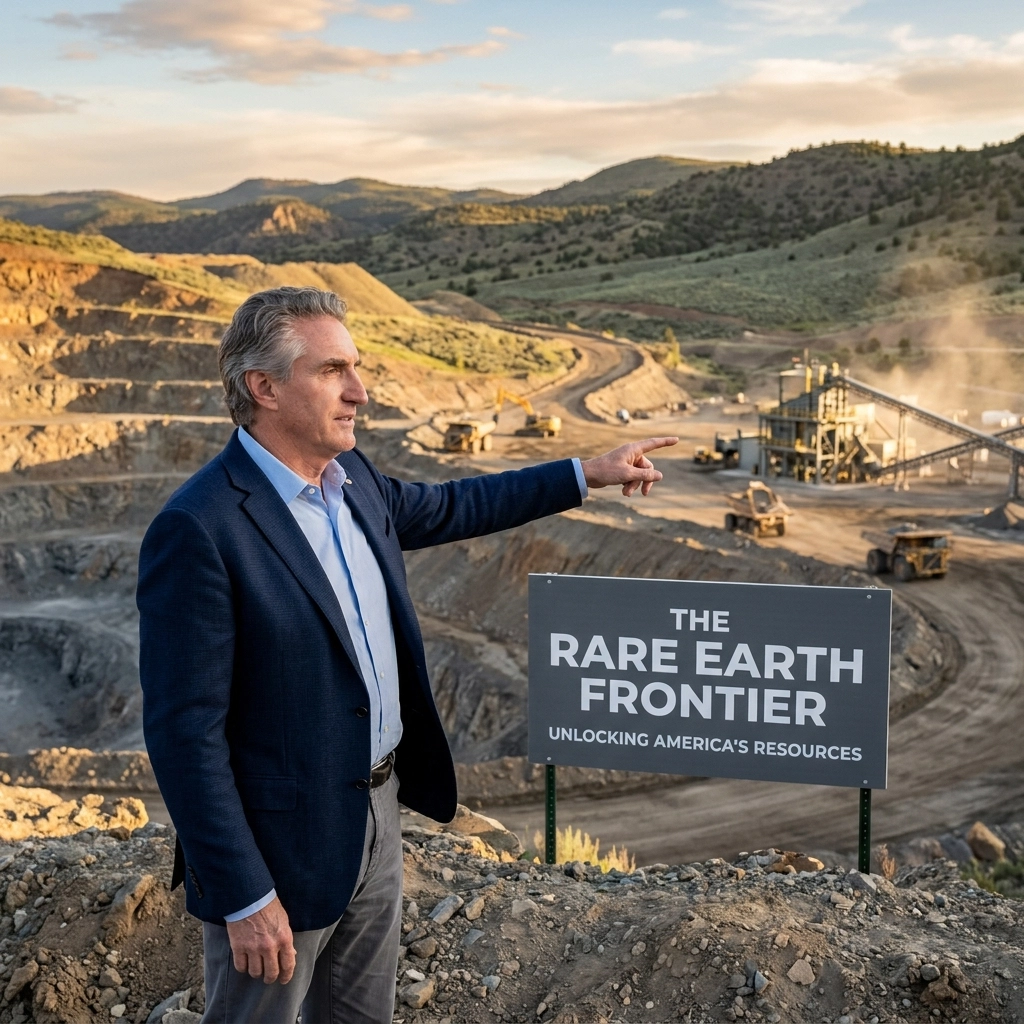
[vc_row][vc_column][vc_column_text css=””]The global energy transition is fundamentally a material transition. As the United States seeks to secure its industrial future, the focus has shifted from the extraction of liquid fuels to the complex chemistry of the periodic table. At the center of this shift is the Department of the Interior (DOI), led by Secretary Doug Burgum, whose mandate has expanded beyond traditional land management into the realm of national security through the lens of critical minerals. By leveraging the vast resources of the American West: specifically Utah, Wyoming, and Idaho: the administration is attempting to dismantle a decades-long reliance on foreign adversaries for the building blocks of modern technology.
The primary vehicle for this transformation is the National Energy Dominance Council. This body, co-chaired by Burgum and Energy Secretary Chris Wright, is designed to synchronize federal policy to ensure that American energy and mineral outputs are not just competitive, but dominant. The council’s strategy hinges on a fundamental realization: energy independence is impossible without mineral independence. According to recent International Energy Agency (IEA) projections, the demand for rare earth elements (REEs) is expected to grow by three to seven times by 2040. To meet this demand, the DOI is pivoting toward a strategy of aggressive domestic exploration and the formation of high-stakes international alliances.
Establishing the Critical Minerals Club and Global Alliances
A central pillar of the current strategy is the expansion of what has been internally termed the Critical Minerals Club. This is not merely a diplomatic gesture but a sophisticated trade bloc designed to create a tariff-free marketplace for materials like neodymium, terbium, and dysprosium. Secretary Burgum has been vocal about the necessity of this coalition to break the monopoly held by China, which currently controls approximately 60% of global rare earth production and nearly 90% of the processing capacity.
The initiative seeks to unite resource-rich allies: including Australia, Canada, South Korea, Japan, and Saudi Arabia: into a cohesive supply chain. Recent reports indicate that 11 additional countries are in the process of joining this alliance, with another 20 expressing formal interest. The goal is to establish a market that prioritizes transparency and security over the lowest possible cost, which has historically been the lever used by state-subsidized competitors to stifle American mining.
By creating a coordinated trading bloc, the U.S. can implement price floors and joint stockpiling agreements. This ensures that domestic mining projects in the West remain financially viable even if global prices are manipulated. The National Energy Dominance Council views these alliances as a defensive perimeter, ensuring that the critical components for everything from F-35 fighter jets to advanced permanent magnets remain accessible regardless of geopolitical tensions.
The Rare Earth Mining Dominance in the American West
While international diplomacy provides the framework, the physical work of unlocking the frontier is happening in the American West. The states of Wyoming, Utah, and Idaho are the primary theaters for this new mining offensive. Wyoming, in particular, has emerged as a potential global leader in rare earth production. The Halleck Creek project and the Bear Lodge deposit represent some of the most significant REE discoveries in North America. These sites are not just high in volume but contain the specific heavy rare earths required for high-performance magnets used in both defense applications and industrial automation.
In Idaho, the focus has intensified on the Idaho Cobalt Belt, a unique geological formation that could provide a domestic source of a mineral currently dominated by the Democratic Republic of the Congo. Meanwhile, Utah is leveraging its long history of copper mining to innovate in the recovery of critical byproducts. The DOI’s new directive encourages a holistic approach to mining, where a single site can produce copper, gold, lithium, and rare earths simultaneously, maximizing the economic yield of every acre of federal land.
The National Energy Dominance Council is facilitating this by streamlining the permitting process, which has historically been a decade-long hurdle for American miners. Under Burgum’s leadership, the DOI is implementing a “map, baby, map” initiative. This involves high-resolution geophysical surveys conducted by the U.S. Geological Survey (USGS) to identify subsurface riches on federal lands that have been overlooked for generations. This data-first approach reduces the risk for private investors and accelerates the timeline from discovery to production.
Circular Economy: Recovering Rare Earths from Mine Waste
Perhaps the most innovative aspect of the Burgum vision is the focus on the circular economy: specifically the recovery of rare earth elements from mine waste and tailings. For over a century, American mining focused on a few primary commodities, leaving behind vast mountains of waste rock that contain trace amounts of critical minerals. New metallurgical technologies are now making it cost-effective to re-process this “waste.”
This initiative serves two purposes: environmental remediation and resource acquisition. By extracting REEs from existing tailings in states like Utah and Idaho, the DOI can increase domestic supply without breaking new ground. According to research from the Colorado School of Mines, the potential for REE recovery from coal byproducts and legacy mine tailings is significant enough to satisfy a substantial portion of domestic demand for certain elements.

The National Energy Dominance Council is currently reviewing tax incentives and grants to support companies developing these recovery technologies. This approach aligns with a broader educational mandate to redefine mining not as a legacy industry of the 19th century, but as a high-tech sector essential for the 21st. The integration of AI-driven sorting and chemical extraction methods is turning old mine sites into the new frontiers of American energy dominance.
National Security and the Energy-Nuclear Nexus
The push for critical minerals is inextricably linked to the revival of the domestic nuclear industry. Nuclear power requires not just uranium: the mining of which is also seeing a resurgence in the West: but a host of critical materials for reactor components and shielding. The DOI’s fast-tracking of uranium projects, such as the Velvet-Wood mine, is a clear signal that the administration views nuclear energy as the baseload foundation for a mineral-intensive economy.
Secretary Burgum’s strategy recognizes that a minerals-based economy requires massive amounts of reliable, carbon-free power. By co-locating mining operations with advanced modular reactors (SMRs), the U.S. can create industrial hubs that are energy-independent and highly efficient. This synergy is a core focus of the National Energy Dominance Council, which seeks to integrate the Department of the Interior’s land-use policies with the Department of Energy’s technological roadmaps.
The geopolitical stakes could not be higher. As the U.S. moves to decouple its supply chains from China, the ability to produce, process, and utilize rare earths domestically becomes a primary deterrent against economic coercion. The Western frontier, once the source of the gold and silver that built the American economy, is now being asked to provide the “white gold” and “green minerals” that will sustain its future.
Economic Implications and the Path Forward
The economic impact of this shift is already being felt across the Western states. In Wyoming, the rare earth sector is poised to become a multi-billion dollar pillar of the state economy, providing high-wage jobs and tax revenue that offsets the volatility of traditional commodity cycles. In Utah, the focus on critical mineral recovery is attracting tech-sector investment, as companies seek to secure their supply chains through direct partnerships with miners.
However, challenges remain. The global market for rare earths is notoriously opaque, and price volatility can deter the massive capital investments required for new mines. This is where the National Energy Dominance Council’s role is most critical. By providing regulatory certainty and fostering international trade agreements, the federal government is attempting to de-risk the sector for private capital.
As we look toward 2026 and beyond, the success of Secretary Burgum’s vision will be measured by the number of active processing facilities on American soil. Extraction is only half the battle; without domestic refining and magnet-making capacity, the ore must still be shipped overseas. The DOI’s current trajectory suggests a commitment to building the full value chain, ensuring that the American West remains the heart of global energy leadership.
The unlocking of the rare earth frontier is more than a mining initiative; it is a fundamental reassertion of American industrial capability. Through the strategic leadership of the DOI and the coordinated efforts of the National Energy Dominance Council, the United States is positioning itself to lead the next era of global energy. The resources of Utah, Wyoming, and Idaho are no longer just geological curiosities: they are the strategic reserves of a nation determined to secure its own future.
Keep In Touch with Shale Magazine
As the new era of energy unfolds, you can bet we’ll be the boots on the ground to keep you informed. Subscribe to Shale Magazine for sharp insight into the arenas that matter most to your life. And don’t forget to listen to our riveting podcast, The Energy Mixx Radio Show, where our very own Kym Bolado interviews the most extraordinary thought leaders, business innovators, and industry experts of our time.
Subscribe to get more posts from Amanda Jenkins[/vc_column_text][/vc_column][/vc_row]