[vc_row el_class=”td_classic_blog_home”][vc_column][vc_column_text css=””]
In his latest Forbes analysis, Burning Bright: What the Data Says About Coal’s Global Surge, our Editor-in-Chief Robert Rapier breaks down sobering new data from the 2025 Statistical Review of World Energy—and the findings might surprise you. Despite a decade of climate pledges, coal isn’t fading. It’s booming.
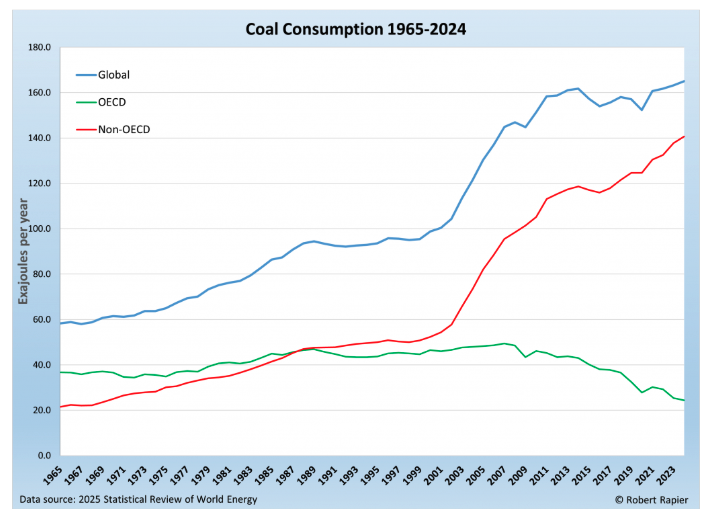
According to Rapier, global coal consumption reached an all-time high of 165 exajoules in 2024, and production surged to 182 exajoules. These aren’t just statistics—they’re a reality check for policymakers, climate advocates, and energy investors.
So what’s fueling this rise?
🌏 Asia Leads the Charge
The surge is powered by rapid industrialization and energy security concerns across Asia, especially in China and India. China alone accounted for 56% of all global coal consumption last year. Meanwhile, India has increased coal use by 45% over the past decade.
Countries like Indonesia, Vietnam, and Bangladesh are also leaning on coal to expand electricity access and industrial infrastructure—where renewables can’t yet scale fast enough to meet demand.
🧯 Declines in the West Aren’t Enough
While Europe and the United States have steadily reduced coal use—Europe down to 10 EJ and the U.S. to 9.9 EJ in 2024—Rapier points out these cuts can’t offset Asia’s growth. Non-OECD nations now consume 71% of the world’s coal, up from 63% a decade ago.
🏭 Infrastructure Inertia
One of Rapier’s most powerful insights: coal’s dominance isn’t just about affordability—it’s about infrastructure. Decades of investment in coal plants, rail systems, and ports in Asia have created a system that’s deeply embedded. Even as governments pursue renewables, new coal projects continue to be approved to prevent blackouts.
📊 Why It Matters for Texas and Beyond
The article carries a powerful message for Texas producers and policymakers. As the global South continues to grow, baseload energy needs will persist. The path to decarbonization must account for this demand—and that means investing in scalable alternatives that can realistically compete with coal on cost and reliability in emerging markets.
Rapier’s analysis doesn’t argue for coal, but it does urge readers to reconcile energy pragmatism with climate ambition. That’s a message that resonates deeply in energy hubs like Texas, where innovation in natural gas, CCS, hydrogen, and nuclear could offer a path forward.
Stay In The Know with Shale
While the world transitions, you can count on Shale Magazine to bring me the latest intel and insight. Our reporters uncover the sources and stories you need to know in the worlds of finance, sustainability, and investment.
Subscribe to Shale Magazine to stay informed about the happenings that impact your world. Or listen to our critically acclaimed podcast, Energy Mixx Radio Show, where we interview some of the most interesting people, thought leaders, and influencers in the wide world of energy.
Subscribe to get more posts from Robert Rapier[/vc_column_text][/vc_column][/vc_row]