
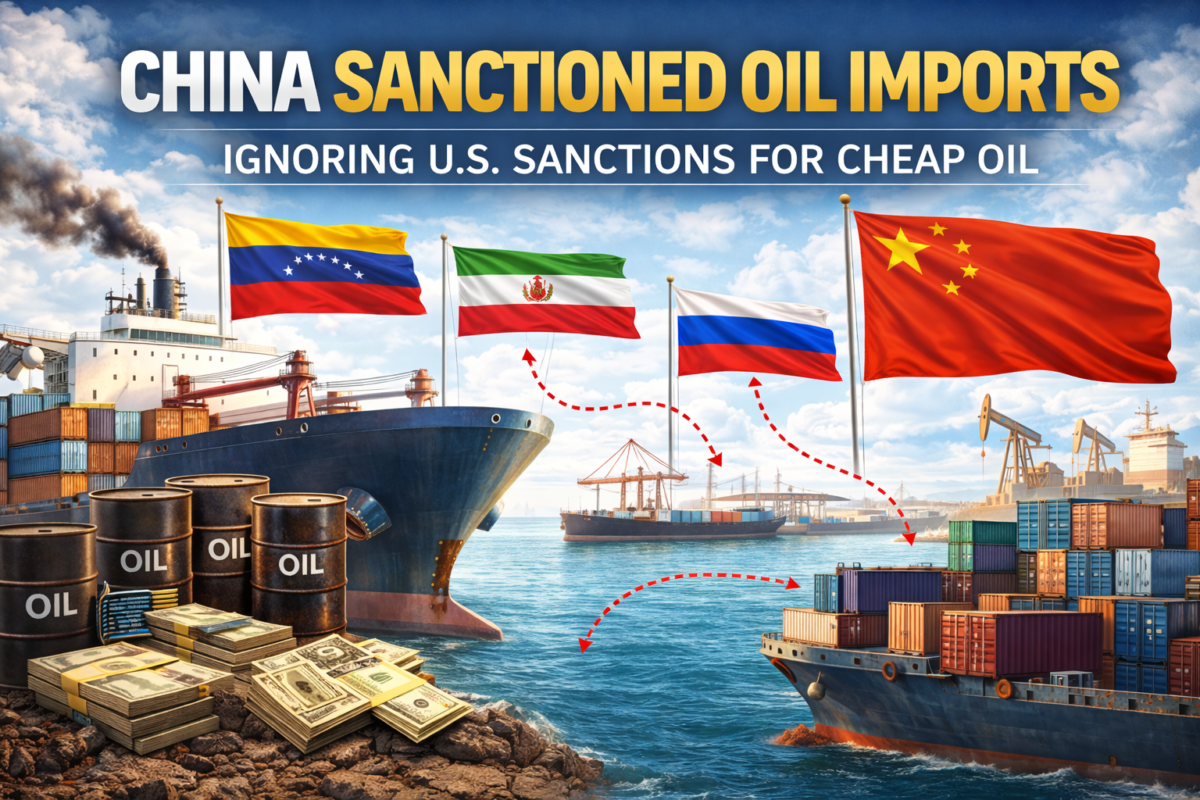
In recent years, China has been ramping up its oil and gas imports from several U.S.-sanctioned countries, such as Venezuela, Iran, and Russia. This has helped the Asian giant to profit from the sanctioned countries’ discounted fuel while other powers are forced to pay standard market prices for adhering to the sanctions.
China’s Energy Import Trends – Iran
The United States lifted several long-standing sanctions on Iran in 2015 under the newly signed Joint Comprehensive Plan of Action. However, when President Trump withdrew the U.S. from the nuclear deal in 2018, the sanctions were reinstated. This led several countries around the globe to stop purchasing Iranian crude.
China is now the principal importer of Iranian crude, buying around 80% of the Middle Eastern state’s shipped oil in 2025, at around 1.38 million bpd. China has been purchasing Iranian oil since around 2018/2019, according to industry estimates.
China managed to circumvent U.S. sanctions by using shadow fleets to deliver the oil to its independent refiners, which are known as teapots. To attract Chinese buyers, Iran has traded its light crude at an average price of between $8 and $10 a barrel, less than the Brent benchmark. As China has ramped up its imports of Iranian crude, it has saved billions of dollars by avoiding higher-priced energy purchases from alternative non-sanctioned states, such as Oman.
Washington introduced penalties on three Chinese teapots in 2025, which encouraged several other independent refiners to reduce their reliance on Iranian energy for fear of repercussions. However, Beijing has rejected the unilateral sanctions on Iranian oil and continues to defend its trade with Tehran.
Venezuela
Before the United States intervention in Venezuela in January, China was importing significant levels of crude from the South American country, once again finding ways to circumvent U.S. sanctions. China imported an estimated 642,000 bpd of crude and fuel oil from Venezuela in 2025, or around 75% of the state-owned oil company’s (PDVSA) exports.
The U.S. introduced sanctions on Venezuela’s oil industry in 2019, aimed at harming the Maduro dictatorship, after which time its crude exports fell significantly.
China’s imports of Venezuelan crude are expected to fall significantly from February, as fewer ships have been able to leave Caracas since the U.S. claimed control of the OPEC producer. In December, President Trump imposed a blockade on sanctioned oil tankers leaving Venezuela, which drove down exports. Now, following the U.S. January intervention, the interim Venezuelan government has negotiated a 50-million-barrel oil supply deal with the Trump administration.
The current geopolitical situation is expected to spur China to look for alternative energy suppliers in the coming months, with the deliveries of crude and fuel oil from Venezuela to China in February estimated to reach just 166,000 bpd.
Russia
As well as Iran and Venezuela, China has come to rely heavily on Russia for its energy imports.
The United States and Europe introduced sanctions on numerous Russian energy products in 2022, following the Russian invasion of Ukraine. These sanctions have been tightened several times since 2022, in a bid to put greater financial pressure on Moscow.
As most countries hurried to find alternative oil and gas suppliers to adhere to the sanctions, some countries, including China and India, began to increase their Russian energy imports, benefitting from the significant discounts Putin was offering.
China imported around 2 million bpd of Russian crude in the first 10 months of 2025, marking a 7.7% decrease from the previous year. This shift was due to an increased reliance on Iran’s energy, which was viewed as a more competitive and less risky option in terms of sanctions.
However, in September, China and Russia signed over 20 cooperation agreements covering energy, aerospace, artificial intelligence, and agriculture when Russian President Vladimir Putin visited Beijing. The two partners also agreed to the Power of Siberia 2 pipeline, which could eventually deliver an additional 50 billion cubic metres of Russian gas per year to China.
In November, Senior Russian energy officials met their Chinese counterparts in Beijing to deepen ties, thereby ignoring the Western sanctions. Following the meeting, Russia’s Deputy Prime Minister Alexander Novak said in a statement that Moscow was looking to expand its long-term hydrocarbon supply contracts.
“Russia is committed to the closest possible partnership with China in the energy sector across all areas of cooperation,” Novak said. “I am confident that integrating the efforts of the two countries in traditional and new energy sectors will ensure the sustainable development of our economies and create a technologically balanced energy landscape for the long term.”
Despite repeated threats from the United States, as well as the introduction of high tariffs on a wide range of Chinese products, China continues to circumvent U.S. sanctions to continue importing energy from various countries. This has allowed China to make significant savings on its energy bill, while allowing it to economically support Iran, Venezuela, and Russia for several years.
Keep In Touch with Shale Magazine
As the new era of energy unfolds, you can bet we’ll be the boots on the ground to keep you informed. Subscribe to Shale Magazine for sharp insight into the arenas that matter most to your life. And don’t forget to listen to our riveting podcast, The Energy Mixx Radio Show, where our very own Kym Bolado interviews the most extraordinary thought leaders, business innovators, and industry experts of our time.