[vc_row el_class=”td_classic_blog_home”][vc_column][vc_column_text]After decades of moving away from nuclear power projects in favor of fossil fuels and renewable energy, several U.S. states are once again showing support for nuclear energy as they look to expand the country’s abundant, clean energy sources.
From Fear to Enthusiasm
Three infamous nuclear disasters – Three Mile Island in Pennsylvania in 1979, Chernobyl in Ukraine in 1986, and Fukushima in Japan in 2011 – spurred a widespread distrust for nuclear power in many countries worldwide. This has led several governments to move away from nuclear power in recent decades due to safety concerns and public pressure.
According to the World Nuclear Association, public support for nuclear power in the United States has improved over the past four decades, with three-quarters of respondents in 2024 saying they favored nuclear power use, compared to around half of respondents in the 1980s and 1990s.
Several factors have supported this shift in public opinion, including the length of time since the last nuclear disaster, a stronger desire to diversify the energy mix beyond fossil fuels, and a greater awareness of nuclear power’s strong safety record.
Nuclear power has been proven to be overwhelmingly safer than many other energy sources, including coal, oil, and gas. Experts believe air pollution from fossil fuels causes an estimated 7 million deaths per year, while nuclear energy poses a similar level risk to wind energy and is around 350 times safer than coal. Per terawatt-hour of energy production, coal is thought to cause 24.6 deaths, oil 18.4 deaths, natural gas 2.8 deaths, and nuclear energy 0.07 deaths.
Nevertheless, a not-in-my-backyard mentality seems to prevail, with 53% of U.S. respondents to a recent Gallup poll somewhat or strongly opposing construction of a nuclear power plant in their area, compared with 45% who favor it. However, these figures are still more positive than in previous polls, in both 2001 and 2007.
Federal Support for Nuclear Power
At the federal level, the Trump administration has demonstrated great support for the accelerated expansion of U.S. nuclear power. In 2025, President Trump announced plans to expand U.S. nuclear energy capacity from 100 GW at present to 400 GW by 2050.
The Department of Energy’s (DoE) Utility Power Reactor Incremental Scaling Effort (UPRISE) aims to expand U.S. nuclear energy capacity by increasing the power output of existing reactors, bringing dormant facilities back online, and completing stalled projects. The UPRISE initiative aims to achieve 2.5 GW of additional nuclear capacity by 2027 and 5 GW of total additional nuclear capacity by 2029.
State-Level Progress
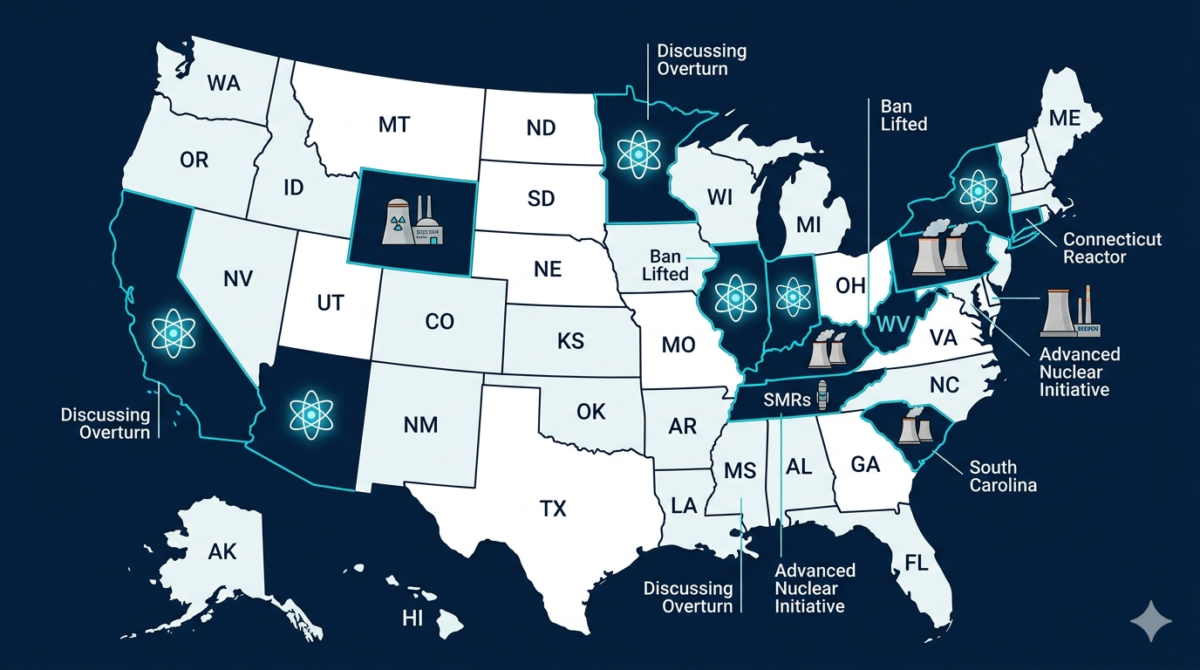
Several U.S. states have shown their support for nuclear power development in recent years, with varying degrees of progress across the country. By November 2025, 11 governors from across the United States had signed on with the National Association of State Energy Officials (NASEO) in support of the Advanced Nuclear First Mover Initiative.
The initiative is led by the state co-chairs New York, Indiana, Kentucky, Tennessee, and Wyoming, and the participating states include Louisiana, Maryland, Pennsylvania, Utah, Virginia, and West Virginia. These states have committed to working with the private sector, the DoE, and the Nuclear Regulatory Commission to accelerate advanced nuclear projects.
New York State’s Governor Kathy Hochul said, “New York is proud to co-lead the… initiative, which demonstrates our commitment to the exploration of innovative technologies to achieve a reliable and affordable electric system for New York families.”
The move has gone hand-in-hand with several states lifting bans on nuclear power development. Wisconsin, Kentucky, Montana, West Virginia, and Illinois have all lifted their moratoria since 2016, while California, Massachusetts, Minnesota, New Jersey, and Vermont are now discussing whether to overturn bans. Meanwhile, Connecticut has eased restrictions on small modular reactors (SMRs).
Incentives to Ramp Up Nuclear Development
The legislative push suggests that several blue states that once strongly opposed nuclear power are now embracing atomic energy. The shift reflects the current federal energy policy, as the Trump administration has made it increasingly difficult to develop renewable energy projects. As states countrywide strive to decarbonize and meet climate goals, nuclear power is providing an obvious alternative to renewable energy for achieving their ambitions.
In addition, the Trump administration’s vocal support for nuclear power development has made it more attractive to several state governments looking for policy and financial support for new energy projects.
The DoE’s Energy Dominance Financing Program will provide loans for “projects that add energy to the grid or enhance reliability”. These loans can support activities such as the construction of new nuclear plants or the renovation and refitting of existing plants.
The launch of federal policies that favor nuclear power and financial incentives for development is expected to encourage greater state-level support for nuclear power across the United States. Meanwhile, the lifting of bans on nuclear development by several states suggests a meaningful legislation shift that will permit new development, with several states already planning for a new era of nuclear power. [/vc_column_text][/vc_column][/vc_row]