
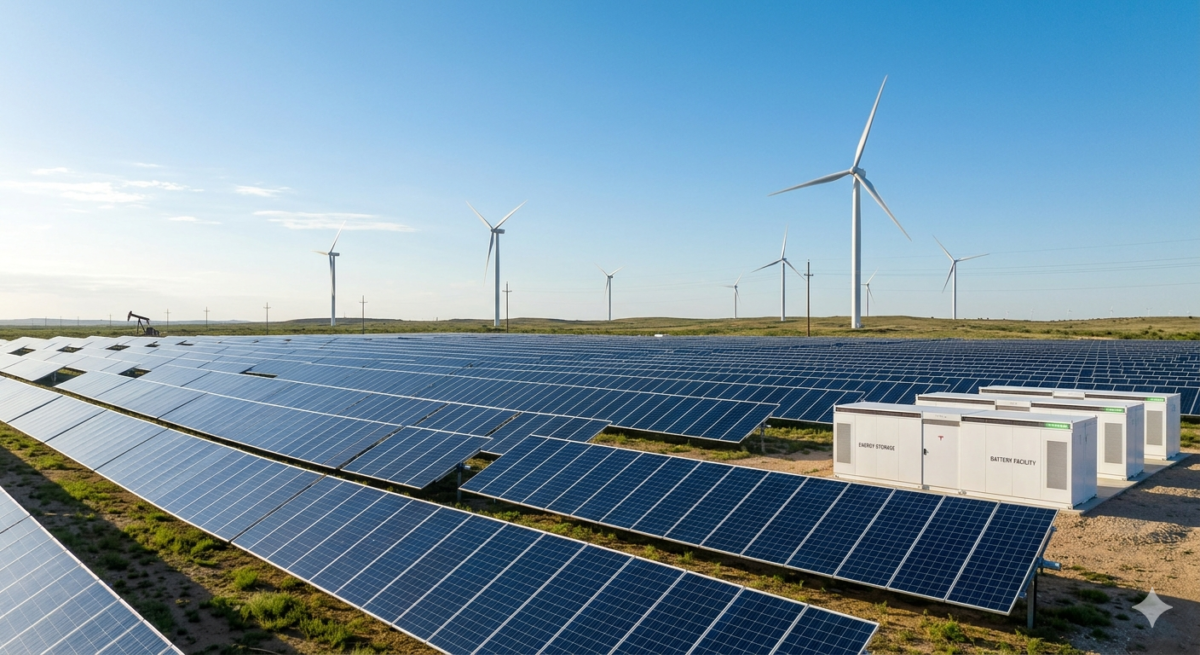
The United States renewable energy capacity has grown to record levels, even as the Trump administration restricts the development of new green energy projects in favor of increasing fossil fuel output. The U.S. has rapidly increased its solar and wind power production in recent years, supported by the deployment of large-scale battery storage technology, as well as steadily grown other renewable energy sectors, such as geothermal energy and hydropower.
Record Renewable Energy Production in 2025
According to the U.S. Energy Information Administration, wind and solar energy projects generated a record 17% of U.S. electricity in 2025. Over the past 20 years, electricity production from wind and solar power has increased significantly, from a contribution to the total U.S. electricity generation of less than 1% in 2005.
In 2025, net wind and solar power generation totaled 760,000 gigawatt hours (GWh) of electricity, 88,000 GWh more than in 2024. Wind power contributed 464,000 GWh of electricity, 3% more than in 2024, while utility-scale solar power generation reached 296,000 GWh, 34% more than in 2024. Small-scale solar generation also grew, to around 93,000 GWh in 2025.
However, solar and wind are intermittent electricity sources, meaning they can only produce energy when the sun is shining or the wind is blowing. However, the accelerated deployment of utility-scale battery storage in recent years has helped make these energy sources more stable, supplying clean energy to the grid day and night.
Spring Records
In Texas, in the spring of 2026, the state’s power grid, known as ERCOT, is expected to break the renewable energy records it set in 2025. On March 14, ERCOT reported wind energy electricity generation of 28.7 GW, an all-time high. It also reported higher levels of solar power generation than in previous years.
Several states have reported record clean energy generation this spring, following the addition of new solar and wind capacity. Around 26.5 GW of utility-scale solar power generation, 5.7 GW of wind generation, and 13 GW of grid batteries were installed in 2025.
In the spring months, consumer demand for electricity is lower than in the winter and summer months, and renewable energy sources can contribute more heavily to demand, thereby decreasing reliance on fossil fuels.
In March 2025, for the first time, fossil fuels contributed less than half of U.S. power production across the month, with clean energy sources accounting for the rest. Thanks to the recent solar and wind additions, the record will likely be broken again this year.
Rising Energy Prices Demonstrates Need to Ramp Up Renewables
Following the U.S.-Israeli attack on Iran in February and the ongoing conflict in the Middle East, energy prices have risen significantly. This is mainly due to restrictions on energy trade and the nearly complete closure of the Strait of Hormuz – a vital trade corridor between Europe and Asia – as well as attacks on Middle Eastern energy facilities.
Consumers are seeing their gas and electric bills increase sharply, as the price at the pump also climbs higher. The “biggest global oil supply disruptions in history” have limited the supply of oil and gas, leading to global shortages of a wide range of products and driving up prices.
Many consumers in the United States might be questioning the Trump administration’s shift in energy policy over the last year, as it sought to restrict renewable energy development in favor of fossil fuel expansion. This has slowed the rollout of new green energy capacity and has stalled U.S. energy diversification efforts.
As the cost of fossil fuels continues to rise, the record-breaking renewable energy output being seen across the country is music to many consumers’ ears. However, it also shows that greater diversification is key to ensuring the future of U.S. energy security.
New Trends Emerging
The ongoing geopolitical instability and higher fuel prices could drive new green energy and cleantech trends, leading to more energy records being broken in the coming years. In March and April, multiple car-sale platforms in the United States reported a substantial rise in consumer interest for electric vehicles (EVs) since the beginning of the Iran war.
According to the online vehicles marketplace Autotrader, in March, inquiries into purchasing a new or used EV rose by 28% and 15%, respectively.
In terms of renewable energy, a ruling in April by a federal judge in Massachusetts has led to several Trump administration efforts to restrict green energy development being overturned. Judge Denise J Casper said that the Trump administration’s policies likely violate federal statute and would cause irreparable harm if the court did not intervene. If this decision holds up, it could encourage several energy companies to invest in new renewable energy capacity, after months of uncertainty. This could help increase the contribution of clean energy sources to the total U.S. power generation in the coming years.
Keep In Touch with Shale Magazine
As the new era of energy unfolds, you can bet we’ll be the boots on the ground to keep you informed. Subscribe to Shale Magazine for sharp insight into the arenas that matter most to your life. And don’t forget to listen to our riveting podcast, The Energy Mixx Radio Show, where our very own Kym Bolado interviews the most extraordinary thought leaders, business innovators, and industry experts of our time.