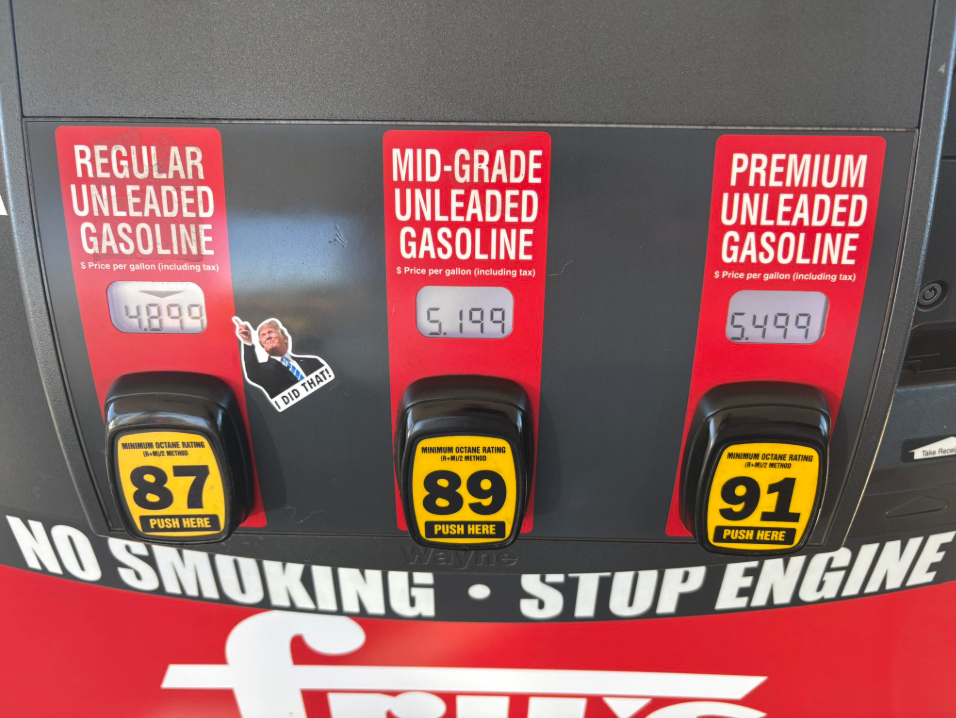
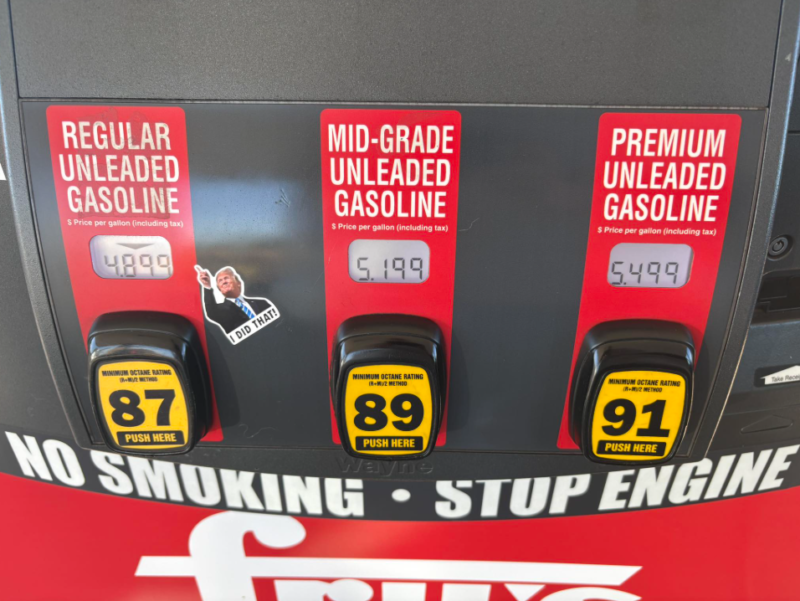
[vc_row el_class=”td_classic_blog_home”][vc_column_text css=””]I was recently fueling up my wife’s car in Tempe, Arizona when I noticed something I hadn’t seen in a while: an “I did that!” sticker pointed at the price on the pump. I snapped the photo below. Those stickers were everywhere during the gas price spike under President Biden. Now they’re back—with the same message, but a different president.
It’s true that fuel prices have spiked under both administrations. But the reality is more complicated than a sticker on a pump suggests. To understand what really happened, you have to look at the underlying market forces—and the specific decisions each president made that either amplified or helped ease those price spikes.
How Presidents Influence Gas Prices
Presidents don’t control gasoline prices. That’s a point I have made for years. Oil is a global commodity, and prices are set by supply and demand forces that extend far beyond Washington. But there are exceptions.
In my 2021 article Revisiting The Blame For High Gas Prices, I wrote that a president’s short‑term influence over gasoline prices is generally limited to three actions:
- Releasing oil from the Strategic Petroleum Reserve
- Changing gasoline taxes
- Engaging in a war in the Middle East
When geopolitical events threaten oil supply—especially in the Middle East—presidential decisions can have an outsized impact. In those moments, policy doesn’t set prices directly, but it can amplify or dampen shocks that are already underway.
Over the past several years, we have seen two clear examples—one under Donald Trump and one under Joe Biden—where presidential actions intersected with market conditions and contributed to sharp moves in gasoline prices.
The Setup: A Fragile Oil Market
To understand what happened, it’s important to start with the broader context.
In 2020, the COVID‑19 pandemic triggered one of the largest demand collapses in oil market history. Prices briefly went negative, and producers around the world shut in production. Investment dried up. The rig count collapsed. Projects were delayed or canceled.
Notably—because its impact would have lingering ramifications—during the 2020 oil market collapse, President Donald Trump helped broker a historic production‑cut agreement with OPEC+ to stabilize prices. That agreement helped stabilize prices at the time, but it also contributed to a tighter supply backdrop as demand recovered.
When demand began to climb in the second half of 2020, supply struggled to keep up. Oil prices started to rise well before Trump left office. Stimulus spending under both Trump and later Biden also contributed to the rebound in demand. By the time Biden was inaugurated in January 2021, oil prices had already risen roughly 50% since the summer of 2020.
That price rise continued throughout Biden’s first year, 2021. OPEC+ kept production cuts in place longer than many expected, adding further pressure to prices. Drilling activity eventually rebounded, and U.S. production began to rise again, but not before one final spike.
By early 2022, gasoline prices had been climbing for 18 months. That trend was largely baked in by market dynamics—not presidential policy. But Trump’s OPEC+ deal continued to shape the supply landscape long after he left office.
Biden’s Two Decisions
Then came Russia’s invasion of Ukraine.
The immediate effect was a surge in global oil prices, driven by fears of supply disruption from one of the world’s largest exporters. In response, the Biden administration made two major decisions that directly impacted the trajectory of fuel prices.
First, the U.S., as part of a coordinated Western response, moved to ban imports of Russian oil. While U.S. dependence on Russian crude was relatively modest, the decision contributed to a broader tightening and rebalancing of global markets as Western nations sought to reduce reliance on Russian energy. Prices spiked, with gasoline and diesel reaching record highs in the U.S.
Part of the reason the Russian embargo was so painful wasn’t just the volume, but the type of oil. U.S. refineries (especially on the Gulf Coast) are geared for heavy/sour crude, which Russia provided. Replacing that with lighter and sweeter crude contributed to a diesel imbalance and subsequent price explosion.
Second, the administration authorized a historic release from the Strategic Petroleum Reserve. Over the course of 2022, hundreds of millions of barrels were released into the market.
That move didn’t eliminate the supply shortfall, but it did provide meaningful relief at the margin. As additional supply came online and demand growth moderated, fuel prices began to ease.
In short, one decision helped push prices that were already high to a new record, while another helped bring them back down.
Trump’s Simpler Case
The dynamic under Donald Trump is more straightforward. While Trump’s first-term influence was defined by managing a supply glut, his current term has been defined by a supply shock.
In President Trump’s second term, oil prices were moderate and relatively stable prior to the decision—by the U.S. and Israel—to attack Iran on February 28, 2026. Iran responded by closing the Strait of Hormuz, the most critical chokepoint in the global oil trade. Roughly a fifth of the world’s oil normally flows through that narrow waterway, and that supply shortfall can’t be readily replaced.
Oil traders don’t wait for every barrel to be physically blocked or lost. The moment a major producer threatens or disrupts traffic through Hormuz, markets immediately price in the risk of prolonged outages, shipping delays, and potential escalation. That’s exactly what happened. Since the attack and Iran’s retaliation, oil prices have risen on the order of 50%, and gasoline and diesel prices have followed.
Compared to the Biden‑era spike—driven by a complex mix of post‑COVID supply lag, OPEC+ restraint, and Russia’s invasion of Ukraine—the current Trump‑era spike is more directly tied to a single geopolitical decision and its immediate consequences for a key transit route.
What This Tells Us
These episodes highlight an important distinction.
Under normal conditions, presidents have limited influence over gasoline prices. Tax policy, regulations, and rhetoric can have some effect at the margins, but they don’t override global supply and demand.
During geopolitical crises, however, the calculus changes.
Decisions that affect global supply—sanctions, embargoes, military actions, or strategic reserve releases—can meaningfully shift prices, at least in the short term. They don’t create the underlying imbalance, but they can make it better or worse.
The Big Picture
If there’s a takeaway here, it’s not that one president “caused” high gas prices, and another didn’t. That’s too simplistic.
In Biden’s case, he inherited oil prices that were already rising due to the aftermath of the COVID‑19 collapse: underinvestment, a slow supply response, stimulus spending under Trump and Biden, and OPEC+ holding barrels off the market. Prices rose further after Russia invaded Ukraine, at which point Biden—along with several allies—chose to embargo Russian oil. That helped push gasoline and diesel prices, which were already high, to all‑time records. Later, Biden authorized a massive release from the Strategic Petroleum Reserve, which helped ease the imbalance and bring prices back down.
In Trump’s case, oil prices were relatively stable until the February 28, 2026 decision to attack Iran. Iran’s retaliation—closing the Strait of Hormuz—directly threatened a major share of global oil flows. That move triggered a sharp increase in the geopolitical risk premium, and oil prices have climbed roughly 50% since, with fuel prices rising in tandem.
Gasoline prices are ultimately set in global markets. But in moments of crisis—whether through embargoes, wars, or chokepoint disruptions—decisions made in the White House can still move them, sometimes dramatically.
This article was originally published on Forbes.com and was written by Robert Rapier, Senior Contributor at Forbes and Editor in Chief of SHALE Magazine. The original version can be found on Forbes here.
Keep In Touch with Shale Magazine
As the new era of energy unfolds, you can bet we’ll be the boots on the ground to keep you informed. Subscribe to Shale Magazine for sharp insight into the arenas that matter most to your life. And don’t forget to listen to our riveting podcast, The Energy Mixx Radio Show, where our very own Kym Bolado interviews the most extraordinary thought leaders, business innovators, and industry experts of our time.
Subscribe to get more posts from Robert Rapier