On January 3, President Trump carried out a unilateral military operation in Venezuela in which the South American country’s President Nicolás Maduro was captured and transported to the United States, essentially bringing an end to his 13-year dictatorship.
Following the move, Trump has made it clear that he intends for United States oil companies to take a strong position in Venezuelan oil. Although Venezuela has more oil reserves than any other country, it accounts for just 1% of global oil production, following years of underinvestment in energy infrastructure and the withdrawal of several oil majors from the market.
By tapping its vast oil resources, Venezuela could begin to grow its economy once again; however, it will require substantial investment to redevelop its energy industry, meaning the government will need to attract foreign oil companies to the market.
Venezuela’s Oil Industry
Venezuela is home to an estimated 17% of the world’s oil reserves, with over 300 billion barrels. During the 1990s, it produced around 5% of the world’s crude. However, years of mismanagement, underinvestment, and U.S. sanctions (imposed in 2015) have driven down production.
It will be a long and expensive process to redevelop Venezuela’s oil industry as it attempts to restore its highly degraded energy infrastructure. Meanwhile, Venezuelan crude is extremely heavy and difficult to extract, resulting in expensive, carbon-intensive production.
Since the U.S. operation in January, there has been greater cooperation between Caracas and Washington, with Venezuela’s acting president, Delcy Rodríguez, appearing more open to working with President Trump on energy and other matters. The signing of a flagship supply pact between the two powers solidifies this cooperation.
Record High Exports
After years of stagnation due to heavy U.S. sanctions on Venezuelan oil, during which most crude was destined for China via a shadow fleet, the country’s oil exports are on the rise.
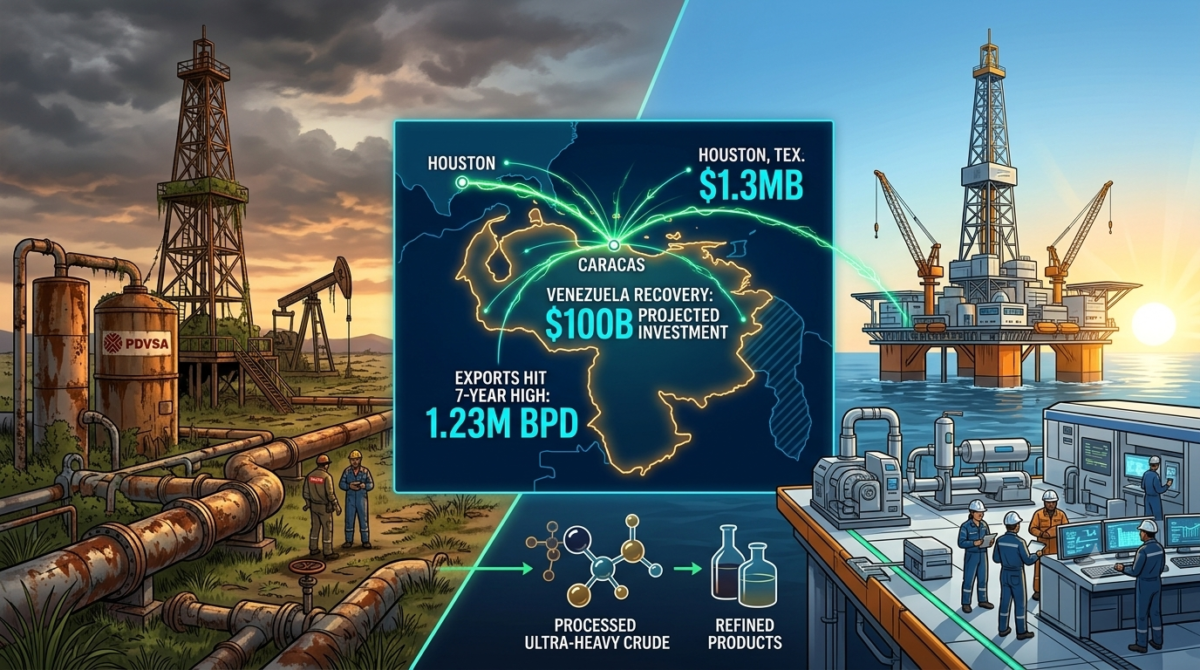
In April, Venezuela’s oil exports increased by 14% to 1.23 million barrels per day, the highest level in over 7 years. This rise has been supported by increased crude imports by the United States, India, and Europe.
The South American country has been draining oil inventories and steadily increasing output since January. Venezuela’s state-owned Petróleos de Venezuela (PDVSA) is now able to ship its crude to joint-venture partners and trading houses, such as Vitol and Trafigura.
In April, Venezuela exported an estimated 66 tankers of oil, compared with 61 in March. This resulted in the April average being the highest monthly volume since late 2018, before the United States imposed sanctions.
Venezuela Aims to Convince Foreign Companies to Invest in its Oil
Shortly after the U.S. operation in Venezuela, President Trump said oil companies would spend at least $100 billion to rebuild the country’s energy sector. Trump also said the U.S. would provide security and protection so “they get their money back and make a very nice return”.
While Venezuela supports PDVSA’s efforts to increase crude output, the interim government is also looking to foreign oil companies to support redevelopment and to develop policies to facilitate foreign investment.
In May, the country’s new oil minister, Paula Henao, spoke at the American Association of Petroleum Geologists oil exploration summit, held outside of Houston. Henao’s visit was one of the first in-person appearances in the U.S. by a Venezuelan oil minister in at least 10 years. Henao also planned to hold private meetings with some oil companies at the event.
The energy minister previously told investors seeking to help boost Venezuela’s oil output that the industry needs pumps, frequency converters, wellheads, valves, pipelines, gas compressors, and chemicals for drilling, producing, processing, and transporting crude and gas.
Exxon May Return
Exxon Mobil, the largest U.S. oil company, has reportedly entered discussions with Venezuela as the firm seeks to acquire the rights to produce oil in the South American country, almost two decades after it was forced out of the Venezuelan market.
If Exxon is successful, it would mark the first step toward achieving President Trump’s aim of the United States having a heavy hand in Venezuelan oil. This marks a significant shift in Exxon’s view of Venezuela’s oil market, with the firm calling Venezuela “uninvestable” as recently as January. It also follows years of legal battles between Exxon and Venezuela’s ruling Socialist Party.
Venezuela has nationalized foreign oil ventures, including Exxon’s assets, twice in recent decades, deterring several international oil companies from entering the market. The Venezuelan government still owes Exxon around $1 billion in damages awarded in legal cases.
According to reports, the deal could be finalized as early as the end of May. If the agreement goes ahead, it is expected to involve Exxon signing contracts to pump oil in up to six fields.
Exxon has invested heavily in Guyana, Venezuela’s neighbor, in recent years, developing major oil fields in an area of the Atlantic that Venezuela has claimed, fueling political tension in the past. However, if Exxon reenters Venezuela’s oil market, it will hold a significant stake in the South American oil market.
Keep In Touch with Shale Magazine
As the new era of energy unfolds, you can bet we’ll be the boots on the ground to keep you informed. Subscribe to Shale Magazine for sharp insight into the arenas that matter most to your life. And don’t forget to listen to our riveting podcast, The Energy Mixx Radio Show, where our very own Kym Bolado interviews the most extraordinary thought leaders, business innovators, and industry experts of our time.