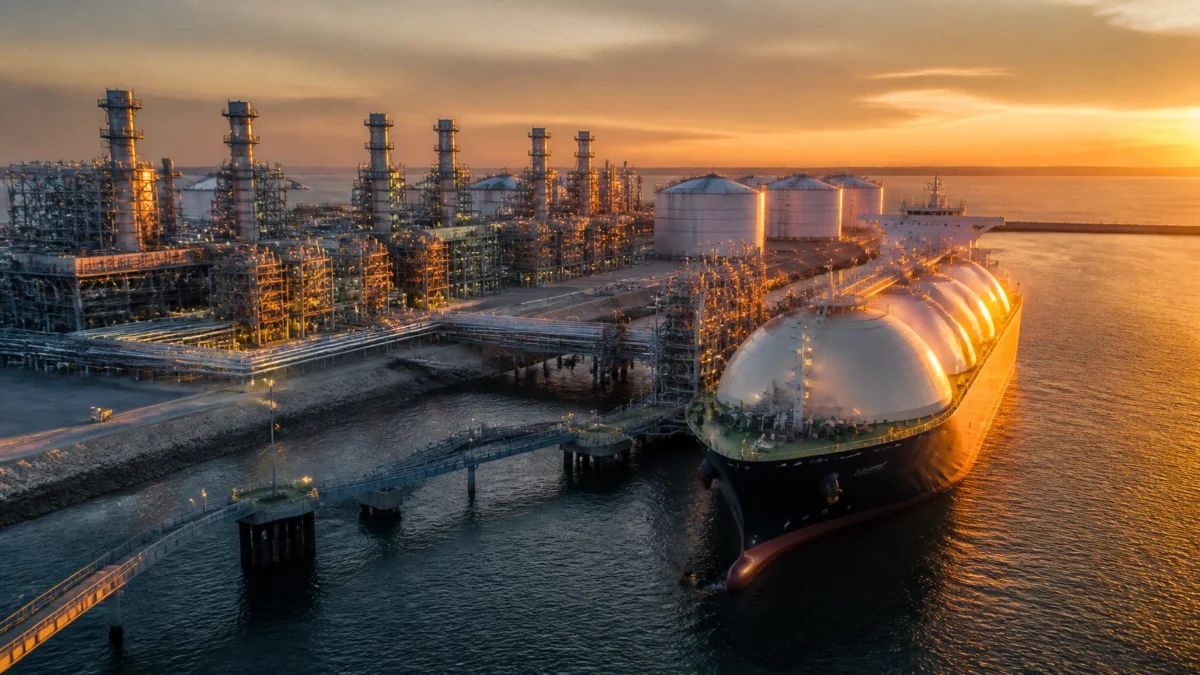
US LNG export growth has transformed from a domestic success story into a vital pillar of global energy security as we move through 2026. The United States has officially hit an unprecedented inflection point, with liquefaction capacity reaching a staggering 17 billion cubic feet per day (Bcf/d). This surge in output is not merely a reflection of increased domestic production; it represents a strategic hedge against deepening Middle East instability and a shifting geopolitical landscape that has placed American energy at the center of the international stage.
While domestic natural gas prices at the Henry Hub remain relatively insulated from the extreme volatility seen in Europe and Asia, the marginal connection between the US Gulf Coast and global markets has never been stronger. As new liquefaction trains come online, the ability of US producers to serve as a swing supplier is fundamentally altering how the world manages energy risk.
Infrastructure Projects Driving the 17 Bcf per Day Milestone
The current expansion of American export capabilities is driven by several massive infrastructure projects that have transitioned from construction to commissioning in the first half of 2026. Two specific developments stand out as the primary catalysts for this capacity jump: the Golden Pass LNG project and the expansion of Corpus Christi Stage 3.
Golden Pass, a joint venture between QatarEnergy and ExxonMobil located in Sabine Pass, Texas, represents one of the largest additions to the mid-decade wave of supply. With its three liquefaction trains, the facility is designed to produce around 18 million tons per annum (mtpa) of LNG. Similarly, the Corpus Christi Stage 3 expansion in South Texas has added seven midscale liquefaction trains, providing much-needed flexibility to the Cheniere Energy portfolio.

These projects are part of a broader movement that includes the Plaquemines LNG facility in Louisiana, which has also ramped up its operations to meet surging international demand. The cumulative effect of these facilities is a structural shift in the US gas balance. According to recent market analysis, the additional 6 to 8 Bcf/d of incremental feedgas demand expected by late 2026 will effectively remove a significant portion of the domestic supply surplus, creating a more stable floor for American gas prices even as production continues to grow in basins like the Permian and the Haynesville.
Hedging Against Middle East Instability and the Hormuz Risk Premium
The rapid expansion of US export capacity comes at a critical time for global energy markets. Ongoing instability in the Middle East has introduced a persistent risk premium to international benchmarks such as the Title Transfer Facility (TTF) in Europe and the Japan Korea Marker (JKM) in Asia. Security concerns surrounding the Strait of Hormuz: a critical chokepoint through which roughly 20 percent of the world’s LNG flows: have led to increased anxiety among major importers.
As major producers in the Gulf region face logistical challenges and security threats, the reliability of US LNG has become a primary selling point for decision-makers in Berlin, Tokyo, and Seoul. Unlike many of its global competitors, US LNG production is characterized by a transparent regulatory environment and a flexible contract structure that allows for cargo redirection based on market needs.

This reliability has allowed the US to capture a larger share of the market, which is expected to rise from 25 percent in 2025 to over 33 percent by the end of the decade. As OPEC signals production shifts to manage the broader energy economy, the steady flow of American natural gas provides a necessary counterbalance to the volatility often associated with traditional hydrocarbon hubs.
The Divergence of Henry Hub and Global Price Benchmarks
One of the most notable trends in 2026 is the widening price divergence between domestic US gas and the rest of the world. Even as global prices spike due to geopolitical triggers, Henry Hub prices have remained comparatively low, recently trading in the $3.50 to $3.90 per MMBtu range. In contrast, TTF and JKM benchmarks have frequently hit double-digit figures during periods of peak demand or supply disruption.
Several factors contribute to this decoupling:
- High domestic production: Improved drilling efficiencies in the shale patches continue to bring new supply to market at lower cost.
- Pipeline constraints: While infrastructure like the Matterhorn Express has provided some relief, the pace of new pipeline construction still lags behind the speed of liquefaction expansion.
- Contractual lag: Long-term contracts and the physical limitations of existing terminals mean that even when global prices skyrocket, the US cannot immediately export its entire surplus.
However, the domestic market is not entirely immune to global events. The sheer scale of the new export capacity means that US gas demand is more sensitive to international shocks than ever before. When a major facility like Golden Pass or Corpus Christi ramps to full utilization, it creates a localized tightening of supply that can lead to increased regional volatility.
Domestic Demand Pressures and the AI Infrastructure Boom
Adding another layer of complexity to the 2026 energy landscape is the massive surge in domestic power demand. The rapid deployment of artificial intelligence and the resulting growth in data center infrastructure have placed significant pressure on the US power grid. Because natural gas remains the primary fuel source for providing reliable baseload power to these energy-intensive facilities, the industry is seeing a tug-of-war between export commitments and domestic electricity needs.

Policy makers are now tasked with balancing these competing priorities. The goal is to maintain the economic benefits of being a global energy leader while ensuring that domestic consumers and industrial users are not burdened by excessive price spikes. This balance is particularly important as Texas continues to explore geothermal energy growth and other renewable integrations to diversify the grid and maintain long-term reliability.
The 2026 inflection point signifies that the US is no longer just a participant in the global gas market; it is the market’s anchor. As export capacity continues to climb toward the high-teens Bcf/d range, the strategic importance of Gulf Coast infrastructure will only grow. The ability to move gas from the wellhead to the water efficiently and reliably remains the ultimate insurance policy for a world grappling with uncertainty.
Keep In Touch with Shale Magazine
As the new era of energy unfolds, you can bet we’ll be the boots on the ground to keep you informed. Subscribe to Shale Magazine for sharp insight into the arenas that matter most to your life. And don’t forget to listen to our riveting podcast, The Energy Mixx Radio Show, where our very own Kym Bolado interviews the most extraordinary thought leaders, business innovators, and industry experts of our time.