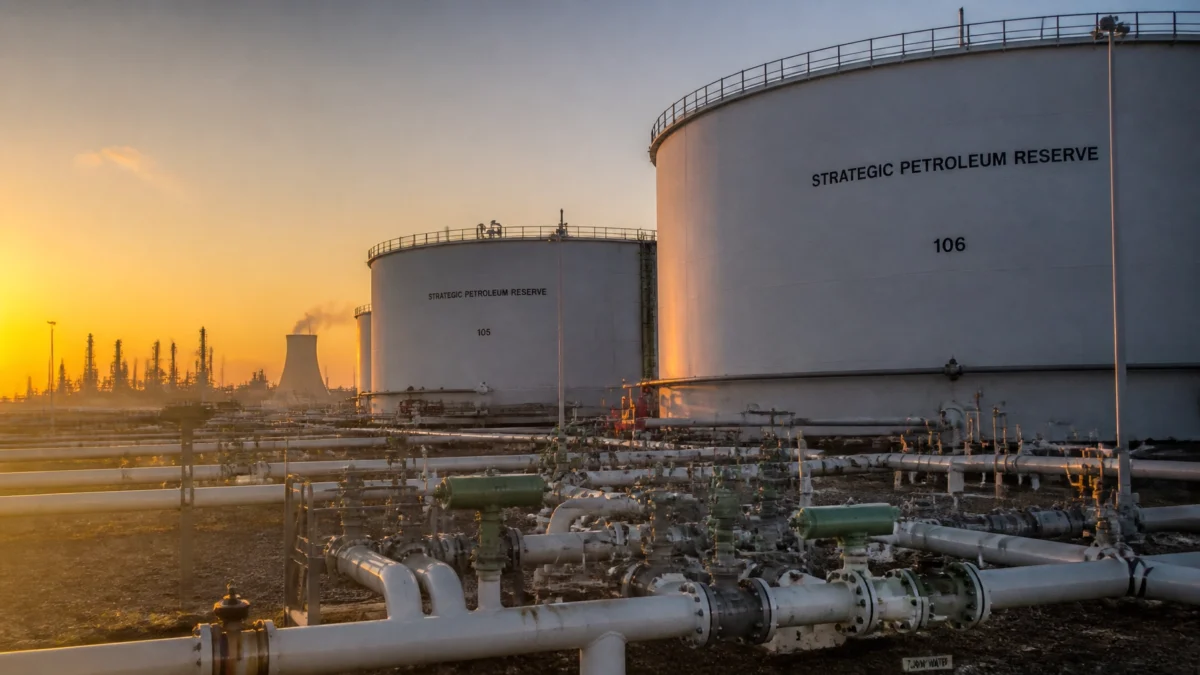

When oil prices spike, markets don’t just react—they reprice risk across the entire economy. For investors, that shift often separates speculative growth plays from companies built to withstand volatility.
This analysis highlights:
- Why oil shocks pressure broader markets and investor sentiment
- How dividend-paying companies provide stability during volatility
- The characteristics that define resilient income stocks
- Five companies positioned to weather energy-driven market stress
- Why Oil Shock Dividend Stocks matter in uncertain markets
Oil prices are notoriously difficult to forecast. But they are very good at signaling anxiety.
Right now, that signal is flashing.
West Texas Intermediate crude surged past $92 per barrel last week following disruptions around the Strait of Hormuz—one of the most important energy chokepoints in the world. Roughly 20% of global oil supply normally moves through that narrow shipping lane, which means even the possibility of disruption can rattle markets quickly.
Spikes like this create a familiar problem for investors. Higher energy costs ripple through the entire economy, squeezing corporate margins, raising transportation costs, and eroding consumer purchasing power. When that happens, the market narrative can change quickly—from confidence about a “soft landing” to concerns about a broader slowdown.
Periods like this are when defensive income investments tend to shine.
In my portfolios at Utility Forecaster, we focus heavily on essential infrastructure—utilities and midstream energy companies that own the pipes and wires that keep the modern economy running. But investors don’t need to limit themselves to those sectors to build resilience.
Across the broader market, there are companies with similar characteristics: essential services, durable demand, strong pricing power, and long histories of paying reliable dividends.
These are companies whose businesses continue operating smoothly even when oil prices spike, markets wobble, and economic headlines turn negative.
Here are five that stand out in today’s uncertain environment.
Hormel Foods: The Low-Volatility Anchor
When markets become volatile, one of the first metrics I look at is beta—a measure of how much a stock tends to move relative to the broader market.
Hormel Foods (NYSE: HRL) has historically carried a beta far below the S&P 500, often around 0.30. In practical terms, that means when markets swing sharply on geopolitical headlines, Hormel’s stock tends to move far less dramatically.
The reason is straightforward. Hormel sells products that consumers buy regardless of the economic cycle. Its portfolio includes widely recognized brands such as SPAM, Jennie-O, and Skippy.
Protein remains a staple of the global diet, and Hormel’s shelf-stable and branded products often become even more attractive when fresh meat prices turn volatile.
For income investors, Hormel also offers an exceptional dividend track record. The company has increased its dividend for 58 consecutive years, making it one of the market’s rare Dividend Kings.
Waste Management: A Utility in Disguise
I often describe Waste Management (NYSE: WM) as the best utility that isn’t technically a utility.
Its business shares many of the characteristics that make traditional utilities attractive investments: limited competition, high barriers to entry, and highly predictable cash flows.
Trash collection is one of the most inelastic services in the economy. Households and businesses generate waste regardless of whether economic growth is strong or weak.
Meanwhile, the barriers to entry are enormous. Permitting a new landfill in today’s regulatory environment is extraordinarily difficult.
Those structural advantages give Waste Management strong pricing power and stable long-term revenue streams.
The company is also expanding its renewable natural gas operations, capturing methane from landfills and converting it into usable energy. That provides both an environmental benefit and a hedge against volatile diesel prices.
Procter & Gamble: The Pricing Power Champion
When inflation becomes a concern, investors naturally gravitate toward companies with strong pricing power.
Few companies demonstrate that better than Procter & Gamble (NYSE: PG).
The company owns many of the most recognizable consumer brands in the world, including Tide, Gillette, Crest, Pampers, and Bounty. These products occupy a unique position in consumers’ lives—they are everyday necessities rather than discretionary purchases.
That brand strength allows Procter & Gamble to raise prices gradually without experiencing meaningful declines in demand.
The company has paid a dividend for more than a century and has increased that payout for over 60 consecutive years.
In uncertain economic environments, that kind of consistency becomes particularly valuable.
PepsiCo: Defensive Strength Through Snacks
Many investors still think of PepsiCo (NSDQ: PEP) primarily as a beverage company, but its snack business has become an equally powerful driver of profitability.
The company’s Frito-Lay division produces some of the most widely recognized snack brands in the world and generates strong margins thanks to its dominant distribution network.
Snacking also tends to hold up well during economic slowdowns. Consumers often cut back on larger discretionary purchases, but smaller indulgences—like a bag of chips or a soft drink—remain part of everyday spending.
That dynamic makes PepsiCo surprisingly resilient during periods of economic uncertainty.
Combined with more than five decades of consecutive dividend increases, PepsiCo remains one of the most dependable income producers in the consumer staples sector.
Realty Income: Monthly Income for Volatile Markets
For investors who value consistent cash flow, Realty Income (NYSE: O) occupies a unique niche.
Often referred to as “The Monthly Dividend Company,” Realty Income pays shareholders every month rather than quarterly.
The REIT owns more than 15,000 commercial properties, most of which operate under triple-net leases. That structure means tenants—not the landlord—are responsible for property taxes, insurance, and maintenance expenses.
Equally important is the company’s tenant base. Realty Income focuses on businesses that serve everyday consumer needs—grocery stores, pharmacies, convenience stores, and other essential retailers.
That focus has helped Realty Income maintain strong occupancy rates through multiple economic cycles.
For income investors, the result is a steady stream of dividend payments that has historically remained resilient even during turbulent markets.
The Bottom Line: Resilience Over Prediction
Trying to predict the exact path of oil prices—or the precise outcome of geopolitical conflicts—is rarely a productive strategy.
Markets will continue reacting to developments around the Strait of Hormuz and other global flashpoints. Oil prices may move higher, or they may retreat as conditions stabilize.
Rather than attempting to forecast every headline, many successful investors focus on building portfolios designed to perform across a wide range of economic scenarios.
The five stocks discussed above share several key characteristics: essential products and services, strong competitive advantages, durable demand, and reliable dividend income.
In uncertain markets, those traits matter more than ever.
Oil shocks, geopolitical tensions, and market volatility will come and go. But companies that sell everyday necessities—and reward shareholders with dependable income—tend to remain standing long after the headlines fade.
For investors navigating the uncertainty of 2026, that kind of resilience may prove to be the most valuable asset of all.
Earlier this week, I held a live briefing to cover the current state of U.S. energy markets amidst global turmoil and why U.S. electricity demand is surging for the first time in 20 years. For a limited time, I’m making this webinar available for replay absolutely free. Listen to my entire briefing on the structural shift reshaping utility and infrastructure investing here.
This article was originally written by Robert Rapier and published on Investing Daily. It has been adapted for SHALE Magazine with additional context for energy market readers.