
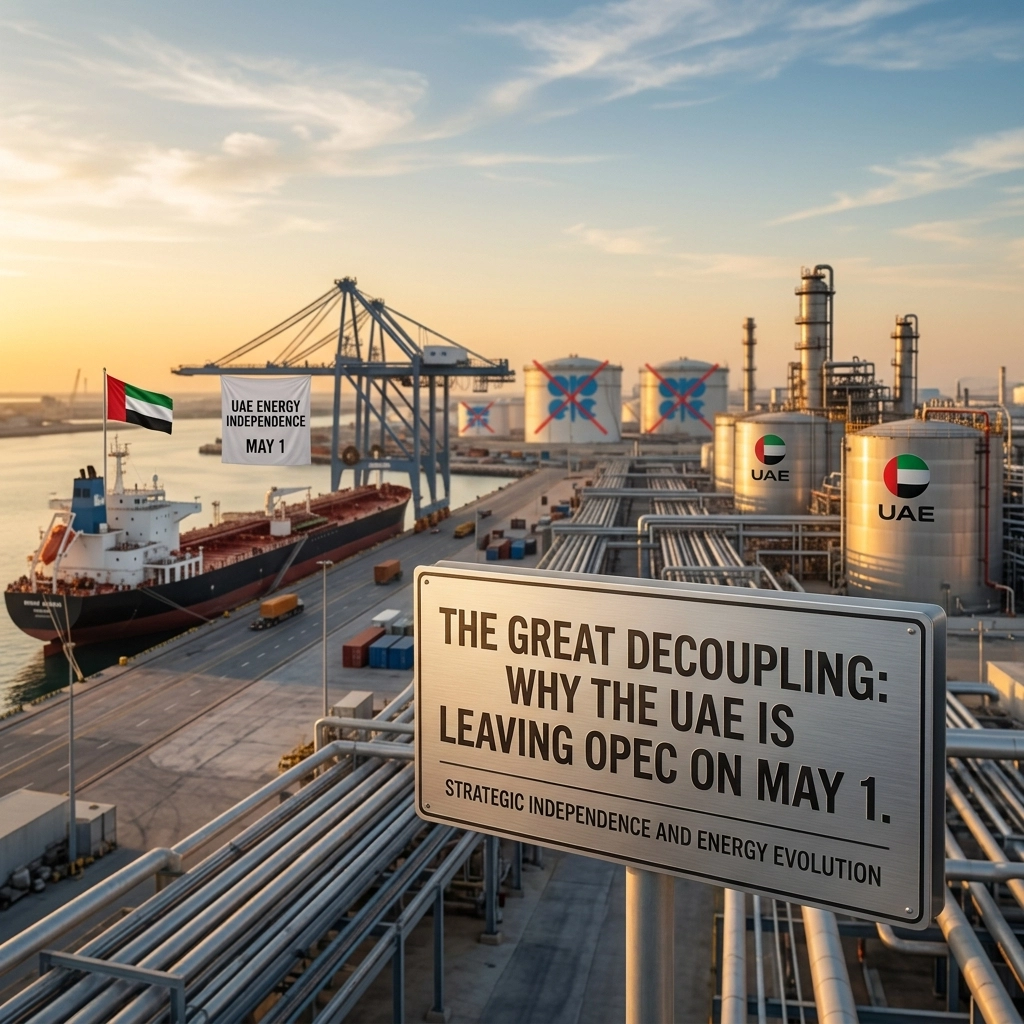
[vc_row][vc_column][vc_column_text css=””]The global energy landscape is absorbing a tectonic shift tied to the United Arab Emirates’ decision to exit the Organization of the Petroleum Exporting Countries and the broader OPEC+ alliance after 59 years of membership. This decision represents more than a change in membership status. It signals a fundamental transformation in how one of the world’s most influential producers views its role in the global energy market.
For decades, the UAE served as a reliable cornerstone of the cartel. However, the alignment between Abu Dhabi’s long-term economic ambitions and the restrictive nature of production quotas has reached a breaking point. As Brent crude prices hover above $111 per barrel amidst regional instability, the UAE has chosen a path of sovereign autonomy over collective coordination.
UAE OPEC market shift: The drive for sovereign autonomy
The decision to leave OPEC did not happen overnight. It is the result of years of friction regarding production baselines and the nation’s desire to monetize its massive infrastructure investments. According to the latest oil and gas news, the UAE currently possesses a production capacity of approximately 4.8 million barrels per day. Under the most recent OPEC+ agreements, however, its production has been frequently capped significantly lower to maintain price floors.
The UAE leadership views these restrictions as an anchor on their national growth. By reclaiming control over its output, Abu Dhabi can now respond directly to market signals rather than administrative mandates from Vienna. This shift moves the nation toward market-driven pricing, a strategy that aligns more closely with non-OPEC producers like those in the United States or Brazil. Analysts at Energy Network Media Group suggest this move could spark a new era of competition in the Middle East, as the UAE prioritizes its own fiscal requirements over cartel unity.
Analyzing the We the UAE 2031 vision
Central to this decoupling is the national strategic framework known as We the UAE 2031. This vision aims to double the nation’s GDP and position the country as a global hub for the new economy. To fund such an ambitious transformation, the UAE requires maximum revenue from its current natural resources. The Abu Dhabi National Oil Company has invested billions of dollars to expand upstream capacity, and holding that capacity in reserve to satisfy a cartel’s quota no longer makes economic sense for the Emirates.
The 2031 vision also emphasizes a pivot toward becoming a diversified energy powerhouse. While oil remains a primary revenue driver, the UAE is simultaneously investing in hydrogen, nuclear power, and renewable energy. The exit from OPEC allows the UAE to manage its carbon intensity and energy transition strategy without the political baggage often associated with the cartel. This independence is vital for a nation that seeks to be viewed as a peer to advanced OECD economies rather than just another commodity-dependent state.
Readers looking for more in-depth coverage of how these state visions impact the private sector can explore our business category.
Production capacity versus cartel restrictions
The math behind the exit is straightforward. The UAE has set a firm goal to reach a production capacity of 5 million barrels per day by 2027. Maintaining membership in OPEC+ would likely mean keeping nearly 1.5 million to 2 million barrels of that capacity offline at any given time. For a state-owned entity like ADNOC, which has focused on efficiency and technological integration, these forced shut-ins represent a poor return on investment.
By leaving the group, the UAE can theoretically flood the market with its excess capacity if it chooses. However, experts suggest that Abu Dhabi will likely take a measured approach. The goal is not necessarily to crash the price of oil, but to ensure that it captures market share as global demand continues to evolve. In a world where shale energy and deepwater projects are highly responsive to price, the UAE wants the same flexibility to ramp up or down based on its own internal data.
Geopolitics and the Strait of Hormuz conflict
The timing of this exit is inseparable from the current regional instability. The ongoing conflict involving Iran and the resulting disruptions in the Strait of Hormuz have created a volatile environment for Gulf producers. The UAE has worked tirelessly to develop alternative export routes, such as the Habshan-Fujairah pipeline, which bypasses the narrow chokepoint of Hormuz.
Strategic autonomy becomes even more critical when supply lines are threatened. By operating outside of OPEC, the UAE can negotiate bilateral supply agreements with energy-hungry nations in Asia and Europe without seeking permission from a committee. This independence provides a security buffer. If regional tensions lead to a sudden supply gap, the UAE can step in immediately to stabilize its own clients, reinforcing its reputation as a reliable energy partner during times of war.
Global energy market consequences and volatility
What happens to the global energy market when its third-largest producer walks away from the table? In the short term, the departure of the UAE makes OPEC structurally weaker. The cartel’s ability to influence global prices through coordinated cuts diminishes when a major player is no longer participating. We expect to see higher price volatility as traders navigate a market where the UAE acts as a “wildcard” producer.
Currently, Brent crude remains above $111 per barrel, largely due to the risk premiums associated with the Iran war. If the UAE increases production as it exercises greater autonomy, it could provide a much-needed ceiling for prices, preventing a runaway spike that would hurt the global economy. Conversely, if other OPEC members feel threatened by the UAE’s move, we could see a breakdown in discipline among the remaining members, leading to a race for market share.

The shift toward market-driven pricing
The UAE’s exit marks a symbolic end to the era of total cartel dominance. We are moving toward a more fragmented, competitive global energy market. In this new reality, energy market trends are driven by individual national interests and technological advantages rather than ideological alignment. The UAE is betting that its low production costs and advanced infrastructure will allow it to thrive in a high-volume, lower-margin environment if necessary.
This move also highlights a growing divide within the Middle East. While Saudi Arabia remains committed to the OPEC+ framework to support its massive Vision 2030 spending, the UAE is taking a different path. This divergence in strategy between the two largest Arab economies will be a defining feature of the energy market for the next decade.
Conclusion: A new era for Abu Dhabi
The Great Decoupling is a calculated risk. By leaving OPEC, the UAE gains the freedom to pursue its 5-million-barrel-per-day target and its 2031 economic vision without external interference. It trades the collective protection of the cartel for the agility of a sovereign actor.
The industry will be watching ADNOC’s export data closely. The transition from a quota-based system to a market-based system provides a real-time test of the UAE’s infrastructure and diplomatic prowess. One thing is certain: the global energy market will not look the same.
Keep In Touch with Shale Magazine
As the new era of energy unfolds, you can bet we’ll be the boots on the ground to keep you informed. Subscribe to Shale Magazine for sharp insight into the arenas that matter most to your life. And don’t forget to listen to our riveting podcast, The Energy Mixx Radio Show, where our very own Kym Bolado interviews the most extraordinary thought leaders, business innovators, and industry experts of our time.
Subscribe to get more posts from Amanda Jenkins[/vc_column_text][/vc_column][/vc_row]