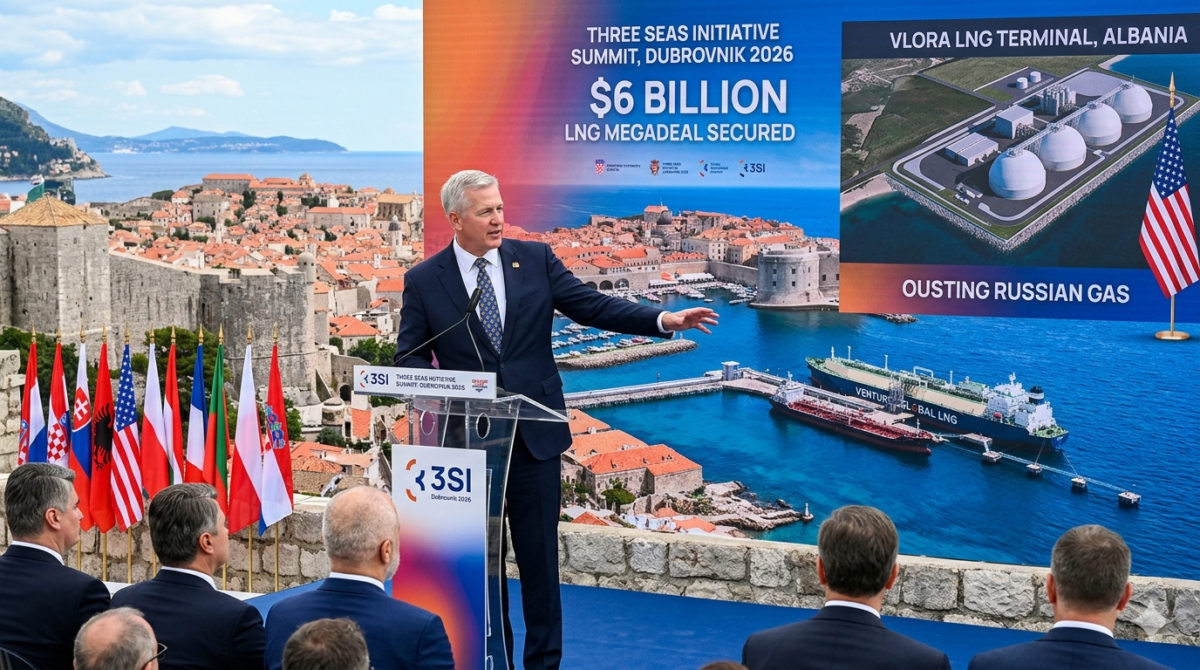
[vc_row][vc_column][vc_column_text css=””]The landscape of the global energy market has shifted significantly as U.S. Energy Secretary Chris Wright concluded a high-stakes diplomatic tour across Central and Eastern Europe. Standing in the historic setting of Dubrovnik during the Three Seas Initiative (3SI) Summit, Wright signaled a definitive era of American energy dominance. The visit resulted in a series of landmark agreements that aim to rewrite the energy map of the Balkans and the broader Mediterranean region. These deals do more than just facilitate trade; they represent a strategic offensive designed to permanently displace Russian natural gas from European infrastructure.
According to delegates at the summit, the primary objective of this mission was to provide tangible infrastructure and long-term supply security to nations that have historically remained vulnerable to Moscow’s energy leverage. By leveraging the immense production capacity of American shale energy, the Department of Energy is positioning the United States as the primary guarantor of European energy stability. This movement aligns with the broader Trump Peace Pipelines Framework, which provides the administrative and financial scaffolding necessary to fast-track natural gas infrastructure across the continent.
The Albania Megadeal and the $6 Billion Vlora Pivot
One of the most consequential moments of the trip occurred in Tirana, where Secretary Wright oversaw the signing of a massive energy export agreement. Venture Global, a leading American LNG producer, entered into a 20-year contract with Aktor LNG USA for a project valued at approximately $6 billion. This agreement centers on the development of the Vlora terminal in Albania, a site that analysts believe will become a critical entry point for U.S. gas into the Western Balkans.
This deal reflects broader energy market trends where long-term contracts provide the price stability necessary for developing nations to transition away from legacy suppliers. The Vlora project will involve the construction of regasification facilities and the integration of power generation capabilities. By locking in a two-decade supply of U.S. LNG, Albania and its neighbors are effectively insulating themselves from the price volatility and political coercion associated with pipelines originating from the East.
Industry experts suggest that this $6 billion commitment is a clear indicator of private sector confidence in the longevity of American gas exports. The agreement also highlights the role of U.S. midstream expertise in delivering complex infrastructure solutions in emerging markets. For those following oil and gas news, the Vlora project serves as a case study in how energy diplomacy and private capital intersect to create regional hubs of stability.

The Southern Interconnection: Bypassing Russian Influence
While the Albania deal focuses on new terminals, a separate €1.5 billion project aims to fix existing gaps in the European grid. Secretary Wright used the Dubrovnik stage to announce progress on the Southern Interconnection, a pipeline project designed to transport U.S. LNG from the Krk terminal in Croatia directly into Bosnia and Herzegovina. This project is led by AAFS Infrastructure and Energy, a U.S.-based firm specializing in critical energy transit.
The Southern Interconnection addresses a historical bottleneck that has left Bosnia and Herzegovina almost entirely dependent on Russian gas. By connecting the Bosnian grid to the existing LNG terminal on the island of Krk, the project introduces immediate competition and supply diversity. This €1.5 billion investment effectively breaks the monopoly of Gazprom in the region, offering a reliable alternative that adheres to Western market transparency standards.
Data from recent energy outlooks suggests that regional interconnections are the most effective way to lower energy costs for industrial and residential consumers in the Balkans. The Krk terminal has already seen record throughput over the last two years, and the addition of the Southern Interconnection will maximize its strategic utility. This initiative demonstrates the U.S. commitment to “energy dominance” through physical infrastructure, ensuring that American shale energy has the pipes and terminals required to reach the most landlocked markets in Europe.
Nuclear Cooperation and the €50 Billion AI Frontier
Secretary Wright’s visit was not limited to traditional hydrocarbons. In Croatia, the Secretary joined local officials to sign a joint statement on civil nuclear energy, signaling a return to baseload reliability through advanced reactor technology. The agreement emphasizes the sharing of technical expertise and the potential deployment of small modular reactors (SMRs) to supplement the existing regional power grid.
However, the most surprising announcement involved a staggering €50 billion investment in digital infrastructure. The U.S. and Croatia are partnering on a 1 GW capacity AI and data center project. This massive undertaking recognizes that the future of the global energy market is intrinsically linked to the demand for electricity generated by high-performance computing. A 1 GW data center requires massive, reliable baseload power: something that can only be achieved through a mix of gas-fired generation and nuclear energy.
This nexus of energy and technology is a core pillar of the current administration’s strategy. By anchoring a €50 billion tech project in a region traditionally dominated by Russian industrial influence, the U.S. is creating a high-tech ecosystem that demands Western standards of energy security. For more on the intersection of finance and large-scale projects, readers can visit finance today to see how these megadeals are structured.
Geopolitical Implications of the 3SI Summit
The Three Seas Initiative has matured from a fledgling regional forum into a central platform for transatlantic energy policy. The announcements made by Chris Wright in late April 2026 underscore a move away from the green-only mandates of previous years toward a pragmatic, all-of-the-above energy strategy. The “Trump Peace Pipelines Framework” serves as the ideological engine for this shift, prioritizing security and economic growth over ideological restrictions on fossil fuel development.
By fast-tracking projects like the Vlora terminal and the Southern Interconnection, the Department of Energy is effectively neutralizing the “energy weapon” that has been used against Central and Eastern Europe for decades. These agreements also provide a massive outlet for American producers, ensuring that the surge in domestic shale energy production finds a high-value market in a region that is eager for reliable partnership.
The focus on “Energy Dominance” also provides a roadmap for other regions looking to diversify their supply chains. The integration of AI, nuclear, and LNG into a single diplomatic package shows that the U.S. is not just selling commodities; it is exporting an entire energy-security architecture. This comprehensive approach is essential for maintaining Western leadership in an era where global energy market trends are increasingly influenced by geopolitical competition.
Looking Ahead: The New Energy Map
The events in Dubrovnik and Tirana represent more than just a successful diplomatic tour; they mark a permanent change in how the U.S. interacts with the European energy sector. The $6 billion Albania deal and the €50 billion AI project prove that American influence is expanding beyond simple exports into the very fabric of European industrial planning.
As these projects move from paper to construction, the regional dependence on Russian gas will continue to erode. The Southern Interconnection and the Vlora terminal will serve as the physical barriers against future energy coercion. For the American worker in the Permian or the Bakken, these deals signify long-term job security and a growing demand for the resources they produce every day.
The Department of Energy has made it clear that it will continue to use every tool at its disposal to support the expansion of American energy infrastructure abroad.
The strategic decoupling of Europe from Russian energy is no longer a theoretical goal: it is a physical reality being built with American steel and shale. Secretary Chris Wright’s April 2026 tour will likely be remembered as the moment the U.S. solidified its role as the primary architect of European energy independence. As the world watches these pipelines and terminals take shape, the message remains clear: the future of global energy is being written in the West.
Keep In Touch with Shale Magazine
As the new era of energy unfolds, you can bet we’ll be the boots on the ground to keep you informed. Subscribe to Shale Magazine for sharp insight into the arenas that matter most to your life. And don’t forget to listen to our riveting podcast, The Energy Mixx Radio Show, where our very own Kym Bolado interviews the most extraordinary thought leaders, business innovators, and industry experts of our time.
Subscribe to get more posts from Amanda Jenkins[/vc_column_text][/vc_column][/vc_row]