[vc_row el_class=”td_classic_blog_home”][vc_column][vc_column_text]As several countries aim to undergo a green transition, governments worldwide are putting increased pressure on heavy industries to find innovative ways to decarbonize operations.
Several hard-to-abate industries, such as steel, cement, and chemicals, are rapidly attempting to make their operations less harmful to the environment by reducing their carbon emissions and introducing other sustainability standards, not only in response to government pressure but also to make themselves more competitive for consumers who are increasingly interested in companies’ environmental, social, and governance (ESG) practices. However, reducing emissions in heavy industries is extremely challenging.
Steel as a Major Contributor to Global Carbon Emissions
The industrial sector contributes around 25% of the world’s energy- and process-related carbon emissions and between 7% and 9% of the total global CO₂ emissions at present. Both iron and steel production rely heavily on fossil fuels, both coal and natural gas.
Steelmaking requires the use of coal as a source of heat as part of the chemical process for converting iron ore to elemental iron, which produces carbon emissions. Unlike in many other industries, steel producers cannot simply switch to renewable energy to power operations. However, they may be able to use alternative inputs to greatly reduce emissions.
Some steelmakers are now using hydrogen as a heat source instead of coal. Emissions can be further reduced through the installation of carbon capture and storage (CCS) technology to sequester carbon emissions, thereby preventing their release into the atmosphere, although the success rate of this type of technology is still uncertain.
Steel can also be recycled to reduce carbon emissions, although this process alone cannot meet the world’s growing steel demand.
Decarbonizing Steel
Several steelmakers around the globe are investing heavily in decarbonizing their operations to become more competitive to consumers who are increasingly concerned about ESG practices. Some are also doing it in response to government pressure or national decarbonization incentives.
In the United States, several steelmakers invested in decarbonization measures under the Biden administration, following the introduction of the country’s most far-reaching climate policy to date, the 2022 Inflation Reduction Act. While there is less of an incentive to clean up operations under the Trump administration, several U.S. steel producers are already on the road to cleaner steel production.
Electric Arc Furnaces
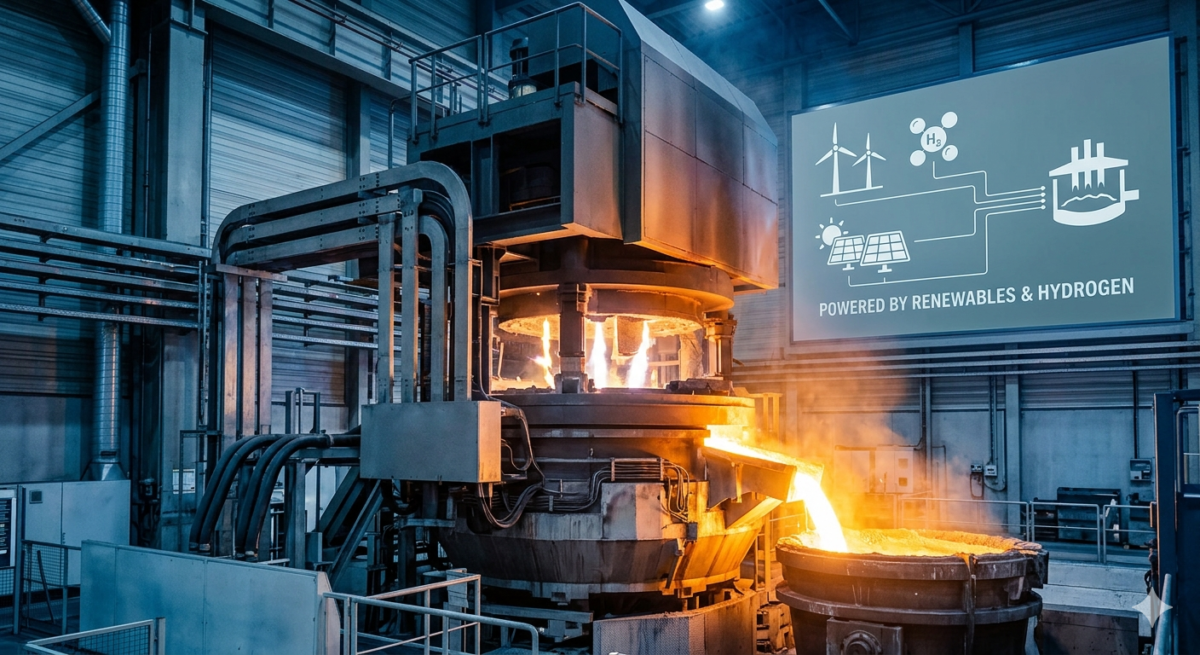
In recent years, an increasing number of companies have switched to electric arc furnaces (EAF), rather than coal blast furnaces. EAF use high-current electric arcs to melt steel scrap and convert it into liquid steel of a specified chemical composition and temperature. In steel production, they are used to convert iron ore into iron, with roughly 31 percent of global steelmaking now using EAF, according to Global Energy Monitor.
EAF can reduce carbon emissions from 2.32 metric tons of CO2 to 0.67 metric tons of CO2 per metric ton of steel produced.
Companies Leading the Way – Boston Metal
The U.S. startup, Boston Metal has introduced an innovative method to remove oxides and other contaminants from the iron ore used in steel production. To achieve this, the iron ore is distributed within an electrolyte before being heated to 1,600 degrees Celsius using electricity. The molten ore separates from impurities and can be tapped off.
Grassroots Innovation – Indiana
In Indiana, the Gary Advocates for Responsible Development (GARD) is putting pressure on steelmakers to use cleaner production methods to improve environmental and health standards without compromising steel production.
A report published in March by the Indiana University Environmental Resilience Institute and the consultancy 5 Lakes Energy revealed that a transition to green steel production could save thousands of jobs, create new economic opportunities, and avoid about $75 million in healthcare costs in the region.
Several of Indiana’s steel production sites were shut down during the steel industry crisis of the late 1970s and 1980s, from which the region still has not fully recovered. GARD members warn that unless the state’s remaining steel facilities modernize and clean up operations, they may also be forced to close more plants. Without modernization, Northwest Indiana steel mill jobs could fall from around 9,000 today to below 5,000 by 2034, the study estimates.
While it may previously have seemed prohibitively expensive to clean up operations, the planned multi-million investment in the Gary Works by Japan’s Nippon could help the plant achieve a shift to green.
Nippon plans to invest $300 million in relining Gary’s largest blast furnace, which will extend its life for around 20 more years. The firm could use some of its remaining $3.1 million investment to replace the mill’s three other blast furnaces with a much cleaner direct reduced iron (DRI) plant, GARD recommends in a recent report. The Indiana University report estimates that it would cost around $3.6 billion to transition Gary Works to cleaner steelmaking.
Keep In Touch with Shale Magazine
As the new era of energy unfolds, you can bet we’ll be the boots on the ground to keep you informed. Subscribe to Shale Magazine for sharp insight into the arenas that matter most to your life. And don’t forget to listen to our riveting podcast, The Energy Mixx Radio Show, where our very own Kym Bolado interviews the most extraordinary thought leaders, business innovators, and industry experts of our time.
Subscribe to get more posts from Amanda Jenkins[/vc_column_text][/vc_column][/vc_row]