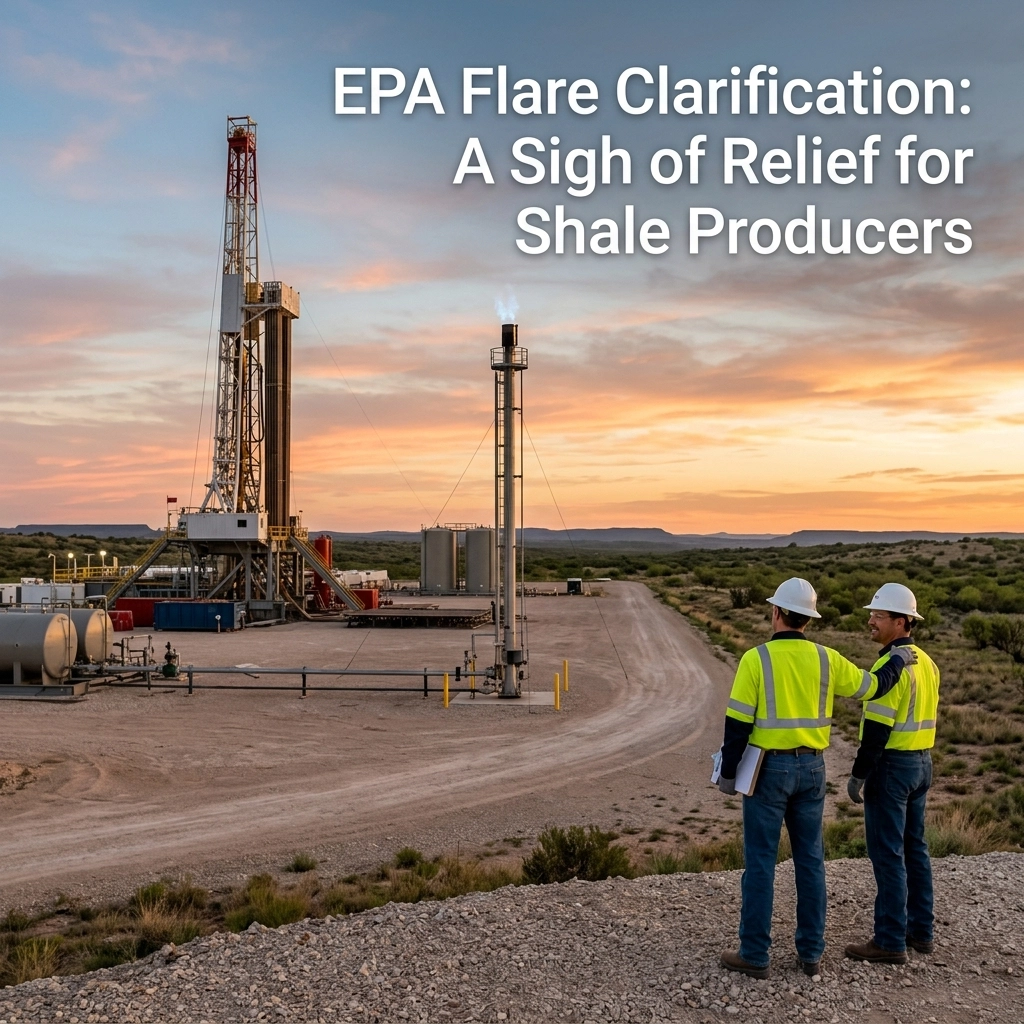
[vc_row][vc_column][vc_column_text css=””]The landscape of American energy production witnessed a significant pivot on May 1, 2026, as the Environmental Protection Agency issued a technical clarification regarding the management of associated gas at oil wells. For producers operating in the nation’s most prolific shale plays, specifically the Permian Basin of West Texas and New Mexico and the Williston Basin in North Dakota, this announcement serves as a critical regulatory lifeline. The guidance arrives just days before the May 7, 2026, deadline originally established to phase out routine flaring at new oil wells under the Clean Air Act’s New Source Performance Standards, specifically the OOOOb and OOOOc rules.
This technical reconsideration acknowledges the physical and logistical constraints that have long complicated the industry’s efforts to eliminate flaring entirely. By clarifying that routine flaring remains permissible in specific uncontrollable scenarios, the EPA has moved to prevent a potential production cliff that could have removed tens of thousands of barrels of oil per day from the domestic market. This decision reflects a broader shift in federal energy policy toward prioritizing market stability and energy security alongside environmental stewardship.
The Regulatory Landscape: From OOOOb/c to Clarification
The journey to this clarification began with the finalization of comprehensive methane regulations in late 2023 and early 2024. These rules, known technically as Subparts OOOOb and OOOOc, were designed to drastically reduce methane emissions and volatile organic compounds from the oil and natural gas sector. A centerpiece of these regulations was the requirement for oil wells that commenced construction, reconstruction, or modification after May 7, 2024, to eliminate routine flaring by May 7, 2026.
Routine flaring occurs when associated gas: a byproduct of oil production: is burned because there is no immediate infrastructure to capture, process, or transport it to market. While industry leaders have made substantial investments in midstream infrastructure, the pace of oil well development has frequently outstripped the speed of pipeline construction. Under the previous interpretation of the rules, producers faced a binary choice as the May 7 deadline approached: shut in production or face heavy penalties for non-compliance.
The May 1st guidance, issued under the leadership of EPA Administrator Lee Zeldin, provides a third path. It interprets existing provisions to allow for continued operations in scenarios where the inability to capture gas is due to factors beyond the operator’s immediate control. This move is consistent with the administration’s goal of achieving energy dominance while maintaining a pragmatic approach to environmental regulation.
Decoding the Technical Reconsideration: Defining Uncontrollable Scenarios
The EPA’s clarification is not a wholesale repeal of flaring restrictions; rather, it is a targeted adjustment that addresses the technical realities of the oil field. The guidance specifically focuses on what constitutes an uncontrollable scenario. According to the document, these scenarios include instances where takeaway infrastructure is insufficient or still under construction, as well as situations where the gas supply from a region temporarily exceeds the available pipeline capacity.
One of the most vital components of the May 1st announcement is the provision for temporary waivers. The EPA has clarified that operators may apply for 30-day waivers in the event of downstream disruptions or maintenance issues. If a midstream processing plant or a major transmission line goes offline for repairs, producers would previously have been forced to halt production at the wellhead. Under the new guidance, flaring may be utilized as a temporary bridge to maintain oil output while the midstream issues are resolved.
Furthermore, the EPA addressed the economic phenomenon of negative pricing. In certain regions, gas production has become so abundant that prices at local hubs have dropped below zero, effectively requiring producers to pay to have their gas taken away. The clarification suggests that in specific instances where the lack of market demand creates a physical impossibility of offloading gas without incurring prohibitive economic damage, limited flaring may be evaluated under the lens of operational necessity.

Regional Resilience: Permian and Bakken Basins
The impact of this EPA routine flaring relief is most acutely felt in the Permian and Bakken basins. These regions are the engines of U.S. crude oil production, but they also face the greatest infrastructure hurdles. In the Permian, the sheer volume of associated gas has frequently outpaced the commissioning of new pipelines. The ability to continue production while midstream assets like the South Central Gulf energy expansion projects catch up is vital for maintaining the region’s growth trajectory.
In North Dakota’s Bakken formation, the challenges are often geographic and climatic. Building infrastructure in the Williston Basin requires navigating complex permitting processes and harsh winter conditions that can delay project completion. Before this clarification, many Bakken producers were facing the prospect of shutting in high-performing wells simply because a connecting pipeline was weeks or months behind schedule.
By allowing limited flaring during these transition periods, the EPA is protecting the economic lifeblood of these states. For shale producers, this is less about a desire to flare: which represents a loss of potential revenue: and more about the operational flexibility required to manage complex, multi-million dollar assets. The Petroleum Association of America (IPAA) has highlighted that this regulatory clarity provides the certainty needed for long-term capital investment in these basins.
Infrastructure Realities and Market Stability
The broader context of this decision is the global demand for reliable energy. As the U.S. continues to serve as a primary supplier for international markets: a role highlighted by the shift in European gas supply: any domestic regulatory action that threatens production has global ramifications. The Department of Energy, led by Secretary Chris Wright, has emphasized that preventing the shut-in of “tens of thousands” of barrels of oil per day is essential for keeping downward pressure on energy costs.
This philosophy is mirrored by the Department of the Interior’s recent actions to streamline energy projects on federal lands. The coordination between the EPA, DOE, and DOI indicates a unified federal strategy to remove “bottleneck” regulations. While the long-term goal remains the build-out of a robust capture and transport network, the current administration recognizes that the transition must be managed at a pace that does not compromise the economy.
The infrastructure gap is not limited to oil and gas pipelines. The energy sector is also grappling with the massive power requirements of AI data centers, which are increasingly looking toward gas-fired generation for reliability. As discussed in recent reports on data center gas power in Texas, the demand for natural gas is expected to surge. Restricting production at the wellhead through rigid flaring rules would be counterproductive to the goal of powering the next generation of American technology.
Economic Implications and the Role of EPA Administrator Lee Zeldin
The appointment of Lee Zeldin as EPA Administrator signaled a shift toward a “reasonable and effective” regulatory framework. His involvement in the flaring clarification underscores a mandate to review Biden-era rules that were deemed overly burdensome by industry stakeholders. By utilizing the technical reconsideration process, the EPA was able to provide relief without the lengthy process of a full notice-and-comment rulemaking, which would have extended well past the May 7th deadline.
The economic relief provided by this action extends beyond the producers themselves. It affects the entire supply chain, from the crews working in the field to the consumers at the pump. When production is shut in, the resulting supply contraction can lead to price spikes in refined products. Maintaining steady oil output is a key component in stabilizing diesel and gasoline prices, a topic that remains central to the mechanics of diesel price surges.
Industry experts note that this clarification also helps preserve the value of mineral rights for thousands of landowners in shale country. When wells are forced to stop producing, royalty payments cease, impacting local economies and tax revenues that fund schools and infrastructure. The EPA’s move is thus seen as a victory for both the energy industry and the communities that support it.
Balancing Emissions with Market Stability
Critics of the move argue that any extension of flaring practices undermines methane reduction goals. However, the EPA’s current position is that the clarification actually encourages the development of better capture technology by providing a predictable regulatory environment. When companies aren’t fighting for their immediate survival against looming deadlines, they are better positioned to invest in long-term solutions like thermoplastic composite pipe for onshore oil and gas or advanced vapor recovery units.
The technical reconsideration also keeps the stringent monitoring and reporting requirements of the OOOOb rules intact. Operators must still prove that their flaring is necessary and falls within the defined uncontrollable scenarios. This ensures that while there is flexibility, there is no “blank check” for emissions. The goal is to move the industry toward a zero-flaring future through innovation and infrastructure build-out, rather than through mandated production cuts.
As we look toward the remainder of 2026, the energy sector will be watching how the EPA implements these waivers and how midstream companies respond to the renewed demand for pipeline capacity. For now, the Permian and Bakken producers can breathe a sigh of relief, knowing that the “May 7th cliff” has been replaced with a bridge toward more sustainable growth.
Keep In Touch with Shale Magazine
As the new era of energy unfolds, you can bet we’ll be the boots on the ground to keep you informed. Subscribe to Shale Magazine for sharp insight into the arenas that matter most to your life. And don’t forget to listen to our riveting podcast, The Energy Mixx Radio Show, where our very own Kym Bolado interviews the most extraordinary thought leaders, business innovators, and industry experts of our time.
Subscribe to get more posts from Amanda Jenkins[/vc_column_text][/vc_column][/vc_row]