



A SHALE Exclusive By Praveen Shiveswara Sridharamurthy
Midstream gas compression systems sit at the center of natural gas transportation, enabling volumes to move from wellheads through gathering systems, processing plants, and interstate pipelines. When these assets perform reliably, they protect throughput, margins, contractual commitments, and environmental performance. When they do not, the consequences ripple quickly across operations and commercial outcomes.
Despite decades of engineering advances, compressor reliability remains a persistent challenge across the midstream sector. Operators routinely contend with unplanned downtime driven by valve failures, cylinder wear, lubrication issues, and engine instability. These events interrupt gas flow, constrain system capacity, and force difficult operational tradeoffs. Reactive repairs and emergency mobilizations inflate operating costs, while overly conservative preventive maintenance programs add labor and expense without proportionate gains in reliability.
The business impact is rarely confined to maintenance budgets alone. Compressor outages can create bottlenecks across gathering and pipeline networks, resulting in curtailed production, flaring, or lost revenue. At the same time, regulatory scrutiny around emissions continues to intensify. Equipment failures that trigger blowdowns or venting expose operators to compliance risk and reputational damage, elevating reliability from a maintenance concern to a strategic priority.
Compounding these challenges is a persistent gap in data visibility. Many compression assets still operate with limited condition monitoring, fragmented telemetry, and siloed maintenance records. Without a unified view of asset health, operators are forced to rely on lagging indicators and human judgment to detect emerging problems before they escalate.
The Limits of Traditional Reliability Practices
Historically, compressor reliability programs have relied on manual monitoring supported by SCADA and DCS systems. While these platforms provide essential operational control, they were not designed to deliver predictive insight. Data is often sampled at coarse intervals, stored in isolated systems, and reviewed only after an issue has already affected performance.
Maintenance teams, operating without reliable early-warning signals, are left to react once alarms trip or failures occur. The result is slower response times, higher repair costs, and avoidable downtime. Even well-intentioned preventive maintenance schedules can miss early signs of degradation or lead to unnecessary interventions that strain resources without meaningfully reducing risk.
What has changed in recent years is not the importance of reliability, but the tools available to address it. Advances in artificial intelligence, combined with cloud-native data architectures, now make it possible to integrate real-time operational telemetry with historical maintenance intelligence at scale. This shift enables operators to move beyond reactive detection toward predictive reliability.
A Predictive, Data-Driven Approach to Compression Reliability
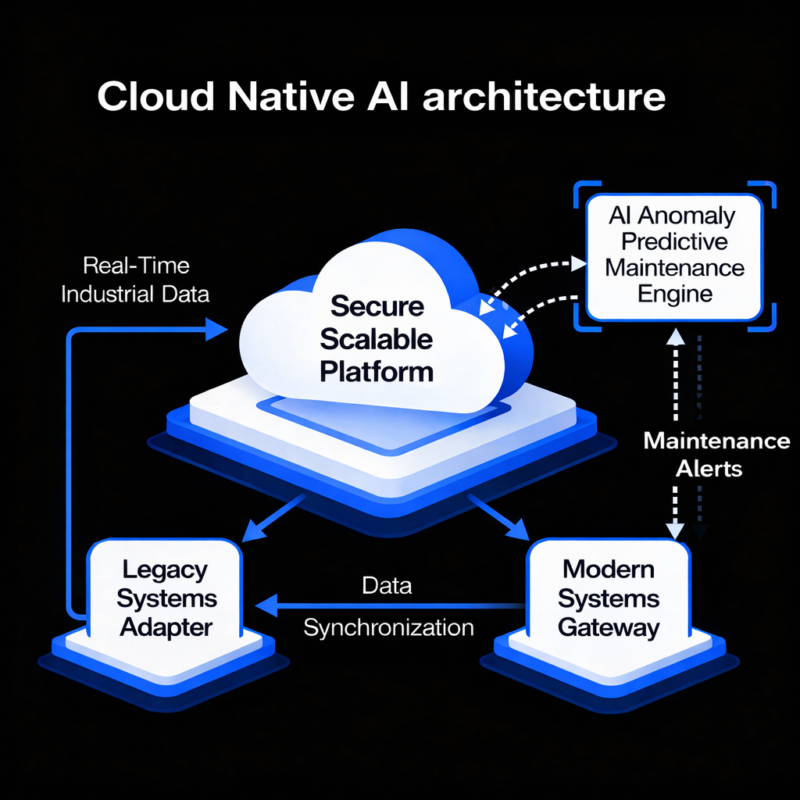
Addressing persistent reliability challenges in midstream compression requires a predictive AI approach that unifies operational and maintenance data into a coherent reliability framework. Deployed on secure, scalable cloud infrastructure, an enterprise AI platform can integrate disparate data streams, apply machine learning models, and translate insights directly into operational action.
At its core, this approach begins with breaking down data silos. Compressor sensor telemetry — including pressures, temperatures, vibration, engine load, and lubrication metrics — is ingested alongside maintenance records, event logs, and parts replacement histories. These data sources are harmonized into a unified asset model that links operating conditions to reliability outcomes over time.
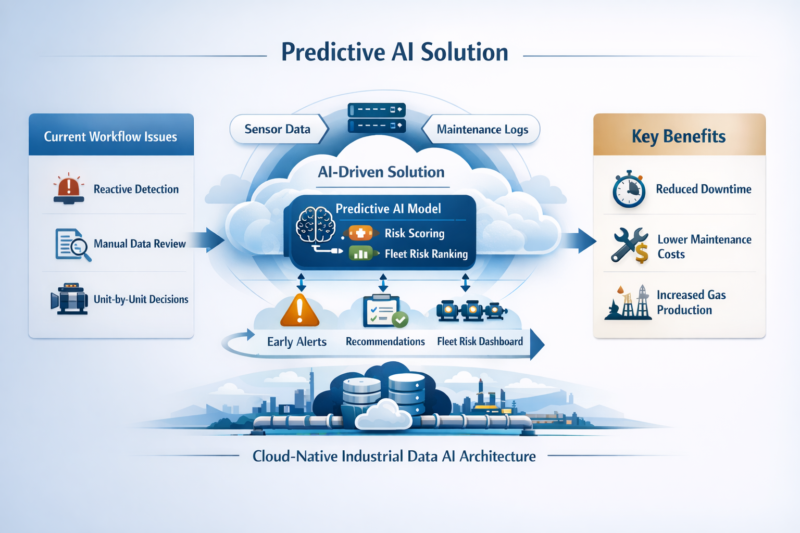
With this foundation in place, machine learning models can be trained on historical failure events and degradation patterns. Subtle precursors — such as rising discharge temperatures, emerging vibration anomalies, or deviations in lubrication pressure — become detectable well before they trigger alarms or cause shutdowns. As real-time telemetry flows into the system, these models continuously evaluate asset health and generate dynamic failure probability scores for each compressor.
Rather than overwhelming operators with raw analytics, predictive outputs are elevated into a broader surveillance intelligence layer. At the fleet level, compressors are ranked by risk tier and weighted against business criticality factors such as throughput dependency, location, redundancy, and downstream impact. This allows operations and maintenance teams to align intervention priorities with the assets that pose the greatest operational or commercial risk.
Generative AI further bridges the gap between analytics and execution by translating model outputs into clear, human-expert–level guidance. When risk thresholds are crossed, the system can route alerts to the appropriate teams while recommending targeted inspection or maintenance actions based on asset behavior, historical outcomes, and operating context. This shifts decision-making from reactive interpretation toward confident, proactive action.
Crucially, predictive insight must connect directly to execution. Integration with enterprise maintenance systems such as SAP or IBM Maximo allows risk signals to trigger work orders, schedule inspections, or recommend corrective actions within existing workflows. Over time, this approach replaces rigid maintenance schedules with flexible, risk-based decision-making that adapts to real operating conditions.
From Reliability Insight to Business Outcomes
When predictive reliability is embedded into daily operations, the impact extends well beyond maintenance efficiency. Improved compressor availability translates directly into higher throughput and greater system resilience. By reducing unplanned outages and emergency interventions, operators can lower operating costs while extending asset life.
Environmental performance improves as well. Fewer unexpected failures mean fewer blowdowns, less flaring, and reduced emissions exposure. Safety outcomes benefit from the avoidance of high-risk emergency repairs that often involve hot work, confined spaces, or high-pressure systems.
In practice, operators deploying predictive reliability programs across compressor fleets have observed measurable results within the first year. Reduced downtime can recover significant incremental gas throughput, on the order of millions of dollars per hundred compressors annually. Early-warning alerts reduce the volume of reactive work orders, easing labor strain and lowering corrective maintenance costs. Unplanned shutdown hours can be reduced by 15 to 20 percent, while overall corrective maintenance volume declines without increasing mean time to repair.
Beyond individual maintenance events, predictive reliability changes how midstream organizations allocate resources across their asset base. Facility-level risk ranking allows operators to distinguish between compressors that are merely underperforming and those that pose a material threat to throughput, safety, or contractual delivery. By tying health scores to business criticality, maintenance planning becomes a strategic exercise rather than a reactive response.
Just as importantly, these gains are achieved through better decision-making rather than increased workload. Maintenance efforts become more targeted, safety risks are reduced, and operational confidence improves across teams.
Learning Systems, Not Static Models
A defining advantage of AI-driven reliability systems is their ability to improve over time. As new telemetry, maintenance actions, and outcomes are continuously ingested, model performance adapts to evolving operating conditions and equipment wear patterns. Corrective actions and inspection results feed back into the system, refining failure signatures and reducing false positives. This feedback loop ensures predictive accuracy does not degrade as assets age or operating regimes change.
Turning Reliability into a Strategic Advantage
The integration of enterprise AI platforms with cloud-native infrastructure allows midstream operators to transform compressor reliability from a recurring operational challenge into a predictive, data-driven advantage. By unifying real-time telemetry, historical maintenance records, and advanced analytics, operators gain early insight into emerging failures, clarity around asset risk, and the ability to act before problems escalate.
Predictive reliability enables operators to recover lost capacity, manage costs, and reduce operational risk by making better use of the data their compression assets already generate, rather than relying on additional equipment or more aggressive maintenance schedules.
As incremental gains become increasingly important in a competitive and regulated energy landscape, reliability can no longer be treated as a back-office function. Predictive reliability programs allow compressors to operate closer to their optimal performance envelope, protecting throughput, safeguarding personnel, and delivering measurable financial and environmental value.
For midstream operators, the shift from reactive maintenance to predictive insight is not merely a technology upgrade; it is a redefinition of how reliability is managed. Intelligence-driven compression operations elevate reliability to a strategic discipline—one that directly influences throughput, safety, emissions performance, and capital efficiency. In a market where incremental gains matter, predictive reliability enables operators to run closer to optimal conditions while maintaining control over risk, cost, and long-term asset performance.

Praveen Shiveswara Sridharamurthy is a Principal Solution Architect for Industrial IoT at LTIMindtree, where he designs and leads enterprise-scale real-time data and analytics platforms for oil and gas and industrial operators. With more than 21 years of experience across energy, utilities, and chemicals, his work focuses on integrating operational telemetry, cloud-native architectures, and advanced analytics to improve asset reliability, throughput, and operational decision-making. Praveen has held senior leadership in technical and architectural roles at Amazon Web Services, ChampionX and Accenture, and has led large-scale cloud migration, predictive reliability, and industrial data initiatives for global energy clients.
Keep In Touch with Shale Magazine
As the new era of energy unfolds, you can bet we’ll be the boots on the ground to keep you informed. Subscribe to Shale Magazine for sharp insight into the arenas that matter most to your life. And don’t forget to listen to our riveting podcast, The Energy Mixx Radio Show, where our very own Kym Bolado interviews the most extraordinary thought leaders, business innovators, and industry experts of our time.