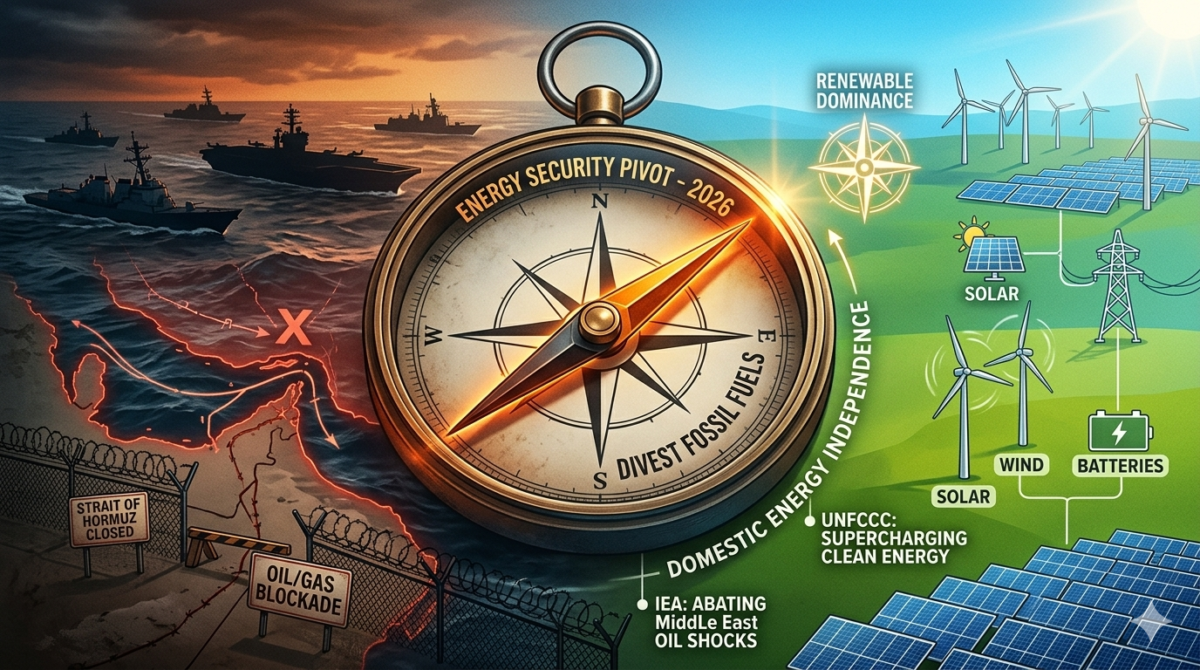
The Iran War is encouraging governments to reassess their reliance on fossil fuels and explore diversification to boost energy security, as previously seen during the post-COVID period.
Strait of Hormuz Spurs Major Energy Shortages
The United States-Israeli attack on Iran in February led Tehran to call for the total closure of the Strait of Hormuz. The waterway, located between Oman and Iran, connects the Persian Gulf with the Gulf of Oman and the Arabian Sea. It is one of the world’s main oil and gas corridors, with an average of 20 million barrels per day (bpd) of crude, or around 20% of the global petroleum liquids consumption, passing through the Strait in 2024.
The prolonged closure of the waterway has severely restricted trade between Asia and Europe, resulting in the largest disruption to global oil markets in history, as termed by the International Energy Agency (IEA) in March.
The disruption has led to severe energy shortages in several parts of the world and has driven up oil and gas prices dramatically over the last two months. This has demonstrated to the world just how dependent it still is on fossil fuels.
Governments worldwide are racing to fill the gap by seeking alternative fossil fuel suppliers, ramping up domestic production, turning coal-fired plants back on, raising renewable energy production, and releasing vital supplies from stockpiles.
The IEA’s energy crisis tracker shows that nearly 40 countries have taken emergency action in the face of soaring oil and gas prices, such as enforcing energy rationing policies.
The Need to Rethink Global Energy
As countries scramble to secure their short- to mid-term energy supplies, the disruption could encourage many to rethink their long-term energy security. Following the Covid-19 pandemic, several world leaders pledged to invest in decarbonization activities and strive for a green transition – meaning a gradual movement away from a dependence on fossil fuels.
However, over the past couple of years, many governments have returned to their old polluting ways, while major energy companies have backtracked on ambitious climate pledges in favor of oil and gas production, to the dismay of environmental organizations worldwide.
Now, in the face of major disruptions to oil and gas trade – as well as other important petrochemicals such as fertilizers and jet fuel – a switch to green energy is looking ever more attractive.
Renewable Capacity Growth Increasingly Necessary – Despite Trump’s Stance
Since coming into office last year, President Trump has attempted to backtrack on former-President Biden’s “Green New Scam” by cutting climate funding and support for renewable energy in favor of the expansion of fossil fuel operations.
However, the global energy disruptions have reenforced that idea that the diversification of the energy mix is key to achieving energy security, allowing countries not to rely on a single or limited source of energy.
In fact, in May, the Executive Secretary of the U.N.’s climate secretariat UNFCCC, Simon Stiell, told a meeting of government officials at the IEA that the U.S.-Israeli war with Iran was “supercharging” the world’s shift to renewable energy, as countries race to decrease their exposure to volatile oil and gas markets.
“War in the Middle East has exposed a brutal truth: Fossil fuel dependency rips away countries’ sovereignty and security, putting food prices, household budgets, business bottom lines, and entire economies at the mercy of geopolitical shocks,” Stiell wrote in a recent op-ed. “The good news is there is a clear solution to both the climate crisis and the fossil fuel cost crisis: accelerating the shift to clean energy systems.”
Meanwhile, the Sierra Club, a major U.S. environmental organization, published an article in May that stated, “The crisis comes at a time when renewable energy deployment has been surging, and the costs of solar, wind, and batteries have fallen dramatically.” The author added, “Calls to speed the transition to renewable energy as a matter of security have proliferated amid the war-driven upheaval of global oil markets.”
Not Everyone Agrees on the Need for a Green Transition
While the Iran War has encouraged many governments to rethink their energy mixes and discuss the potential for greater diversification, some leaders remain steadfast in their support for oil and gas.
“Intuitively, you would imagine that this would encourage diversification away from the fuels that are in short supply now,” stated the IEA’s chief energy economist, Tim Gould.
However, in the Middle East, several countries are striving to rebuild damaged fossil fuel facilities and come back stronger.
Qatar’s finance minister, Ali bin Ahmed Al Kuwari, stated, “People, they want[ed] to move away from oil and gas for many years. They could not achieve it. So, it will take much longer… It is so difficult now at this stage, really, to have a replacement for energies.”
The Trump administration appears to have a similar view for the United States, with repeated calls for the oil and gas industry to ramp up production to fill the gap and become the world’s dominant fossil fuel supplier – even in the face of rising consumer energy bills and higher prices at the pumps.
Keep In Touch with Shale Magazine
As the new era of energy unfolds, you can bet we’ll be the boots on the ground to keep you informed. Subscribe to Shale Magazine for sharp insight into the arenas that matter most to your life. And don’t forget to listen to our riveting podcast, The Energy Mixx Radio Show, where our very own Kym Bolado interviews the most extraordinary thought leaders, business innovators, and industry experts of our time.