
Chevron’s Microsoft Gas Deal Tests AI’s Energy Trade-Offs
Chevron’s Project Kilby would supply a Microsoft data center in West Texas with dedicated natural gas-fired electricity under a 20-year agreement, linking the expansion of artificial intelligence directly to Permian Basin energy resources.
The proposed development illustrates a growing challenge for technology companies: securing large amounts of dependable electricity while managing infrastructure constraints, community concerns and climate commitments.
Chevron announced approximately 2.67 gigawatts of planned generating capacity, developed in phases, with first power anticipated in 2028. Its announcement targeted a final investment decision by the end of 2026, subject to remaining conditions. Those milestones describe a proposed development—not a fully approved, operating facility. Chevron’s project announcement.
What Is Project Kilby?
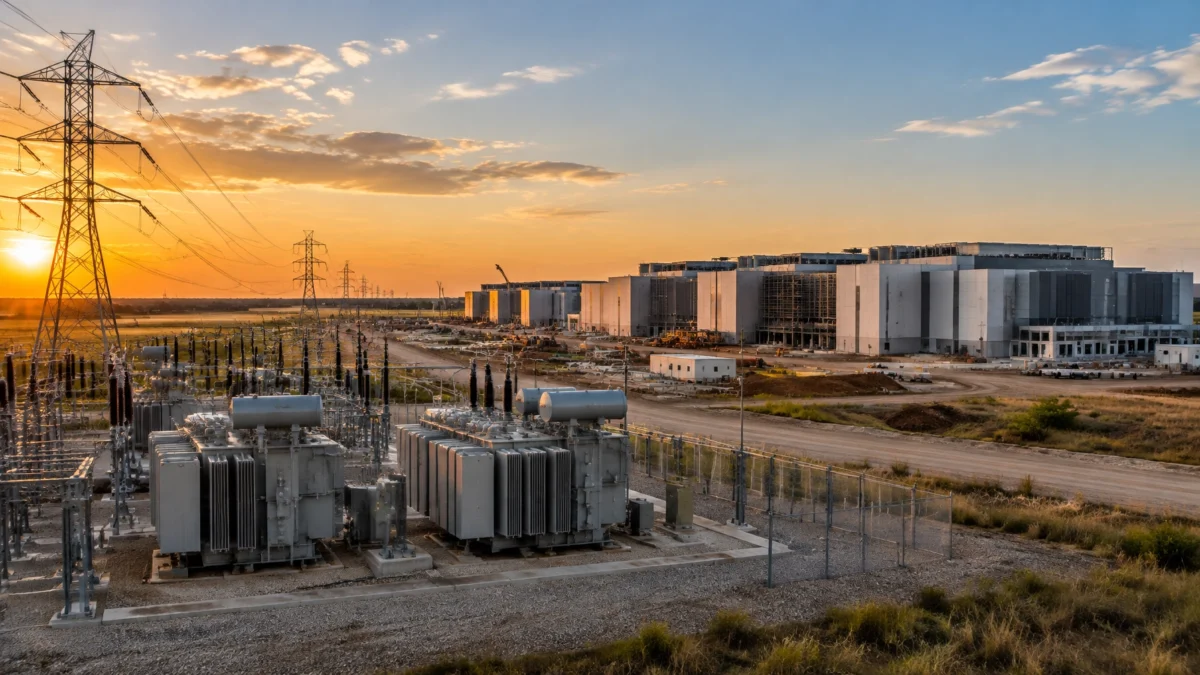
Project Kilby pairs a planned natural gas power facility with a Microsoft-operated data center in Reeves County, near Pecos.
Chevron announced the agreement through Energy Forge One, working with Engine No. 1 on the development. GE Vernova equipment would provide most of the generation, supplemented by equipment from Caterpillar subsidiary Solar Turbines.
The approximately 2.67 GW figure refers to planned generating capacity. It should not be treated as a measurement of the campus’s actual electricity consumption or server capacity.
Generation capacity, electricity delivered and computing load are related but different. Plant equipment consumes some electricity itself, and output varies with operating conditions, maintenance and reliability requirements.
Likewise, the 2028 target refers to initial power delivery—not necessarily completion of the entire development. Chevron announcement, distributed through Business Wire.
Why Put a Power Plant Beside a Data Center?
Co-locating generation and computing infrastructure can reduce dependence on new transmission capacity and utility service timelines.
Instead of relying entirely on electricity delivered through the public grid, the campus would receive dedicated power from nearby generating equipment. That approach offers greater control over the development schedule, but also requires the project to provide its own reliable power system.
A data center cannot assume every turbine will operate continuously. Its power design must accommodate maintenance, equipment failures, fuel interruptions and changing computing loads.
ENMG examines those engineering and commercial challenges in On-Site Gas Generation for AI Data Centers.
The distinction is important: bringing your own power does not eliminate infrastructure requirements. It moves more responsibility for building and operating that infrastructure onto the project and its partners.
Does Dedicated Generation Protect Other Electricity Customers?
Chevron presents the co-located approach as a way to mitigate impacts on the regional grid. That is a project objective, not proof that every potential cost has been eliminated.
Dedicated new generation can avoid drawing an equivalent amount of electricity from existing utility supplies. However, the wider effects depend on the final arrangements for backup service, transmission connections, public infrastructure and cost allocation.
A future connection to export surplus electricity would also require an actual connection and operating framework. A plant cannot remain completely isolated while simultaneously supplying the public grid.
The relevant questions include who pays for any shared facilities, whether the campus requires emergency grid service and how available generating capacity would be measured during periods of regional stress.
These issues connect to the broader challenges covered in U.S. Grid Modernization: Improvements Needed Imminently.
Natural Gas Offers an Opportunity—and Operating Risks
For Chevron, the project creates an opportunity to connect its energy business with a large, long-term electricity customer.
For Microsoft, the value lies in securing power for computing infrastructure whose development may otherwise depend on constrained utility capacity.
Natural gas generation is dispatchable: output can be controlled rather than depending directly on sunshine or wind. But dependable electricity still requires dependable fuel delivery, functioning equipment and sufficient backup capacity.
Kilby therefore should not be framed as proof that one resource has solved every AI energy problem. Its performance would depend on the entire system—from gas supply and turbines to cooling, controls and maintenance.
The broader relationship between computing growth and physical infrastructure is explored in The AI Energy Demand Surge Behind the Boom.
What Does the Deal Mean for Microsoft’s Climate Commitments?
A long-term gas-power agreement creates tension with Microsoft’s climate objectives, but it does not establish that the company has abandoned them.
Microsoft’s current sustainability disclosures continue to state goals of becoming carbon-negative, water-positive and zero-waste by 2030. Its July 2026 sustainability report describes rising AI demand as a challenge requiring changes in how those commitments are implemented. Microsoft’s sustainability commitments; 2026 report announcement.
Three concepts must remain separate:
- Annual renewable-energy matching: Procuring renewable electricity or associated attributes equivalent to electricity consumption over a year.
- Hourly carbon-free matching: Matching electricity use with carbon-free generation during the corresponding hours.
- Carbon-negative operations: Reducing emissions and removing more carbon than the company emits across its defined footprint.
Microsoft announced in February 2026 that it had achieved its annual renewable-electricity matching milestone for 2025. That does not mean every facility physically runs on renewable electricity every hour. Microsoft’s annual matching announcement.
Carbon-free electricity also includes nuclear power; it is not synonymous with renewable electricity. Microsoft’s agreement with Constellation supports restarting Three Mile Island Unit 1 as the Crane Clean Energy Center—a separate unit from the reactor involved in the 1979 accident. Constellation’s announcement.
The unresolved issue is how Kilby’s emissions would fit into Microsoft’s long-term accounting and reduction plans. Renewable procurement elsewhere does not physically remove emissions from a gas turbine in West Texas.
Water and Economic Benefits Need Clear Boundaries
Chevron projects more than $10 billion in state and local tax revenue and support for almost 2,000 jobs. These are company projections, not realized benefits; the announcement does not provide enough detail to treat them as annual revenue or permanent operating positions.
The company also says power plant operations would use non-potable, brackish groundwater instead of freshwater, while reuse of water produced by oil and gas operations is being explored. Those statements should not be expanded into a verified water plan for the entire data-center campus. Chevron’s announcement.
Brackish-water use may reduce direct demand for freshwater, but evaluating its benefits requires information about withdrawals, treatment, disposal and the affected aquifer. Exploring produced-water reuse is also different from having an approved, operating system.
What Do the Emissions Estimates Actually Show?
The Environmental Integrity Project, an environmental watchdog, lists potential annual Kilby emissions of approximately 13.9 million U.S. tons of greenhouse gases measured as CO₂-equivalent, 3,230 tons of criteria pollutants and 139.29 tons in its hazardous-air-pollutants/formaldehyde category.
These are potential emissions, not measured releases. EIP’s methodology uses permit records where available and calculations for other projects.
A material discrepancy remains: its Kilby entry lists 2,869 MW, compared with Chevron’s announced 2,670 MW. The figures should not be presented as a confirmed emissions forecast for the announced configuration without reconciling the underlying equipment and permit records. EIP report, methodology and Appendix C.
This uncertainty does not make the emissions concern irrelevant. It means the comparison must use the same project configuration and operating assumptions.
Community Acceptance Remains a Separate Test
National polling suggests developers face a skeptical audience.
Gallup’s March 2–18, 2026, survey found that 71% of Americans opposed an AI data center in their local area. The result describes national opinion—not a survey of Reeves County residents or opposition specifically to Kilby. Gallup’s findings.
ENMG’s coverage of local opposition to data centers examines the concerns behind that response.
For Kilby, local evaluation should consider expected employment and tax receipts alongside water demand, air emissions, noise, traffic and infrastructure responsibilities. National enthusiasm for AI does not settle those local questions.
The Bottom Line
Project Kilby is a test of whether dedicated natural gas generation can deliver the power needed for a major AI campus while meeting its financial, reliability and community obligations.
The next meaningful milestones are a final investment decision, a clear phased construction schedule, reconciled permit and capacity information, and transparent environmental and infrastructure commitments.
The project could create a substantial new connection between Permian energy production and digital infrastructure. It would also add combustion emissions that Microsoft must address within its stated climate strategy.
Both can be true. Reliable electricity is essential to AI development; so is an honest accounting of what providing it requires.
Frequently Asked Questions
What is Project Kilby?
Project Kilby is a proposed co-located natural gas power development intended to supply a Microsoft data center in West Texas under a 20-year agreement.
How much generating capacity is planned?
Chevron announced approximately 2.67 GW, developed in phases. That figure is not a measurement of continuous data-center electricity consumption.
When would it start supplying electricity?
Chevron’s announcement targeted initial power delivery in 2028, subject to project conditions and a final investment decision.
Does annual renewable matching mean a data center uses renewable power every hour?
No. Annual matching balances electricity consumption and renewable procurement over a year. Hourly matching is a different standard.
Are Kilby’s published emissions figures actual emissions?
No. They describe potential annual emissions. EIP’s listed plant capacity also differs from Chevron’s announcement, requiring reconciliation.
Keep In Touch with Shale Magazine
As the new era of energy unfolds, you can bet we’ll be the boots on the ground to keep you informed. Subscribe to Shale Magazine for sharp insight into the arenas that matter most to your life. And don’t forget to listen to our riveting podcast, The Energy Mixx Radio Show, where our very own Kym Bolado interviews the most extraordinary thought leaders, business innovators, and industry experts of our time.
Subscribe to get more posts from Felicity Bradstock