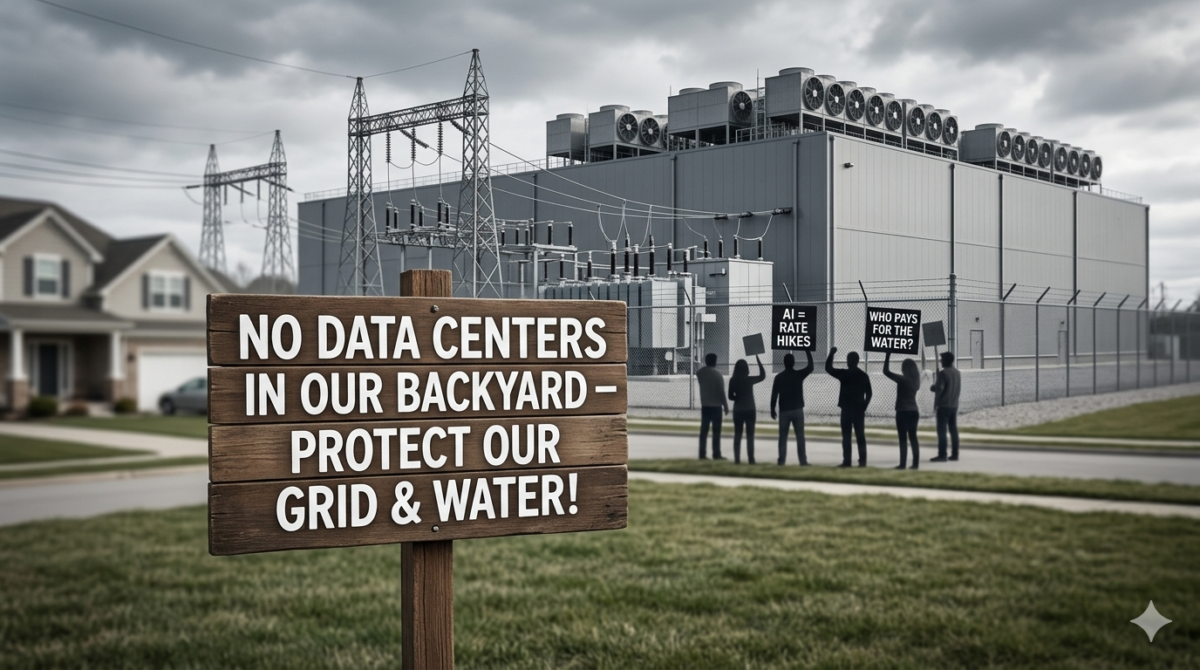
Data centers have become increasingly controversial as consumer energy bills have increased, and the power demand for tech companies continues to rise. Many consumers are now calling for greater accountability around data center energy use and asking state governments to restrict new developments.
A recent poll has shown that there are rising concerns around various aspects of data center development, including the availability of affordable power for U.S. households and the heavy use of resources, such as water and arable land.
Gallup Results – 71% Against Data Centers
According to a Gallup survey conducted in March, seven in 10 participants opposed the construction of data centers for artificial intelligence (AI) in their local area, including nearly half, 48%, who were strongly opposed. Less than a quarter of respondents favored data center development, with 7% strongly in favor.
The March survey was the first poll produced by Gallup that asked about data center development, reflecting the growing discussion around the matter.
Data centers house computing equipment to power AI and other advanced computing operations. They typically cover large areas of land and require massive quantities of electricity to power, as well as lots of water to cool equipment. The huge resource use at these sites has led many to raise concerns over the environmental burden of data centers.
In the survey, Gallup asked people to rate their level of concern about the environmental impact of AI data centers, to which 46% said they worried a great deal and 24% a fair amount.
Gallup also asked an open-ended question about the reason for people’s opposition to data centers to better understand the trend. Those in favor of data center development mainly cited economic benefits, while those who opposed construction cited a wide range of reasons, including environmental concerns.
Half of the opponents mentioned the excessive use of resources by data centers, including 18% each referencing their use of water and energy. Around 20% feared higher utility bills, cost-of-living increases, and questioned who would pay for the cost of building the data centers.
Interestingly, a majority of all major demographic groups, including all party groups, say they would oppose having a data center constructed where they live. However, Democrats were much more likely than Republicans to be strongly opposed, at 56% versus 39%.
Meanwhile, opposition was slightly lower among those living in the West (63%) and East (68%) of the country compared to those in the Midwest (76%) and South (75%).
Not In My Back Yard
It is not uncommon for people to have a “not in my back yard” (NIMBY) response to new developments, particularly when related to energy. The NIMBY view has been common in previous decades when discussing coal plants, nuclear power stations, and renewable energy projects, such as wind and solar farms. However, the recent opposition comes at a time of rising energy costs and greater concerns over sustainability.
Many people in the United States are concerned about the rising energy demand vis-à-vis the availability of energy, particularly with global restrictions in energy trade and related energy shortages driving up oil and gas prices dramatically.
State Response to Data Centers
While little has been done to tighten federal regulations on data center development, some states are putting their own limits on new construction in response to consumer calls for greater accountability for tech companies.
Lawmakers in over 10 states have proposed temporary bans on data center construction so far this year, while dozens of county and city governments have already passed such measures.
In April, Maine Governor Janet Mills signed an executive order to establish the Maine Data Center Advisory Council. The council will make recommendations on large-scale data center development in Maine to protect ratepayers, maintain electric grid reliability, minimize environmental impacts, and enable responsible economic development, according to the state government. The move came after Mills vetoed a ban on data center construction for the following 18 months.
“It is necessary, important and urgent that the State plan for potential impacts of large-scale data centers on our state, given the serious conversations about them here and around the country. Through this order, this work starts today,” said Governor Mills.
“I look forward to this Council’s work to examine the serious questions and concerns about data center development in Maine and provide recommendations about how best to protect our environment and ratepayers while providing for responsible economic development that benefits communities.”
Bans on the construction of new data centers have been proposed in Minnesota, Michigan, New York, Pennsylvania, Maryland, Vermont, New York, Oklahoma, Georgia and South Carolina. Such proposals have been rejected in South Dakota and Wisconsin.
Meanwhile, Virginia and Texas have the most data centers in the country to date, with 579 and 411 server farms, respectively.
Keep In Touch with Shale Magazine
As the new era of energy unfolds, you can bet we’ll be the boots on the ground to keep you informed. Subscribe to Shale Magazine for sharp insight into the arenas that matter most to your life. And don’t forget to listen to our riveting podcast, The Energy Mixx Radio Show, where our very own Kym Bolado interviews the most extraordinary thought leaders, business innovators, and industry experts of our time.