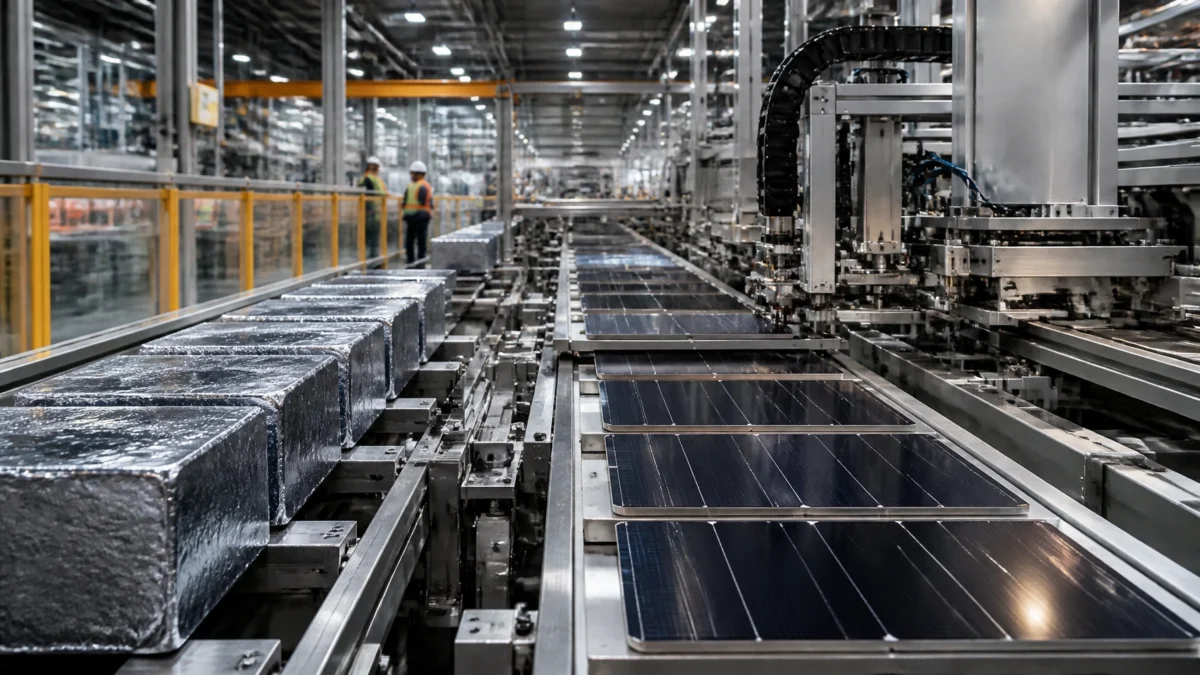
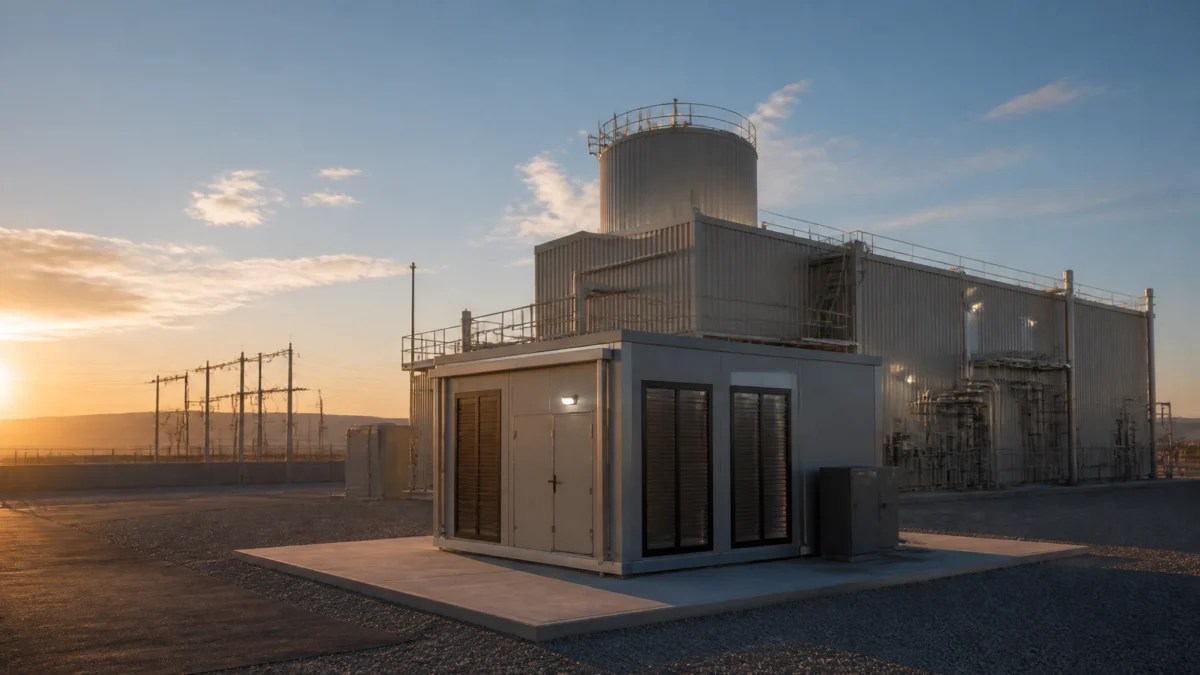
Crusoe and Aalo Atomics plan to test whether an advanced nuclear reactor can power an artificial intelligence data center at Idaho National Laboratory in 2027. The proposed proof of concept would pair Aalo’s sodium-cooled microreactor technology with a Crusoe Spark modular data center running Crusoe Cloud.
The companies announced the partnership on July 30, according to POWER Magazine. Their longer-term plan calls for deploying Aalo Pods across Crusoe’s data center portfolio by the end of 2029, subject to reactor testing, regulatory approvals, manufacturing capacity, financing and site-specific requirements.
The 2027 demonstration will connect power and computing
The Idaho project is intended to test an integrated system rather than evaluate the reactor and data center separately.
A Crusoe Spark unit will provide the computing load. Crusoe describes Spark as a prefabricated, modular AI data center that integrates servers, cooling, power systems, monitoring and fire suppression into a transportable package. The company says the platform can be deployed in units ranging from hundreds of kilowatts to larger grouped clusters.
POWER reports that an individual Spark unit requires just under 1 megawatt of electricity. Aalo’s commercial reactor architecture, by comparison, is designed around 10-megawatt electrical reactor units. That difference gives the initial demonstration additional headroom, while allowing the companies to study how a nuclear system responds to real computing demand.
The test is expected to examine:
- Startup and shutdown sequences
- Changes in AI computing demand
- Power quality and conditioning
- Battery energy storage integration
- Grid-connected and islanded operation
- Maintenance and refueling scenarios
- Responses to equipment failures
- The potential to scale from one reactor to a larger multi-reactor plant
Matt Loszak, Aalo’s chief executive, told POWER that the partnership would help the companies evaluate the reactor, energy management systems, batteries, power electronics and data center as one operating system. That matters because a data center’s electrical requirements are not necessarily constant. AI training and inference workloads can create rapid changes in demand, while nuclear reactors are generally designed to produce steady output.
The demonstration could therefore provide operational information that cannot be obtained from reactor testing alone.

Aalo’s criticality milestone is an early step
The planned Crusoe demonstration follows a recent milestone in Aalo’s development program at INL.
On July 4, 2026, Aalo’s Critical Test Reactor, or CTR, achieved a zero-power fueled criticality demonstration at the national laboratory, according to Nuclear Engineering International and POWER Magazine. A reactor reaches criticality when its nuclear chain reaction becomes self-sustaining. In a zero-power test, however, the system operates at negligible power and does not generate electricity for customers.
The CTR allows Aalo to examine reactor physics, fuel behavior, control systems, instrumentation and operating procedures. It is not the same as demonstrating a full-power commercial reactor.
Nuclear Engineering International reported that the Aalo-X design uses graphite moderation, liquid sodium cooling and uranium dioxide fuel. Aalo’s architecture places fuel assemblies within graphite blocks, with liquid sodium carrying heat away from the core.
Aalo’s next stage is a full-power Aalo-X demonstration plant, which the company has described as a 30-megawatt-thermal, 10-megawatt-electric sodium-cooled reactor. POWER reported that Aalo has also begun work on Project Ascension, a commercial-scale system intended to produce electricity for an on-site data center.
Those projects remain important conditions for the Crusoe partnership. The 2027 data center demonstration depends not only on the successful completion of zero-power reactor testing, but also on full-power operation, electrical integration and the necessary federal approvals at the INL site.
How the Aalo Pod is designed to scale
Aalo’s commercial product is the Aalo Pod, described by the company as a 50-megawatt-electric extra-modular reactor power plant.
Each Pod would contain five 10-megawatt reactors connected to a shared turbine. The approach is intended to provide a larger block of power while preserving the ability to manufacture and deploy reactor modules in stages.
| System | Planned electrical output | Role in the partnership |
|---|---|---|
| Crusoe Spark module | Just under 1 MWe | Initial AI data center load |
| Aalo-1 reactor | 10 MWe | Basic commercial reactor unit |
| Aalo-X demonstration | 10 MWe | Full-power demonstration pathway |
| Aalo Pod | 50 MWe | Five-reactor commercial power plant |
Planned capacity comparison
Crusoe Spark       <1 MWe   █
Aalo-1             10 MWe   ██████████
Aalo Pod           50 MWe   ██████████████████████████████████████████████████
The companies’ plan is to begin with a relatively small Spark installation at INL and later deploy Aalo Pods at Crusoe data centers by the end of 2029. That sequence would allow the companies to move from a controlled federal research environment to commercial sites with larger loads and more complex infrastructure.
Aalo has also said its design is intended to reduce the need for external cooling water compared with conventional water-cooled power plants. Such a feature could be useful for data centers in regions where water availability is a siting concern. However, the full water, cooling, emergency planning and environmental requirements would depend on the final plant design and location.
Why nuclear power is attracting data center developers
AI data centers require large amounts of electricity and place new demands on power systems. Developers are pursuing a range of solutions, including utility connections, natural gas generation, renewable power, battery storage and nuclear energy.
For data center operators, nuclear power offers the potential for firm generation that can operate regardless of weather conditions. It could also reduce reliance on diesel backup systems or natural gas generation if the reactor and supporting infrastructure can meet reliability requirements.
For the broader energy system, the implications are more complicated.
A nuclear-powered data center located behind the meter could reduce the need for some transmission upgrades. It could also allow computing capacity to be built in locations where the grid has limited spare capacity. On the other hand, behind-the-meter generation can change how utilities plan for demand, reserve requirements and cost allocation.
Natural gas is likely to remain part of the data center power mix during the near term because gas turbines can be deployed more quickly than nuclear plants and can provide flexible generation. Renewable resources and batteries can also contribute power, although their ability to serve continuous high-density loads depends on project design, storage duration, transmission access and weather conditions.
Nuclear deployment could therefore complement, rather than immediately replace, other power sources. The key question is whether advanced reactors can be produced and licensed quickly enough to match the pace of AI infrastructure expansion.

Regulatory status will determine the commercial timeline
The INL demonstration benefits from its location on a federal research site. Aalo’s criticality test proceeded under the Department of Energy’s authority rather than through the commercial Nuclear Regulatory Commission licensing process used for reactors deployed at private sites.
That distinction is important. A test reactor at a national laboratory can operate within a specialized federal safety and oversight framework. A commercial Aalo Pod located near a private data center would face additional requirements involving nuclear licensing, environmental review, emergency planning, security, fuel supply, grid interconnection and local permitting.
The companies’ target of deploying Aalo Pods by the end of 2029 is therefore a stated objective, not a guaranteed commercial schedule. It will depend on the results of the 2027 test and on whether Aalo can complete its regulatory pathway and expand manufacturing.
The availability of nuclear fuel is another consideration. Advanced reactor developers require reliable supplies of suitable fuel, and the United States is working to expand domestic nuclear fuel capabilities. Supply-chain performance for specialized reactor components will also influence costs and delivery schedules.
What industry observers should watch next
Several milestones will determine whether the partnership advances beyond demonstration:
- Completion of Aalo’s full-power Aalo-X plant at INL
- Electricity production from the reactor, rather than zero-power criticality alone
- Connection of a functioning Crusoe Spark unit to the nuclear power system
- Performance data from variable AI workloads
- Use of batteries and power electronics to manage load changes
- Commercial licensing progress for the Aalo Pod
- Factory expansion and component supply
- Selection of the first commercial Crusoe sites
The 2027 test could become an important reference point for nuclear power and high-performance computing. It would demonstrate a physical pairing of an advanced reactor and an AI data center, but it would not by itself establish the cost, reliability or regulatory performance of a commercial fleet.
Crusoe and Aalo’s plan reflects a broader effort to match firm electricity generation with rapidly expanding digital infrastructure. The project’s significance will ultimately depend on what the demonstration shows about operations, safety, economics and deployment speed. Until those results are available, commercial nuclear-powered data centers remain a promising development pathway rather than an established industry model.
For more reporting on nuclear energy, power markets and emerging infrastructure, visit SHALE Magazine and SHALE TV.
Sources
- POWER Magazine on the Aalo and Crusoe 2027 INL demonstration
- Nuclear Engineering International on Aalo-X criticality
- Aalo Atomics on the Aalo-X project
- Crusoe on its Spark modular AI data center platform
- Idaho National Laboratory on accelerating nuclear energy

Keep In Touch with Shale Magazine
As the new era of energy unfolds, you can bet we’ll be the boots on the ground to keep you informed. Subscribe to Shale Magazine for sharp insight into the arenas that matter most to your life. And don’t forget to listen to our riveting podcast, The Energy Mixx Radio Show, where our very own Kym Bolado interviews the most extraordinary thought leaders, business innovators, and industry experts of our time.
Subscribe to get more posts from Amanda Jenkins