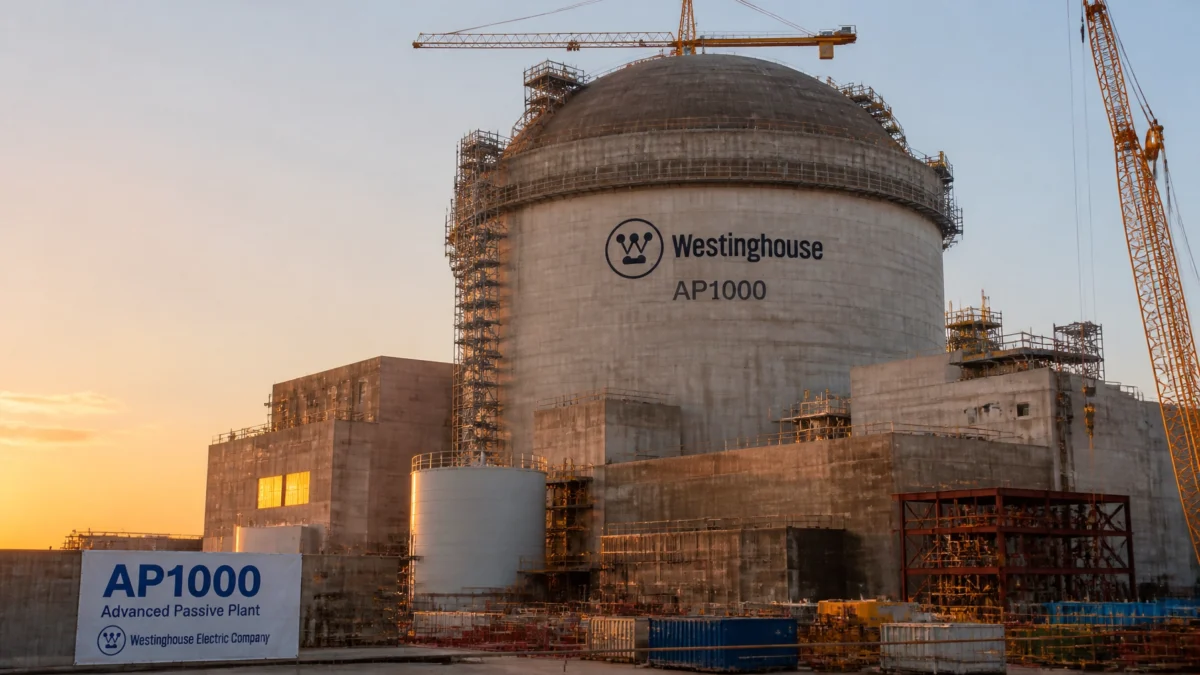
American nuclear supply chain expansion took a massive leap forward today as the U.S. Department of Energy (DOE) announced a landmark conditional commitment of up to $17.5 billion in federal loans. This massive financial injection is designed to jumpstart the deployment of ten Westinghouse AP1000 advanced commercial reactors across five domestic sites, marking the single largest federal investment in the nuclear power sector in decades. Announced on June 23, 2026, the initiative aims to revitalize a domestic industry that has struggled with cost overruns and construction delays, pivoting instead toward a repeatable, modular model of energy production.
Under the leadership of Energy Secretary Chris Wright, the DOE is positioning this move as a critical strategic pivot. By providing the necessary capital to secure long-lead equipment and bulk-purchased components, the federal government is attempting to slash the typical construction timeline by up to three years. This isn’t just about building reactors; it is about building a sustainable industrial ecosystem capable of meeting the voracious electricity demands of the modern economy, particularly the surging power needs of the data center and artificial intelligence sectors.
Breaking Down the American Nuclear Supply Chain Loan Program
The financial architecture of this announcement is as complex as the reactors themselves. The $17.5 billion is structured as a series of conditional loans under the newly formed American Nuclear Supply Chain Loans program, managed by the Office of Energy Dominance Financing (EDF). Rather than a single lump sum, the DOE expects to issue up to five separate loans, with each loan supporting a pair of reactors. This 2-for-1 structure is intended to leverage economies of scale, allowing utilities to share infrastructure, workforce training, and regulatory overhead across two units at a single site.
One of the most striking requirements of this program is the equity mandate. For each of the five projects to move forward, the partnering entities must contribute approximately $1 billion in upfront equity before a single dollar of DOE loan funds is disbursed. In a typical arrangement, Westinghouse is expected to provide $500 million in equity, with the utility partner matching that amount. This shared skin-in-the-game approach is a direct response to the financial failures of the past, ensuring that both the technology provider and the operator are fully committed to the project’s long-term success.
- Total Funding: Up to $17.5 billion in conditional federal loan commitments.
- Reactor Count: 10 Westinghouse AP1000 advanced commercial reactors.
- Site Count: Up to 5 separate locations across the United States.
- Equity Requirement: $1 billion per two-reactor project ($500M from Westinghouse, $500M from utility).
- Timeline: Goal to have all 10 reactors under construction by 2030.
The focus on bulk purchasing is a central pillar of the strategy. By using federal backing to order reactor vessels, steam systems, and turbines in batches of ten rather than one-offs, the DOE aims to drive down unit costs through standardized manufacturing. This approach mirrors the “fleet” model successfully used in France and China, moving away from the bespoke, “first-of-a-kind” engineering hurdles that have historically plagued the U.S. nuclear industry.
Rebuilding the American Nuclear Supply Chain with AP1000 Technology
The selection of the Westinghouse AP1000 reactor for this massive rollout was not a matter of chance. As Secretary Chris Wright noted during the announcement, the AP1000 is currently the only fully designed and licensed advanced commercial reactor operating in the United States. With units already performing reliably at Plant Vogtle in Georgia, the technology has a proven track record of delivering roughly 1.1 gigawatts of dependable baseload power. This reliability is the bedrock upon which the American nuclear supply chain must be rebuilt if the nation hopes to maintain grid stability while phasing out older, more carbon-intensive assets.
According to recent analysis from the Energy Information Administration (EIA), the integration of modular, repeatable designs is the only viable pathway to making nuclear energy cost-competitive with natural gas and renewables. The AP1000’s modular design allows for significant portions of the plant to be built in factories and shipped to the site, reducing the amount of complex on-site labor required. This shift toward a manufacturing-centric model is expected to revitalize domestic factories that haven’t seen a major nuclear order in a generation.
The broader implications for energy security cannot be overstated. Westinghouse, which is owned by Brookfield and Cameco, already has letters of intent from seven potential utility partners who are eager to host these new units. These partners see the writing on the wall: the transition to a high-tech, electrified economy requires a massive increase in firm, dispatchable power. Unlike intermittent sources like wind and solar, nuclear plants provide the steady frequency and voltage support necessary for a modern industrial grid. By standardizing on a single technology platform, the U.S. can develop a specialized workforce and a deep inventory of spare parts, further insulating the domestic energy sector from global supply chain shocks.
Economic Impacts and the American Nuclear Supply Chain Future
The timing of this $17.5 billion announcement coincides with a period of unprecedented growth in electricity demand. The rapid expansion of data centers, particularly those supporting generative AI, has forced many utilities to revise their load growth projections upward for the first time in two decades. In many regions, the existing grid is already nearing capacity, and the lead time for new fossil fuel plants or long-distance transmission lines often exceeds a decade. The DOE’s goal of having ten reactors under construction by 2030 is an aggressive attempt to bridge this looming “power gap.”
Beyond the immediate generation of electricity, the revival of the nuclear sector promises significant domestic job creation. The DOE estimates that the construction of ten reactors will require a peak workforce of tens of thousands of skilled tradespeople, including specialized welders, electricians, and nuclear engineers. Furthermore, the long-term operation of these plants will provide thousands of high-paying, multi-generational jobs in the communities that host them. This aligns with the broader mission of Energy Network Media Group to analyze how policy shifts impact the ground-level energy economy.
As we look toward the 2030s, the success of this $17.5 billion gamble will depend on the ability of the private sector to meet the DOE’s equity and performance benchmarks. While the conditional commitment is a powerful signal to the markets, it is not a blank check. Utilities and investors will be watching closely to see if the first of these five projects can break ground without the delays that characterized earlier nuclear endeavors. If successful, this program could serve as the blueprint for a broader “nuclear renaissance” that extends beyond large-scale reactors to include small modular reactors (SMRs) and even fusion technology in the decades to come.
Keep In Touch with Shale Magazine
As the new era of energy unfolds, you can bet we’ll be the boots on the ground to keep you informed. Subscribe to Shale Magazine for sharp insight into the arenas that matter most to your life. And don’t forget to listen to our riveting podcast, The Energy Mixx Radio Show, where our very own Kym Bolado interviews the most extraordinary thought leaders, business innovators, and industry experts of our time.
Subscribe to get more posts from Amanda Jenkins