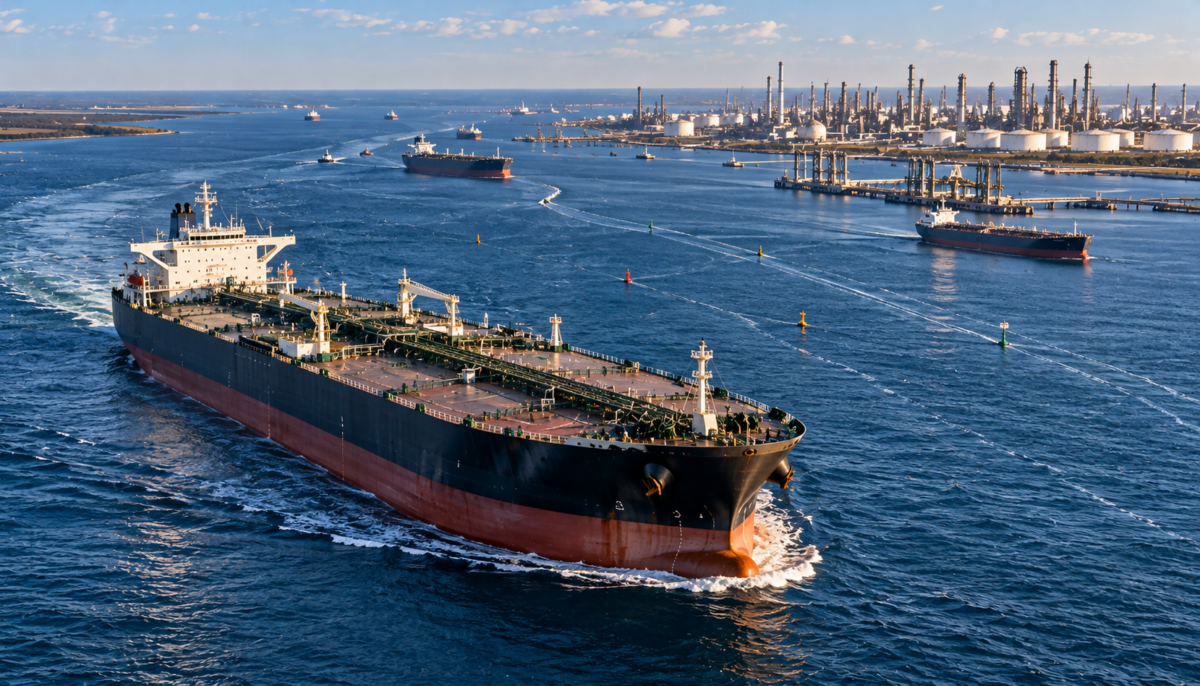
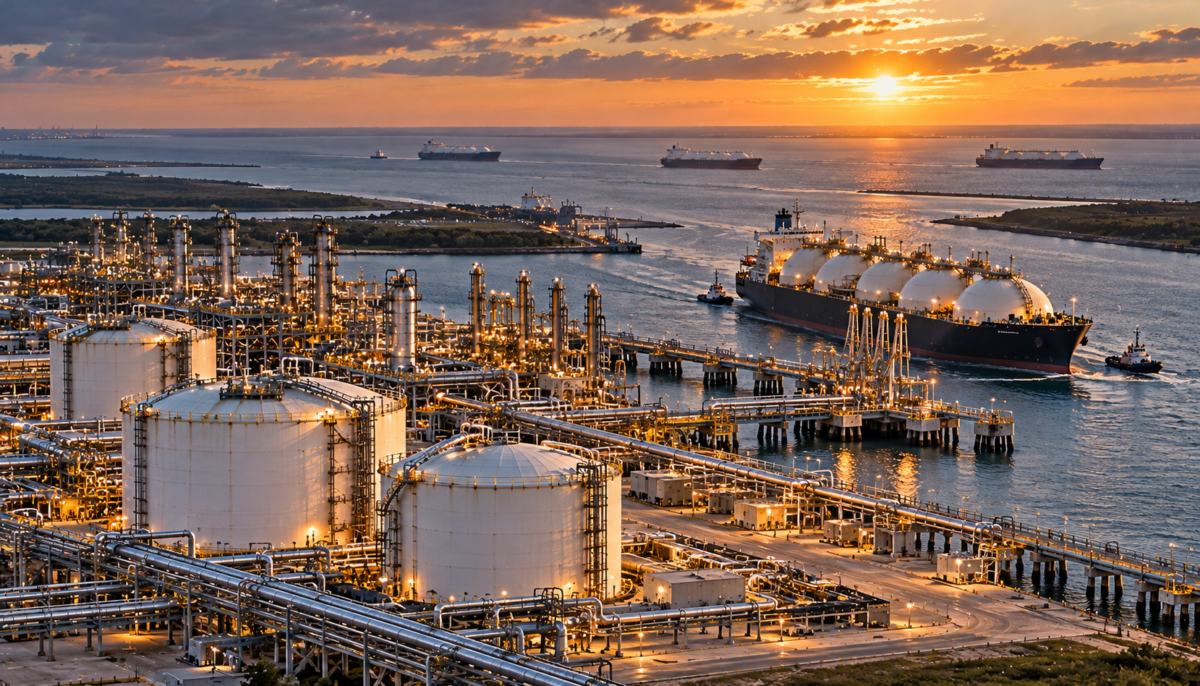
A decade ago, the United States was only beginning to emerge from an energy outlook that had once assumed steadily rising dependence on imported natural gas. For years, the prevailing concern was that domestic production would struggle to keep pace with demand, leaving the country increasingly reliant on liquefied natural gas brought in from overseas. That expectation proved badly wrong. Horizontal drilling and hydraulic fracturing unlocked enormous shale gas resources, domestic production surged, and facilities originally designed to receive imported LNG were instead converted into export terminals.
The transformation happened quickly. Cheniere Energy shipped the first large-scale LNG cargo from the Lower 48 out of Sabine Pass in 2016, and by 2023 the United States had become the world’s largest LNG exporter. U.S. LNG exports increased to a record 15.1 billion cubic feet per day in 2025, and the U.S. Energy Information Administration now forecasts that exports will average 17.6 Bcf/d this year and 18.6 Bcf/d in 2027. EIA also expects U.S. LNG export capacity by 2031 to be nearly double the level that existed at the end of 2025.
That growth represents one of the more remarkable reversals in modern energy markets, but it also changes the nature of the risk facing the industry. For much of the past decade, the central question was whether the United States could build enough export infrastructure to take advantage of its abundant domestic gas. As additional capacity comes online, the more important issue becomes whether global demand will grow fast enough to keep those terminals well utilized and economically attractive.
Why the U.S. Became an LNG Powerhouse
The United States has several structural advantages that helped it rise so quickly in the global LNG market. The most obvious is the scale of the domestic resource base. Production growth from the Marcellus, Haynesville, Permian Basin, and other shale regions gave exporters access to large volumes of relatively low-cost natural gas. That resource advantage was reinforced by an existing industrial system of pipelines, storage facilities, ports, engineering expertise, and access to capital that made the Gulf Coast a natural location for LNG development.
The commercial structure of U.S. LNG also proved important. Many export contracts are linked to Henry Hub natural gas prices rather than directly to crude oil, and U.S. contracts have generally offered buyers more flexibility to redirect cargoes than some traditional LNG supply agreements. That flexibility became particularly valuable after Russia invaded Ukraine in 2022, when Europe suddenly needed alternatives to Russian pipeline gas. Europe received 69% of U.S. LNG exports that year, up from 34% in 2021, and was still taking about 68% of U.S.-origin LNG through most of 2025, according to EIA data on U.S. LNG trade flows.
This year’s Middle East conflict provided another demonstration of the value of flexible supply. Disruptions to Gulf LNG flows tightened global markets just as new North American capacity was ramping up. During the first half of 2026, U.S. LNG exports averaged 17.4 Bcf/d, 23% higher than during the same period a year earlier. New terminals and expansions accounted for much of that growth, allowing U.S. exporters to respond to higher international prices and lost supply elsewhere.
Those episodes strengthened the strategic case for U.S. LNG, but they should not be mistaken for evidence that demand will rise indefinitely. Periods of geopolitical disruption can create extraordinary demand for flexible cargoes. They do not eliminate the long-term requirement that new liquefaction plants operate at high enough utilization rates to justify the billions of dollars invested in them.
The Supply Wave Is Global
The United States is not expanding in isolation. Qatar is undertaking a major increase in LNG production, Canada has entered the large-scale export market, and additional projects are moving forward in Africa, Australia, and elsewhere. The result is a substantial global supply wave that was already expected to reshape LNG markets before the latest Middle East disruptions.
Canada is especially relevant to U.S. exporters because its Pacific Coast geography gives it an advantage in serving Asian buyers. LNG Canada began exports from Kitimat, British Columbia, and in September its partners reached a final investment decision on a second phase. LNG Canada Phase 2 will double capacity from 14 million metric tons per year to 28 million metric tons. A cargo leaving British Columbia can reach major Asian markets much more directly than one traveling from the U.S. Gulf Coast, an advantage that becomes more important when shipping costs are high.
Qatar retains advantages of its own, including very low production costs and proximity to both Asian and European markets. Other suppliers are also trying to capture a share of the same demand growth that has encouraged U.S. developers to keep building. That competition does not threaten the existence of the U.S. LNG industry, but it could have a significant effect on the economics of the marginal projects that come online later in the decade.
Before the current Middle East conflict, the rapid addition of new liquefaction capacity was expected to loosen global LNG markets during the second half of this decade. The conflict has altered that schedule rather than eliminated the supply wave altogether. Damage to Gulf LNG infrastructure and the disruption of shipping through the Strait of Hormuz removed nearly 20% of global LNG supply at one point, and the International Energy Agency now expects those disruptions to delay the market-easing effects of new LNG capacity by at least two years.
That distinction is important. The market may remain tighter in 2026 and 2027 than analysts previously expected, but projects already under construction in North America and elsewhere are still moving toward completion. Eventually, those new volumes will compete for customers.
The Demand Case Is Strong, but Not Unlimited
Asia remains the most important source of long-term LNG demand growth. Electricity consumption continues to rise rapidly in many emerging economies, and natural gas can serve several roles at once: replacing coal in power generation, supporting industrial development, and providing flexible generation as more intermittent renewable power enters the grid. China, India, Vietnam, the Philippines, and other countries could collectively absorb substantial additional LNG volumes over the next decade.
Europe also remains important, even if total gas consumption there eventually declines. The loss of Russian pipeline supply fundamentally changed the region’s approach to energy security. European countries invested heavily in LNG import capacity, diversified their suppliers, and became more willing to pay for the flexibility that global LNG markets can provide. Even in a future in which Europe consumes less natural gas overall, LNG may retain considerable value as insurance against disruptions elsewhere in the energy system.
The problem for exporters is that LNG demand can be highly sensitive to price. Wealthier countries may be willing to pay elevated prices during a crisis, but developing economies often cannot. When LNG prices spike, buyers in more price-sensitive markets have historically reduced purchases, switched fuels, or delayed demand growth. The current Middle East disruption has already produced some of that response, with the IEA reporting demand reductions and fuel switching in several importing markets as prices increased.
The competitive landscape is changing as well. Renewable power continues to expand, battery storage is becoming increasingly important, and nuclear energy is receiving renewed attention in a number of countries. Efficiency improvements, new transmission infrastructure, and demand-response technologies can also reduce the amount of gas needed for power generation. None of these developments eliminates the market for LNG, but they make it difficult to assume that every proposed export terminal will enjoy decades of strong utilization simply because global energy consumption continues to grow.
Capacity Is Not the Same as Utilization
This distinction is easy to overlook during a construction boom. A project can receive permits, secure financing, sign long-term contracts, and eventually enter service without necessarily earning attractive returns over its full life. Liquefaction plants are expensive, long-lived assets, and their economics become much less compelling if utilization rates decline or if competition compresses margins.
The first generation of U.S. LNG projects benefited from an unusually favorable combination of circumstances. Shale gas provided abundant feedstock, existing infrastructure lowered development barriers, Europe abruptly needed new supply after 2022, and repeated geopolitical disruptions increased the value of flexible cargoes. Those conditions helped U.S. exporters grow faster than almost anyone anticipated.
The next generation may face a more competitive environment. U.S. exporters will increasingly compete against established Gulf suppliers, new Canadian capacity, and additional projects elsewhere in the world. Shipping costs will become more important as competition intensifies, particularly for Gulf Coast cargoes headed to Asia, where producers located closer to the market have a natural transportation advantage.
None of this means the U.S. LNG boom is nearing an end. The United States has built a durable competitive position and is likely to remain one of the world’s largest LNG suppliers for years to come. The domestic resource base is enormous, export infrastructure continues to expand, and geopolitical events have repeatedly demonstrated the value of diversified global supply.
What is changing is the investment question. The problem is no longer whether the United States has enough natural gas to support a major export industry. It clearly does. The next phase will depend on how much LNG the world actually needs, what buyers are willing to pay for it, and whether the new export capacity now being built can maintain utilization rates high enough to justify the capital behind it.
For most of the shale era, U.S. natural gas producers and LNG developers were constrained by infrastructure. Increasingly, the constraint may be demand itself.
Keep In Touch with Shale Magazine
As the new era of energy unfolds, you can bet we’ll be the boots on the ground to keep you informed. Subscribe to Shale Magazine for sharp insight into the arenas that matter most to your life. And don’t forget to listen to our riveting podcast, The Energy Mixx Radio Show, where our very own Kym Bolado interviews the most extraordinary thought leaders, business innovators, and industry experts of our time.