Why Have Oil Shipping Costs Increased So Much?
When Americans think about the price of oil, they usually focus on the number quoted every day in financial markets. If Brent crude is trading above $100 a barrel or West Texas Intermediate is near $100, those numbers become shorthand for whether oil is expensive or cheap. But that market price is only part of what ultimately determines the cost of getting crude oil to a refinery.
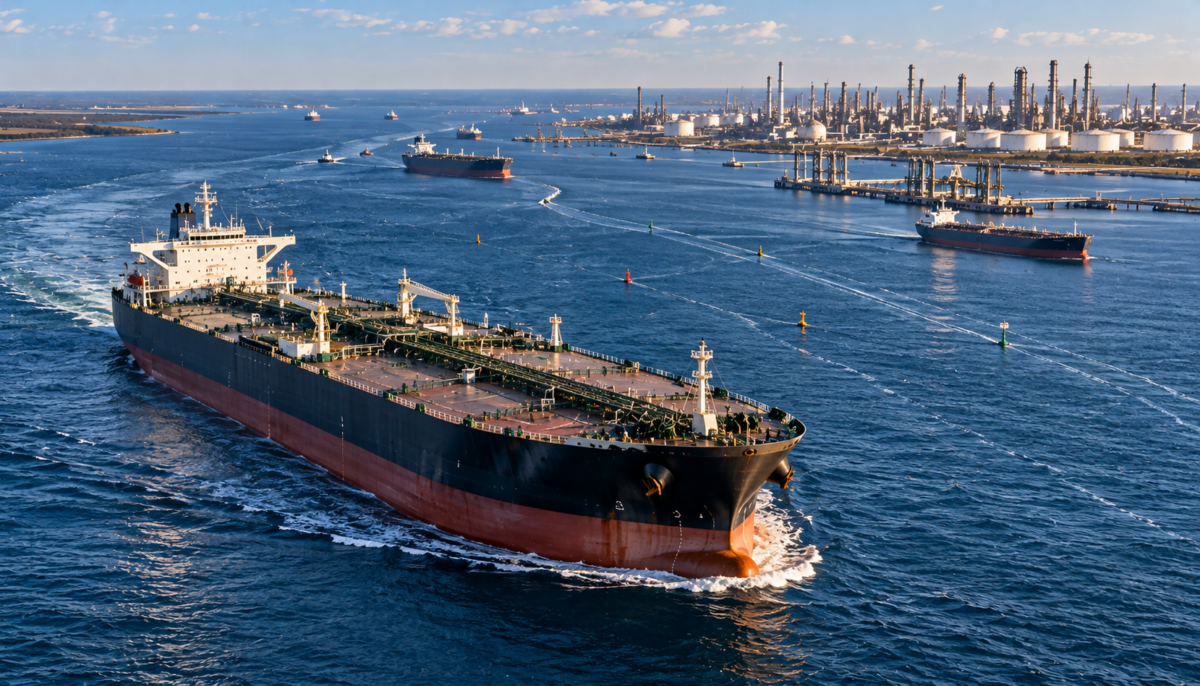
But oil shipping costs have become impossible to ignore. Reuters recently reported that shipping roughly 2 million barrels of crude from the United States to Japan aboard a very large crude carrier could cost about $81 million. That works out to approximately $40.50 for every barrel on the ship, compared with roughly $9 million for a similar voyage a year earlier. At current rates, freight alone can represent a huge addition to the underlying value of the oil.
For most consumers, tanker rates are an obscure corner of the energy market. Yet the extraordinary increase in shipping costs is helping reshape global oil flows and adding another layer of expense to a market already dealing with elevated crude prices, refinery constraints, and geopolitical risk.
Oil Has to Get to the Refinery
A barrel of crude oil is only useful if it can get from where it is produced to a refinery capable of processing it. The gasoline, diesel, jet fuel, and other products produced there then have to make another journey to the markets where they are consumed.
In normal times, ocean transportation is inexpensive enough on a per-barrel basis that few consumers ever think about it. The largest crude carriers can move roughly 2 million barrels at a time, creating enormous economies of scale and allowing oil to travel halfway around the world without freight overwhelming the value of the cargo.
That system becomes far more expensive when tankers are scarce or voyages become riskier and longer. The Energy Information Administration says tanker rates reached record levels in September as insurance costs increased and ships took longer routes to avoid conflict zones. Longer voyages also tie vessels up for more days, effectively reducing the available tanker fleet even if the physical number of ships has not changed.
The distinction between the quoted price of crude and its delivered cost is therefore crucial. A refinery does not care only what a barrel costs at an export terminal. Freight, insurance, delays, and other transportation costs all become part of the economics by the time that barrel arrives.
A Global Transportation Bottleneck
The current tanker crunch developed as geopolitical tensions disrupted traditional oil-trading patterns. Attacks on shipping, higher insurance premiums, changes in routing, and additional ship-to-ship transfers have all absorbed transportation capacity. At the same time, strong demand for vessels on several major routes has pushed charter rates to extraordinary levels.
The impact is already visible in where oil is moving. Reuters reported that freight costs from the U.S. Gulf Coast to Asia recently reached roughly $80 million per cargo, making some U.S. crude uneconomic for Asian refiners. Buyers that might otherwise have purchased American barrels have been looking instead to Middle Eastern or Latin American suppliers simply because the transportation arithmetic changed.
That same freight squeeze has contributed to an unusual buildup of heavy crude in the Americas. Heavy barrels remain valuable for complex refineries, particularly when diesel markets are tight, but transporting them overseas has become prohibitively expensive in some cases. Meanwhile, U.S. refiners are already operating at very high utilization rates and cannot simply absorb every barrel that no longer makes economic sense to export.
This is one of the less intuitive features of global oil markets. One region can have more crude than it can readily use while buyers elsewhere struggle to obtain enough, not because the oil does not exist, but because the logistics linking the two markets have become too expensive.
Why Americans Should Care
A tanker carrying American crude to Japan may seem far removed from the price someone pays at a service station in Texas, Ohio, or Arizona, but oil and refined fuels are traded globally. U.S. producers sell into that market, U.S. refiners compete for barrels within it, and transportation costs influence where crude and refined products ultimately flow.
When shipping costs rise by tens of dollars per barrel, they alter those trade flows. A barrel that once made economic sense to send from the Gulf Coast to Asia may remain in the Western Hemisphere instead, while an Asian refiner may bid for oil from another region. Those shifts can affect regional crude discounts, refinery margins, and eventually the prices of refined fuels.
The same problem is not confined to crude oil. Petroleum products also move by tanker, so higher freight rates can affect diesel, gasoline, jet fuel, and fuel oil even after the refining step is complete. The recent shipping surge is contributing to higher fuel costs and broader inflationary pressure, particularly in regions heavily dependent on imported energy.
The pass-through to American gasoline or diesel prices is not one-for-one because taxes, refinery margins, local inventories, pipeline capacity, and other factors also influence the final retail price. Even so, transportation costs have become too large to dismiss as a minor component of the petroleum supply chain.
Why Tanker Rates Exploded
The economics of tanker transportation are fundamentally about vessel availability. There may be thousands of oil tankers operating around the world, but only a limited number are in the right place, of the right size, and available at the right time for a particular cargo. When voyages become longer or ships spend more time waiting, rerouting, or transferring cargo, effective capacity shrinks.
Geopolitical risk adds another layer. Shipowners expect greater compensation when vessels and crews are operating in dangerous regions, while insurance costs rise as the probability of damage increases. Those higher expenses are ultimately reflected in charter rates.
The scale of the increase has been extraordinary. Some very large crude carriers have recently generated daily returns of more than $1 million, compared with around $55,000 per day during 2025. Those earnings are not evidence that every tanker operator suddenly became vastly more efficient; they are a signal that buyers are competing aggressively for scarce transportation capacity.
Rates have already retreated somewhat from their peaks, illustrating how quickly shipping markets can move when vessel demand changes. Even after the recent decline, however, supertanker rates remain elevated, with continued instability in the Middle East and heavy use of ship-to-ship transfers keeping pressure on available capacity.
More Oil Does Not Solve Every Oil Shortage
The current episode also helps explain why simply adding more barrels does not automatically solve an energy crisis. Governments can release crude from strategic reserves, producers can increase output, and exporters can redirect cargoes, but every additional barrel still has to reach the right refinery at an economically acceptable cost.
If the limiting factor is transportation rather than production, more supply at the wrong location may accomplish less than expected. In extreme cases, additional barrels can accumulate in one region even while buyers elsewhere are paying exceptionally high prices, because the infrastructure connecting those markets has become the constraint.
For years, tanker freight was one of the least visible parts of the petroleum supply chain because it generally functioned efficiently and cheaply enough to attract little attention outside the industry. The recent surge has changed that equation. When moving a barrel of oil can add roughly $40 to its delivered cost, transportation is no longer a footnote to the oil-price story.
Consumers will never see a separate “tanker charge” on a gasoline receipt, but the cost of moving energy around the world is embedded in the prices they ultimately pay.
This article was written by Robert Rapier, Senior Contributor to Forbes and Editor in Chief of SHALE Magazine. The original version of this article appeared on Forbes.com.
Keep In Touch with Shale Magazine
As the new era of energy unfolds, you can bet we’ll be the boots on the ground to keep you informed. Subscribe to Shale Magazine for sharp insight into the arenas that matter most to your life. And don’t forget to listen to our riveting podcast, The Energy Mixx Radio Show, where our very own Kym Bolado interviews the most extraordinary thought leaders, business innovators, and industry experts of our time.