AI nuclear deployment timelines are experiencing a seismic transformation following a landmark federal announcement by the United States Department of Energy. While our recent macro-level overview, “Nuclear Energy Gets a $60 Million AI Boost: Inside the Genesis Mission’s First 278 Projects”, explored the broader Genesis Mission rollout encompassing 278 diverse projects across all fifty states, this analytical deep-dive turns its focus exclusively toward the crown jewel of that federal initiative. Project Prometheus represents a historic, sixty-million-dollar, three-year Phase II funding award designed to completely overhaul how advanced nuclear reactors are conceptualized, licensed, manufactured, and operated. As global electricity demand surges due to heavy industrial expansion and data center proliferation, energy economists and policy makers are looking to artificial intelligence to solve the traditional cost overruns and protracted schedules that have historically plagued atomic energy development.
The Architecture of Project Prometheus and Public-Private Collaboration
The sheer scale and collaborative breadth of Project Prometheus distinguish it from standard federal research grants. Led by the Idaho National Laboratory in close coordination with Oak Ridge National Laboratory, Argonne National Laboratory, and Sandia National Laboratories, the initiative brings together a massive thirty-two-partner consortium. According to Department of Energy press releases and reports covered by Reuters, the public investment is heavily matched by private capital and industrial cost-share commitments exceeding two hundred million dollars.
This unprecedented pooling of resources creates a unified, secure digital thread spanning the entire lifecycle of next-generation fission systems. Rather than operating in isolated silos, national laboratories, top-tier research universities, leading cloud infrastructure providers such as Amazon Web Services and NVIDIA, and commercial reactor developers are building a shared ecosystem. Key industrial pioneers participating in the consortium include X-energy, Oklo, TerraPower, Westinghouse, GE Vernova, Aalo Atomics, Valar Atomics, Standard Nuclear, and Kiewit Nuclear Solutions.
To understand the financial and operational scope of the initiative, consider the following key financial and structural metrics:
- Total DOE Phase II Federal Award: Sixty million dollars allocated over three years.
- Industrial Cost Share and Private Capital: Over two hundred million dollars in combined co-investment.
- Participating National Laboratories: Idaho, Oak Ridge, Argonne, and Sandia.
- Lead Technical Platform: Integration with high-temperature gas-cooled reactor data, including TRISO-X fuel specifications and the Xe-100 small modular reactor design from X-energy.
Accelerating AI Nuclear Deployment Timelines Through Digital Twins
The central thesis driving Project Prometheus is that artificial intelligence, when paired with rigorous human oversight, can compress multi-decade engineering cycles into manageable, predictable schedules. Historically, navigating the Nuclear Regulatory Commission review process, fabricating specialized high-tolerance components, and constructing heavy civil infrastructure required immense capital tied up for ten to fifteen years. Project Prometheus aims to slash these AI nuclear deployment timelines by fifty percent while simultaneously targeting ambitious performance benchmarks across multiple engineering domains.
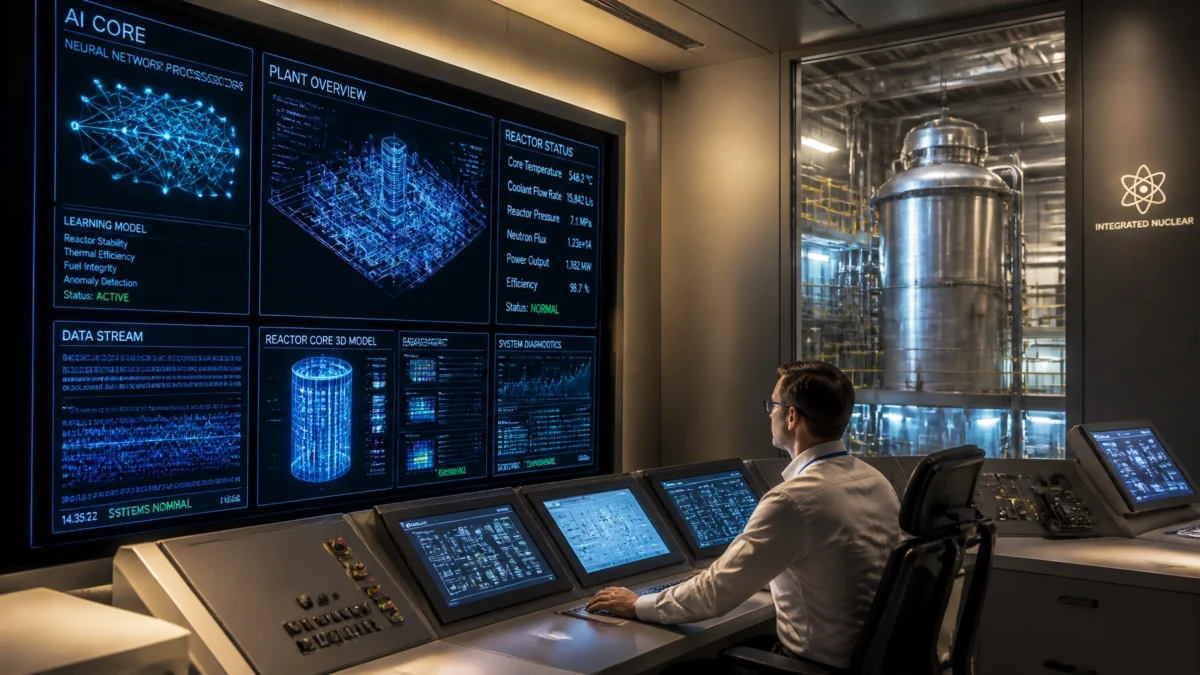
Engineers and data scientists within the consortium are deploying advanced multi-agent machine learning architectures and digital twins to streamline four critical phases of development. First, AI-assisted design and engineering tools are being built to optimize core physics, thermal hydraulics, and material durability under extreme operating conditions. Second, AI-enabled regulatory and licensing workflows are being trained on decades of historical safety documentation, transforming unstructured archival records into searchable, model-ready datasets that dramatically accelerate compliance filings.

Third, manufacturing and construction methodologies are being overhauled through predictive modeling. By simulating fabrication sequences before physical ground is broken, project teams aim to achieve a threefold reduction in manufacturing cycle times for reactor pressure vessels and containment structures. Fourth, semi-autonomous operational monitoring systems are being developed to manage plant diagnostics and routine maintenance with minimal on-site staffing, reducing ongoing operational expenditures by half.
Bridging Traditional Hydrocarbons and Advanced Fission in the Modern Grid
As an industry publication dedicated to comprehensive energy analysis, SHALE Magazine consistently emphasizes that grid reliability requires an all-of-the-above resource mix. The integration of artificial intelligence into nuclear engineering is not occurring in a vacuum; it directly supports the massive baseload power requirements demanded by modern heavy industry, manufacturing renaissance hubs, and energy-intensive computing infrastructure.
While traditional oil, natural gas, and midstream logistics remain the foundational backbone of the global energy economy, advanced nuclear energy provides the zero-emission firm power necessary to stabilize grids experiencing unprecedented load growth. As noted in recent Energy Information Administration outlooks and Federal Energy Regulatory Commission filings, maintaining grid resilience amid accelerating electricity demand requires rapid deployment of reliable, dispatchable generation sources.

The collaborative nature of Project Prometheus ensures that lessons learned from decades of fossil energy project management and heavy civil construction are directly leveraged by nuclear pioneers. Firms like Kiewit Nuclear Solutions bring decades of heavy industrial construction expertise to the table, ensuring that AI-driven digital models align with real-world constructability standards in the field.
Strategic Implications for Global Energy Markets and Policy Makers
The launch of Project Prometheus carries profound geopolitical and economic implications. As global competitors race to export advanced nuclear technology to developing nations, the United States must demonstrate that advanced reactors can be built on time and within budget. By standardizing AI workflows and data infrastructure across multiple reactor designs, the DOE-led consortium is creating a replicable blueprint that benefits the entire domestic nuclear supply chain.

Industry stakeholders, financial analysts, and policy makers monitoring these developments should recognize that Prometheus marks a permanent shift in how energy infrastructure is financed and built. The transition from bespoke, one-off engineering projects to standardized, AI-optimized modular manufacturing represents a fundamental maturation of the advanced nuclear sector. As negotiations proceed between the Department of Energy and project awardees, the energy economy stands on the precipice of a new era where speed, safety, and economic viability converge.
Keep In Touch with Shale Magazine
As the new era of energy unfolds, you can bet we’ll be the boots on the ground to keep you informed. Subscribe to Shale Magazine for sharp insight into the arenas that matter most to your life. And don’t forget to listen to our riveting podcast, The Energy Mixx Radio Show, where our very own Kym Bolado interviews the most extraordinary thought leaders, business innovators, and industry experts of our time.
Subscribe to get more posts from Amanda Jenkins