
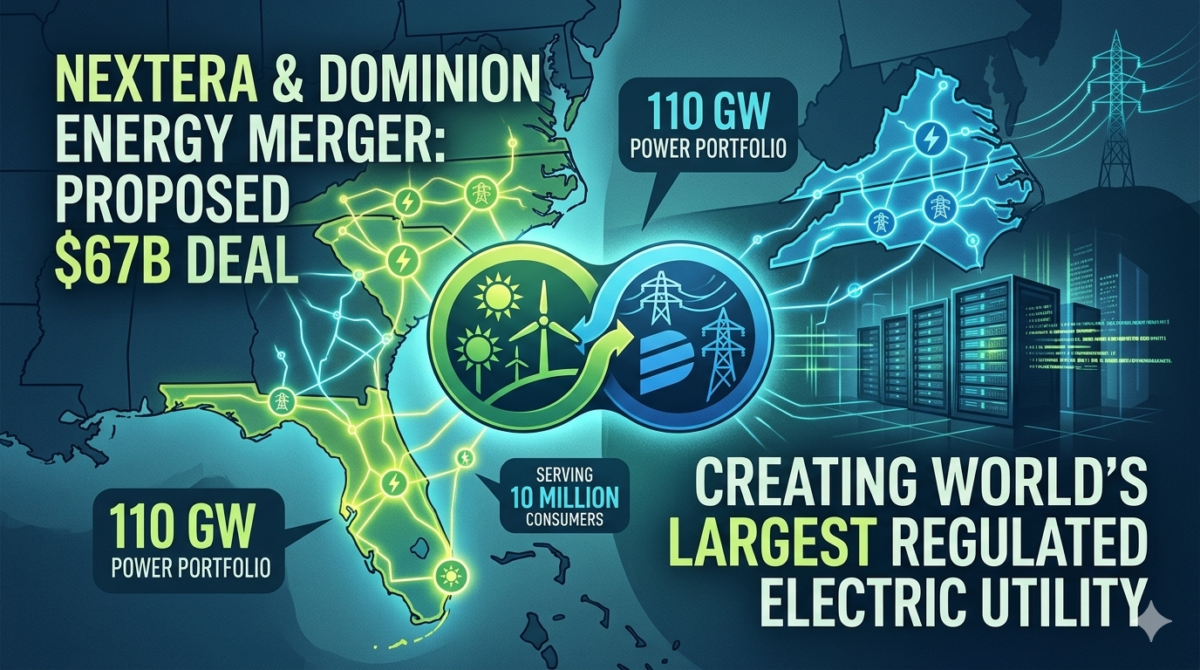
NextEra and Dominion Energy announced on May 18th plans to merge, which could create the world’s largest regulated electric utility business, according to the companies. While the merger still requires approval from state and federal regulators, it could mark an era of change for customers in Florida, Virginia, North Carolina, and South Carolina.
How Will the Merger Look?
NextEra’s purchase of Dominion Energy for $67 billion in an all-stock deal is expected to create the third-largest energy company in the United States.
The combined company is expected to have a portfolio of around 110 gigawatts (GW) of power generation across various energy sources, and serve around 10 million consumers in Florida, Virginia, North Carolina, and South Carolina.
To achieve the merger, the two firms must gain approval from several local, state, and federal regulatory agencies, which will assess the potential impact of the move on consumer energy bills. Completing the merger could take as long as 12 to 18 months.
In a joint statement, the two firms said that the combined company would prevent rates from swelling and proposed $2.25 billion in bill credits over two years for Dominion customers in Virginia, North Carolina, and South Carolina.
“With the concerns about affordability throughout the country, the key issue here is keeping rates down, and keeping the growth affordable,” explained Paul Patterson, an energy analyst at Glenrock Associates LLC.
Power Demand Concerns
Due to rising inflation and recent global energy supply chain disruptions, U.S. consumers are growing increasingly concerned about energy prices. Some fear that less competition could lead to further price increases.
Patterson said that growing consumer concerns around energy demand, rising energy prices, and the rapid development of data centers across the United States will be considered by regulators when deciding whether to approve the merger.
Similarly, Darrell West, a senior fellow at the Brookings Institution’s Center for Technology Innovation, explained that “anytime there’s a merger, there’s a worry consumers might face raising rates.”
Dominion currently serves consumers in the northern Virginia area, which has become known as “Data Center Alley” due to the rapid rollout of new data centers in the region. This development has led the power demand in the region to soar over the past few years, growing at an annual rate of 3.1% between 2019 and 2024, at more than three times the national average of 0.9%, according to data from the U.S. Energy Information Administration.
Increased power demand in Virginia has driven consumer energy bills up by over 20% in the last two years, while the power supply has stagnated.
If the merger goes ahead, the combined company is expected to pursue its ambitious data center ambitions, using Dominion’s expertise and existing relationships.
NextEra announced in January that it was considering expanding its nuclear fleet to deliver electricity to data centers. This came after the firm announced last year that it would be restarting its Duane Arnold nuclear power generating station in Iowa to power Google data centers.
Despite consumer fears of data centers’ power use and rising energy costs, NextEra Energy’s CEO, John Ketchum, said in a May press release that the larger scale and efficiencies attained from the merger would translate “into more affordable electricity for our customers in the long run.”
However, not everyone is so certain about this expectation. Shelby Green, a research and communications manager at the Energy and Policy Institute, pointed out that in a previous merger involving NextEra Energy, customer rates did indeed go up.
“Families and small businesses can expect to pay more in their utility bill, and that’s a major concern if this acquisition goes through,” said Green.
Concerns over NextEra’s Track Record
While consumers are mainly concerned about potential energy bill increases, the advocacy group Clean Virginia worries about NextEra’s “deeply troubling track record” in Florida, where the firm’s subsidiary utility Florida Power & Light (FPL) operates. Clean Virginia is concerned that, based on past actions in other states, NextEra may be more concerned about its profits than what is best for consumers.
FPL cut power to almost 1.3 million homes in 2024 when customers couldn’t afford to pay their bills. When Florida legislators filed a bill to ban shutoffs during life-threatening weather events, FPL registered to lobby against it. This is particularly concerning given the increasing prevalence and severity of severe weather events across the United States.
FPL also lobbied against another piece of legislation, which would have capped utility profits and required regulators to consider affordability when setting rates.
At a time when consumers are increasingly struggling to pay their ever-rising energy bills, and concerns over data center energy use continue to mount, regulators must focus on affordability. When assessing whether the NextEra-Dominion merger should go ahead, regulators must evaluate the potential impact on consumers, in addition to the overall expansion of U.S. power.
Keep In Touch with Shale Magazine
As the new era of energy unfolds, you can bet we’ll be the boots on the ground to keep you informed. Subscribe to Shale Magazine for sharp insight into the arenas that matter most to your life. And don’t forget to listen to our riveting podcast, The Energy Mixx Radio Show, where our very own Kym Bolado interviews the most extraordinary thought leaders, business innovators, and industry experts of our time.


How will this merger impact thousands of Dominion stockholders who have invested relative small thousands of dollars in Dominom?