By Kym Bolado
CEO, Energy Network Media Group
When I read the proposal to send every Texas household a one-time $1,500 check by drawing approximately $17 billion from the state’s Economic Stabilization Fund, better known as the Rainy Day Fund, I immediately thought back to one of the most difficult chapters in modern Texas history.
Many Texans have forgotten what that looked like.
I haven’t.
Long before I founded Energy Network Media Group, I worked in the nonprofit sector serving individuals living with mental illness and their families. During the budget crisis that followed the Great Recession, I watched firsthand what happens when a state is forced to make painful financial decisions.
Texas entered the 2011 legislative session facing an estimated $27 billion budget shortfall. Unlike the federal government, Texas cannot simply borrow its way out of a deficit. Our Constitution requires lawmakers to pass a balanced budget before they can conduct the state’s business.
That reality forced difficult decisions.
School districts reduced staffing and implemented hiring freezes. State agencies tightened their budgets. Health and human services programs were cut. Local governments struggled to maintain services.
Those weren’t just numbers on a spreadsheet.
They changed lives.
One of the most heartbreaking things I witnessed involved our mental health system.
Many people couldn’t get an appointment with a psychiatrist for two or three months, even though the medications they relied upon had to be renewed every month. With nowhere else to go, they turned to hospital emergency rooms, not because they had suffered a heart attack or been injured in a car accident, but because they had simply run out of options.
Emergency rooms became overcrowded. Families struggled to find help. Doctors and nurses were trying to manage problems that should have been handled through routine mental healthcare.
I also watched community programs that served seniors struggle to survive. Organizations that helped older Texans with meals, transportation, and utility assistance were stretched to their limits. Law enforcement agencies operated under tighter budgets. Schools worried about losing teachers while communities worried about losing vital public services.
That’s what a budget crisis looks like.
It isn’t a political talking point.
It’s something that touches every family in one way or another.
Fortunately, Texas is in a much different position today.
One of the biggest reasons is our energy industry.
The shale revolution transformed the Texas economy. Oil and natural gas production generated billions of dollars in severance tax revenue, helping build the Economic Stabilization Fund into one of the strongest reserve funds of any state in the nation.
That didn’t happen by accident.
It happened because Texas planned ahead.
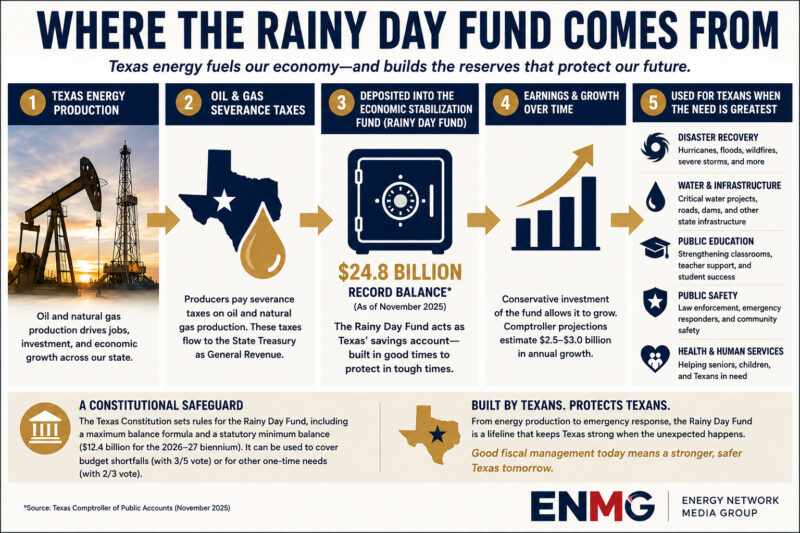
The Rainy Day Fund was created in 1988 to help our state respond to extraordinary circumstances. Over the years it has been used for disaster recovery, water infrastructure, public education, and other one-time investments that strengthen Texas for the long term.
That is very different from sending one-time checks.
I understand why families would welcome an extra $1,500. Inflation has affected everyone. Grocery bills are higher. Insurance costs continue to climb. Housing has become more expensive.
Those challenges are real.
But good public policy requires us to think beyond today’s headlines.
Ask yourself a simple question.
What if another Hurricane Harvey struck tomorrow?
What if another Winter Storm Uri left millions of Texans without electricity and water?
What if Texas experienced another major recession?
Would we feel comfortable knowing we had already spent roughly two-thirds of our financial reserves?
The next emergency won’t wait for the Legislature to meet.
The next disaster won’t arrive on anyone’s political timetable.
There is another reason Texans should think carefully before reducing the Rainy Day Fund.
Water.
In my opinion, water may become the single greatest challenge facing Texas over the next several decades.
From West Texas to South Texas, from the Hill Country to our rapidly growing metropolitan areas, communities are facing increasing pressure on their water supplies. Population growth continues. Drought conditions have become more frequent. Reservoirs are under stress. Aging infrastructure must be repaired or replaced. New water supplies, including desalination, water recycling, groundwater development, pipelines, and new reservoirs, will require billions of dollars in long-term investment.
This isn’t speculation.
It’s already happening.
In fact, the Rainy Day Fund has already helped address this challenge. Texas lawmakers previously used the fund to help establish long-term financing for statewide water infrastructure because they recognized that water security is one of the state’s most important responsibilities.
That’s exactly how this fund should be used.
Not for temporary relief, but for long-term investments that protect every Texan.
If Texas finds itself with financial resources beyond what is needed for emergencies, I’d rather invest those dollars in making sure our children and grandchildren have reliable water supplies than send checks that will be spent in a matter of weeks.
Some have argued the state is “hoarding” money.
I see it differently.
Texans don’t cancel their homeowners insurance because they haven’t had a fire.
They don’t cancel flood insurance because it hasn’t rained in months.
They keep insurance because they know disasters don’t announce themselves in advance.
The Economic Stabilization Fund serves that same purpose for nearly 32 million Texans.
It allows our state to respond after hurricanes, floods, wildfires, freezes, and economic downturns. It protects education, public safety, healthcare, infrastructure, and the essential services our communities depend upon.
Most importantly, it reminds us why Texas energy matters.
Every dollar deposited into the Rainy Day Fund tells the story of our state’s energy industry. Oil and natural gas production have done far more than create jobs and strengthen our economy. They have helped build the financial foundation that allows Texas to prepare for uncertainty instead of reacting to it.
The Rainy Day Fund is one of the greatest examples of responsible fiscal management in our state’s history.
We built it because previous generations understood that prosperity doesn’t last forever.
Let’s not forget the lessons they learned.
The Rainy Day Fund isn’t a surplus.
It’s Texas’ insurance policy.
It protects us after disasters. It helps stabilize government during economic downturns. It allows Texas to invest in the infrastructure that will shape our future—including something as fundamental as water.
Insurance only matters when the storm arrives.
Water only matters when it doesn’t.
Keep In Touch with Shale Magazine
As the new era of energy unfolds, you can bet we’ll be the boots on the ground to keep you informed. Subscribe to Shale Magazine for sharp insight into the arenas that matter most to your life. And don’t forget to listen to our riveting podcast, The Energy Mixx Radio Show, where our very own Kym Bolado interviews the most extraordinary thought leaders, business innovators, and industry experts of our time.
Subscribe to get more posts from Kym Bolado