
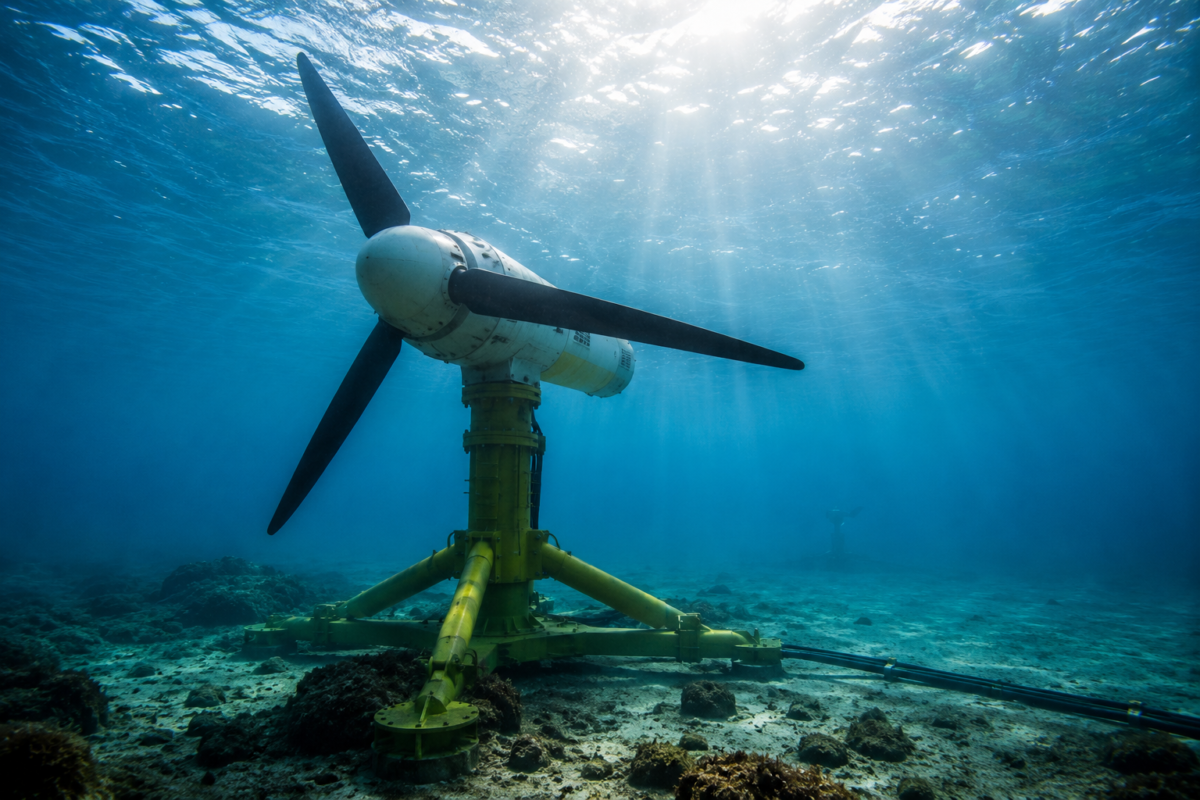
Marine energy, or tidal energy, is a little-known source that is growing steadily worldwide. Despite cutting funds for several renewable energy sectors, the United States Department of Energy (DoE) continues to back marine energy, with new funding programs announced this year.
Marine Energy Overview
Certain bodies of water can be used to produce electricity by using a wave energy converter to capture and convert wave energy. Some devices are positioned under the water’s surface; others are anchored to the ocean floor; while another technology pushes waves through a narrow channel to power a turbine.
Waves have the highest energy density of a renewable energy source, meaning there is significant potential to harness their power to produce abundant, clean energy. Unlike less stable renewable energy sources, such as wind and solar power, tides are highly predictable, with a high and a low tide occurring twice every day.
However, due to a lack of interest in marine energy, its development has fallen behind several other green energy sources, meaning that greater investment must be made in research and development to expand tidal energy capacity.
Several countries, including Australia, China, Denmark, Italy, Korea, Portugal, Spain, the United Kingdom, and the United States, are currently developing their marine energy sectors.
The U.S. Energy Information Administration (EIA) estimates that the waves around the United States coasts could be sufficient to provide 66% of the country’s electricity if exploited.
Challenges for Harnessing Tidal Energy
Several challenges to constructing marine energy projects have deterred companies and governments from pursuing the development of the clean energy source in the past.
Developing and operating tidal energy facilities is typically quite expensive. There are also environmental concerns around the use of cables, turbines, and other infrastructure in bodies of water, which could harm marine life. Further, many coastal populations have opposed project development due to the common “not in my backyard” stance to unfamiliar energy projects.
Significant investment is required to scale up tidal energy for commercial rollout. The International Energy Agency (IEA) suggests in its Ocean Power tracking report that using marine energy to help the world reach carbon neutrality by 2050 would require an average capacity growth of 33% a year between 2020 and 2030. “Marine technologies hold great potential, but additional policy support for energy research, development and demonstration is needed,” the IEA states.
Nevertheless, greater investment in research and development could help develop marine energy in the years to come and help to diversify the energy mix.
Marine Energy Growing in the U.S.
In May, the U.S. Testing Expertise and Access to Marine Energy Research (TEAMER) program approved a record 34 marine energy projects through its 17th Request for Technical Support, at a value of $4.8 million.
TEAMER is backed by the DoE and managed by the Pacific Ocean Energy Trust. Its aim is to support marine energy development by enhancing access to national research infrastructure to tackle technical barriers and accelerate the deployment of the energy source.
The technical support recipients will be given the tools to conduct research and development into tidal power at TEAMER facilities. The companies approved to develop projects include Equinox Ocean, Ocean Energy USA LLC, and Orbital Marine Power, among others.
Small-Scale Projects Contribute to Research
Several U.S. states are developing small-scale marine energy projects to explore the potential for new technologies in the sector. This is particularly being seen in rural areas without easy access to conventional energy sources.
In Michigan, Beaver Island is situated at the northernmost end of Lake Michigan, around 70 miles from the maritime border with Canada. It has around 600 permanent residents and is popular in the summer among tourists. It is only accessible by boat or plane, and getting electricity to the island is no easy feat.
Power is provided to Beaver Island via cables from mainland Michigan, crossing around 30 miles of lakebed. For this reason, power outages are a common occurrence during severe weather events or when wires break. A 2025 ice storm resulted in Beaver Island losing power for several weeks. This has led researchers to look for alternative energy sources to help prevent future outages.
In June, researchers from the University of Michigan deployed two devices that were designed to convert the kinetic energy of waves into electricity. The prototypes look like small boats with a PVC frame and measure around two feet. During the demonstration, researchers successfully used the technology to power a lightbulb and charge a cell phone.
The researchers have been working closely with the island’s community to understand their needs and the resources available. Lei Zuo, the lead researcher on the project, explained, “We need to work with the community together to identify the need and design together with them.”
Beaver Island is just one example of a rural community that could use tidal power to provide a stable source of electricity where one is not currently available. Developing more projects like these could also enhance research and development in U.S. marine energy.