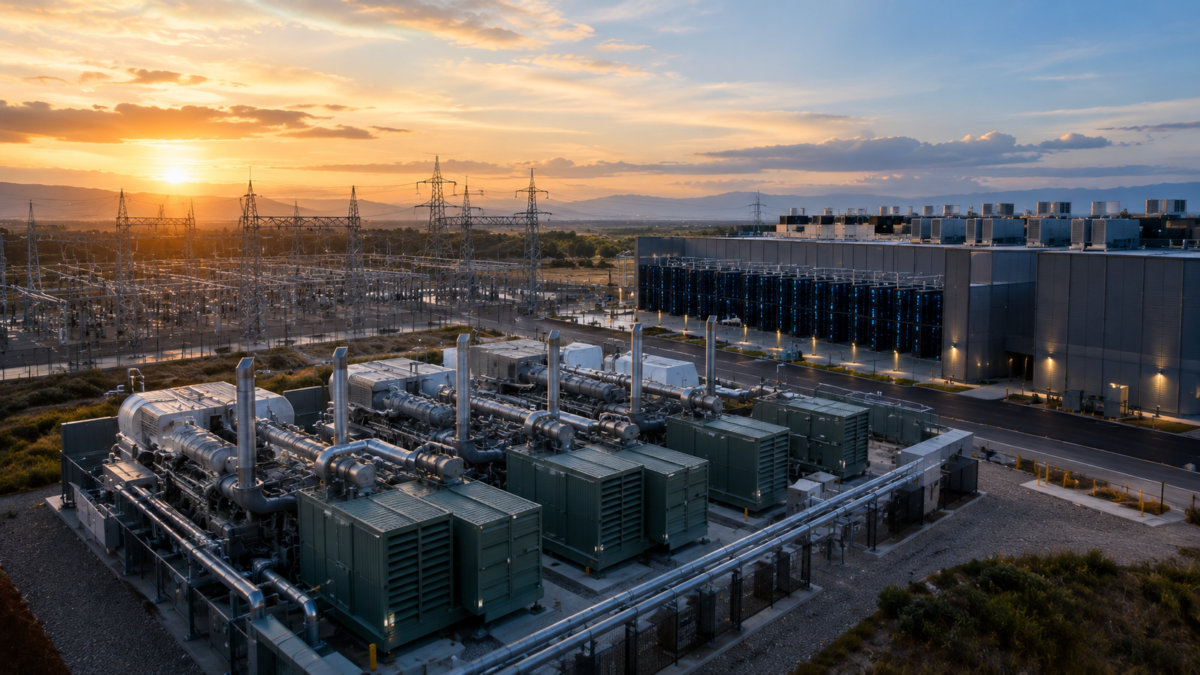
Data center developers are slowly but finally contending with building their own on-site electricity generation to power campuses. When a data center wants to drop 300+ MW of load in one place, and the utility serving that load is continuously re-assessing the new transmission and generation required to support it, and arbitrating, very publicly, who pays for it and when, data center projects are easily and regularly upended.
Some grace is due to the utilities and transmission operators managing this influx. Take Dominion Energy Virginia as an example: as of year-end 2024, Dominion had 40GW of data center load requests in its planning queue, against observed data center load of less than 4GW and existing generating capacity of 27GW. [1] Every landowner with flat land and a transmission line crossing their property now believes they’re sitting on the next data center megasite. When powered land deals (formerly agricultural land) in Loudoun County trade at $1M+ an acre, against a basis of $10K an acre, you understand why farmers, powered land flippers, and genuine third-party data center developers and hyperscalers are all flooding utilities with visionary interconnection requests, asking them to double the infrastructure they’ve spent 80 years building.
Figure 1. Dominion Energy Virginia: Installed Capacity vs. Data Center Load vs. Interconnection Queue (GW, year-end 2024)
 |
/Source: PJM generating capacity in the DOM Zone as of March 2026. Dominion Energy queue data from State Corporation Commission Rate Case, year-end 2024.
That’s not an easy ask for utilities, especially when they’re defending against the narrative that data centers are driving up everyday residents’ bills. Utilities want the load, but they want real load, and separating the two is difficult when unsuspecting landowners land real projects with real hyperscalers, and tenured third-party developers regularly fail. Dominion knows not all 40GW of that queue will land, but picking which powered land projects will succeed and fail, and which worthy projects they will make long-lead infrastructure investments around, is incredibly difficult.
Put this in context: a third-party data center developer normally begins tenant negotiations two years out from the “date certain” power will turn on. Because power markets are so tight, the concept of “date certain” is nonexistent. Powered-land flippers now market deals knowing an egregious amount of uncertainty exists, articulating their knowledge of what those uncertainties are, and as a hedge, are starting to articulate a developer’s ability to produce power on-site from gas generation and fuel cells.
Here’s the honest framing: hyperscalers are tech companies at heart. They are not developers, and they are not power producers. They are power-informed partners, forced, and often unequipped, to understand, build, and operate power production facilities themselves. That’s a problem when they’re trying to build gigawatt campuses that rival the largest generating asset that exists in a utility’s service territory.
Hyperscalers can outbid every third-party developer for power reservations and post the egregious letters of credit utilities now require, but they don’t have the patience to start greenfield development – to take raw land and convert it to data-center-ready land, now, a 4–7 year process. That’s why roughly half of all hyperscale data center capacity is still built and owned by third-party data center developers – Vantage, CloudHQ, Digital Realty and the like – rather than by the hyperscalers themselves. [2] But that split is already moving: AWS, Google, Meta, and Microsoft’s credit and balance-sheet advantage is pulling more of that capacity toward self-builds every year. Layer on-site power into that picture and the gap gets sharper still, because almost none of the third-party developers holding that other half are also fluent in gas generation.
Now, every powered-land deal that’s marketed to developers includes a story about how easy (or difficult) an on-site gas generation solution could be to stand up. Very few of those projects are actually under construction, and the ones that are, are being led by unsuspecting players. We’ll explore why that’s the case across hyperscalers, third-party data center developers, equipment providers, and power producers. But first, some background on why on-site gas generation is such a hard problem to solve in the first place.
Table 1. On-Site Gas Generation for AI Data Centers: Active U.S. Projects
 |
/Source: Pen Holdings On-Site Gas Generation Tracker, compiled from company press releases, trade press, and regulatory filings, June–July 2026. Williams is the only pipeline/midstream company in this list operating its own dedicated generation subsidiary — see Section 3b.
Why On-Site Gas Generation Is Hard
AI Load Is Brutally Volatile
Data center loads, particularly AI training and inference loads, are volatile in a way traditional data center load never was. NVIDIA’s own engineering team puts it plainly: “the power draw of a rack can swing from an ‘idle’ state of around 30% to 100% utilization and back again in milliseconds.” [3]
A 300MW load that swings 70% in milliseconds is a logistical nightmare even for a utility running 27GW of diverse generation – gas peakers, nuclear, wind, solar – across a robust transmission network. For an islanded facility, not interconnected to the broader transmission system, with no other generating assets available to it, that same swing hitting a much smaller base of equipment can do really expensive damage.
It’s Enormously More Expensive
So what’s the fix for load volatility on an islanded system? Over-install equipment. Extra spare generating units, extra batteries, extra synchronous condensers, all sized to a reliability standard the utility grid otherwise delivers for free across a diverse asset base.
Take a representative example: a gas-gen power block serving a 120MW IT-load building. At a 1.4 PUE, 165MW needs to be delivered at five-nines reliability – the additional megawatt draw covers everything running outside the data hall, including electrical and mechanical equipment. To hit that reliability level, you’re buying 253MW of Bergen reciprocating engines (11.5 MW per unit) — 22 engines total, of which 17 run 24/7 and the rest sit on spinning reserve or full redundancy so the plant can absorb maintenance cycles and operating issues without missing a beat. For a non-interconnected data center power solution, you’re buying 22 units to reliably deliver 17 units’ worth of power (+30% in equipment expense). If you’re talking about a Siemens simple-cycle SGT-750, providing 40MW per unit, you’re procuring 6 turbines for 4 turbine’s-worth of reliable power (+50% in equipment expense). In both examples, you’re building a ~250MW power plant to serve a ~120MW data center. That reality is why an on-site generation offering runs anywhere from 80% to 200% more expensive than the utility bill a tenant is used to paying.
Figure 2. Sizing a Gas-Gen Power Block to Serve 120MW of IT Load
 |
The technology choice matters, too: reciprocating engines offer the best turndown for a volatile load but carry the worst NOx profile, open-cycle turbines trade some of that flexibility for a cleaner NOx profile and less maintenance, and combined-cycle turbines have the best heat rate of the three but are the slowest to install and the least suited to a swinging load – which is exactly why you don’t see them behind the meter today.
Traditional Power Producers Aren’t Built for This
A generating asset built to serve millions of utility customers looks nothing like the configurations data centers are piloting behind the meter. Dominion’s own proposed Chesterfield Energy Reliability Center — leverages four 250MW GE 7FA.05 simple-cycle turbines for its 1,000MW project. It’s a transmission-interconnected asset built to serve its +6M customer base [4]. That power plant is a very different animal from a 250MW, 22-unit reciprocating engine power block sized to ride out one data center building’s volatile load.
Figure 3. Comparing a Utility-Scale Gas Generating Facility to a Behind the Meter AI Load
 |
That’s why the on-site gen project tracker above is missing the power production names you’d expect. There’s no NRG, no Southern, no Dominion, no Duke leading a behind-the-meter gas project for data centers. Instead, you see unsuspecting names: Williams, primarily an upstream gas producer and pipeline company, building and operating its own dedicated generation subsidiary; Chevron, an oil and gas major with decades of experience running islanded 10–20MW generating facilities at remote production sites, extending that competency into data center power; and VoltaGrid, an “energy-as-a-service” gas-microgrid specialist that didn’t exist in this form five years ago. These companies are filling the gap traditional IPPs and regulated utilities haven’t been bold enough to step into yet, leaning on adjacent experience (islanded oilfield generation, or EAAS microgrids built for remote industrial sites) rather than utility-scale plant design.
Table 2. Power Producers Leading On-Site Gas Generation for Data Centers
 |
/Source: Pen Holdings On-Site Gas Generation Tracker, June–July 2026.
Data Center Developers & Hyperscalers Are Slow to Adopt Something This New
Islanded power generation assets for data centers are challenging engineering builds, and they’re new. Relying on an incumbent utility with billions of dollars of existing assets to power a site is objectively less risky than piloting an islanded asset to meet the moment’s demands with a vendor list this unproven. When the utilities hyperscalers are used to dealing with aren’t included in on-site generation offerings, offtakers get nervous. And until about six months ago, many hyperscalers were still carrying ESG commitments that precluded them from owning the CO2 and emissions burden of a gas plant whose sole purpose is powering their data center.
It also comes with new permitting and development challenges: xAI’s Colossus facility in Memphis is the clearest public example of how fast this can go sideways. Aerial imagery in April 2025 showed xAI had stood up 35 gas turbines behind Colossus 1, a mix of VoltaGrid’s 2.5MW units and Solar Turbines’ 16MW SMT-130s, for a combined 422MW, the vast majority running without air permits. The Southern Environmental Law Center sent a Clean Air Act notice of intent to sue; xAI removed the unpermitted units and later obtained permits for the 15 that remained. At Colossus 2, across the state line in Southaven, Mississippi, xAI stood up 27 more turbines (up to 495MW), also without permits, triggering an NAACP/Earthjustice lawsuit — and in mid-2026 the Department of Justice intervened to keep those turbines running, citing national security. [5] Whatever you think of the politics, the operational lesson holds: xAI built first and permitted later, at a scale that outran what local regulators were prepared to review. That’s the behind-the-meter risk in miniature. The constraint isn’t only engineering — it’s regulatory speed running headlong into construction speed.
Developers Must Build Competency Here, Or They’re Outsourcing Their Power Destiny
Community hostility toward a conventional data center is already high, and it accelerates fast once you’re proposing to build a large, noisy gas plant next to it — ask the residents fighting Vantage’s Loudoun County campus, or the groups like the Sierra Club and Piedmont Environmental Council organizing against it. [6] Despite these new (and very material) challenges with on-site gas generation, as utility connections keep slipping and come with collateral requirements many developers can’t absorb (Dominion, for instance, requires every data center connection to hold $1.5M/MW of collateral for an undisclosed period ahead of an executed energy contract) [7], third-party developers (and hyperscalers) need a real framework for power self-sufficiency. It’s expensive, yes, but data centers are relatively price-insensitive customers.
Here’s the vision for third-party developers: market a coherent power-block design to serve data centers with power generation on-site, get tenants comfortable enough to sign a lease for it, use their credit to make equipment deposits, avoid as much of the regulatory apparatus as you can, and get electrons moving.
Few third-party developers have demonstrated that competency yet – and the ones that do are the best positioned to continue building. It also addresses a huge PR pain point – a data center cannot be accused of stealing power from ratepayers when it’s not touching the integrated grid.
Who Wins and Who Loses
Four groups are racing for position here: equipment makers, power producers, third-party developers, and the hyperscalers themselves.
Equipment: Right-Sized Wins
Which OEMs win, and which lose? Appropriately sized units win. If you’re serving a 120MW IT building, buying an additional 10-50MW unit is more palatable than buying a spare 500MW unit to meet your reliability target. No data center should host a 500MW Vernova 7HA combined cycle unit for power– that’s too large a share of the plant’s total capacity to have at risk at once.
As building sizes grow, the OEMs that win will keep shifting, but today, the equipment driving the behind-the-meter boom sits in the 10–50MW range. The smaller the units are, the more flexibility you have with managing outages and the resulting requirement for additional units. One caveat – that dynamic is tempered by the complexity of having additional operating complexity for a multi-unit generating facility. In my example above, it’s easier to manage 6 pieces of SGT-750 equipment than managing 22 reciprocating engines, but that ease comes at a cost: the turbine option overprocures by 50%, while the reciprocating option overprocures by only 30%. That’s a tradeoff.
Table 3. OEM Equipment for 10–50MW Behind-the-Meter Generation
 |
/Source: OEM public specification sheets and press releases, compiled July 2026.
The Williams Socrates project in Ohio is a useful real-world cross-check on which equipment actually gets specified: three Solar Turbines Titan 250s, nine Solar Turbines PGM 130s, three Siemens Energy SGT-400s, and fifteen Caterpillar 3520 reciprocating engines — a blend of open-cycle turbines and recips, all comfortably inside the 10–50MW band, and notably nothing from a large-frame combined-cycle vendor. [8]
Power Producers: First Movers Get Repeat Business
The producers building construction and operating experience with the specific nightmare of an islanded data center power asset first are the ones winning. Williams is the clearest example. Its Socrates South project in New Albany, Ohio, two 200MW behind-the-meter facilities dedicated entirely to a Meta affiliate, with zero physical grid connection, was approved by Ohio regulators in June 2025. [9] Williams didn’t stop there: its Q1 2026 earnings materials disclose a fifth “Power Innovation” project, Neo, a 682MW, $2.3B build under a 12.5-year contract targeting service in the second half of 2028, described by the company as its largest behind-the-meter build to date, with additional named projects (Socrates North, Atlas, Silver Spur) already in the pipeline. [10] A midstream gas company that had never operated power generation for a third party is now doing it on a repeatable, named-project basis. That’s what a winner looks like in this category: not one clever deal, but a model built to run again.
VoltaGrid is the second name worth watching closely, precisely because it isn’t tied to one hyperscaler or one developer. It’s the gas-microgrid partner behind Vantage’s 1GW+ multi-site portfolio (including the Shackelford County, Texas campus serving OpenAI), a 2.3GW modular gas fleet for Oracle Cloud Infrastructure backed by Energy Transfer pipeline supply, and some of the 2.5MW units running behind xAI’s Colossus 1 in Memphis. [11] A five-year-old company now shows up across four of the biggest hyperscale gas-gen efforts in the country, and just took a $1 billion strategic investment from Blackstone and Halliburton to keep scaling. [12] That’s a company compounding the exact experience curve this piece keeps coming back to.
Third-Party Data Center Developers: If You’re Not in the Game Already, You’re Being Left Behind
The developer with the most working experience in this on-site generation today is Vantage Data Centers, and it isn’t close. Vantage shows up three separate times in the project tracker above, each with a different partner and a different outcome: a VoltaGrid-powered San Antonio campus with an unconfirmed hyperscaler tenant, the Shackelford County “Frontier” megacampus built for OpenAI (also VoltaGrid), and the Loudoun County VA2 campus in Virginia, which has been running its own gas turbines continuously since March 2025. [13]
Crusoe is the other developer with real – if uneven – experience: its Abilene “Stargate” campus already has GE Vernova turbines running behind the meter for Oracle Cloud Infrastructure, with Microsoft since stepping into the expansion capacity Oracle and OpenAI walked away from. STACK Infrastructure’s experience cuts the other way – its Project Jupiter campus in New Mexico was originally planned around 700-900MW of gas turbines, but STACK pulled the plug on that plan in April 2026 and pivoted to Bloom Energy fuel cells instead, after the gas pipeline right-of-way it needed got tangled up in permitting. That’s a cautionary tale as much as a track record.
What’s notable: there are many, many, large, incumbent data center developers whose name is not behind a single gas generation project. That’s a competency deficit that needs to be resolved as hyperscalers go directly to Williams, VoltaGrid, and Crusoe to do it for them. The universe of 300MW+ utility-connected sites grows smaller and smaller – if a developer isn’t positioned to develop an on-site generation offering themselves, their days of new builds will be limited as the hyperscalers writing the checks are quietly building the same competency.
Figure 4. Who’s Actually Doing On-Site Gas Generation? Top Developers by Active IT Capacity
 |
Hyperscalers: xAI & Meta Leaned in First, Giving Them an Operating Edge
xAI deserves industry-wide credit for being the first mover. The design, construction, and operating experience they piloted paid dividends for the industry – shaping equipment selection and design for subsequent projects. Meta followed thereafter, and now has two real projects under construction. A name that’s notably absent – Amazon. If they announced a gas-project tomorrow, they’d have four years less experience building and operating one of these things than its competitors. That’s a distinct competitive disadvantage, because these systems and configurations are complicated – knowing how to do them well, without disrupting compute operations, is not an easy feat.
Google should get credit for buying a power development platform outright, and it has projects moving, but its deployment strategy is focused on renewables, with gas in a minority, backup role. They haven’t disclosed gas capacity, turbine OEM, or a firm in-service date so we’ll see how deep into gas-gen they ultimately get.
Figure 5. Hyperscalers Are Cutting Out the Middleman: Direct Power Deals, 2024-2029
Source: Williams Companies; Entergy Louisiana; GlobeNewswire; PowerMag; Chevron Newsroom; Data Center Dynamics, compiled July 2026.
 |
Where This Goes Next
Twenty-four months ago, nobody was talking about on-site generation for data centers, in front of or behind the meter. When xAI announced Colossus in June 2024, the idea read as absurd. xAI was the first mover, and, permitting fights aside, it will be remembered as the project that proved the model could be built fast, even if it proved that the hard way. Every developer, producer, and OEM in this piece is racing to be the vendor of choice for the next thirty projects like it, not just the first one.
What I’m watching over the next 12 months: (1) beyond Williams and VoltaGrid, which power production companies will drive new behind the meter projects. This theme could disrupt the entire utility ecosystem – if data center load growth becomes entirely satisfied by on-site generation, the growth engine of any traditional utility or power producer is brought next to zero, and its stock will reflect that eventually. (2) which other third-party data center developers figure out this development competency, pushing out less power-informed developers today. (3) what power gen modalities this expands to after the industry is comfortable with gas – on-site nuclear, geothermal, etc., become the next flavor of development and investment opportunities for data centers.
About the author:
Bella Warwick Director – Data Centers, Powered Land, and Power Brokering
As the Director of Greysteel’s Data Center, Powered Land and Power Brokering practice, Bella Warwick has deep experience supporting data center developers, hyperscalers, and power producers execute real estate transactions and mature infrastructure development. Prior to Greysteel, Bella lead site acquisitions for CloudHQ, a global hyperscale data center developer. There she managed the company’s first collocated gas generation-data center project – managing gas transportation and commodity solutions, equipment selection and power plant design, and commercial sales efforts. Bella leverages that experience to support data center developer clients execute similar projects and solutions across the country.
As the Deputy Chief of Staff to Virginia Governor Glenn Youngkin from 2022-2025, Bella oversaw the Governor’s energy portfolio – working with regulated utilities, merchant power producers, Regional Transmission Organizations, the State Corporation Commission, the Office of the Attorney General, and ratepayers to manage the influx of unprecedented load growth from AI and electrification. Ms. Warwick began her career in finance, and worked in M&A advisory, equity and debt financings, and sponsor investments for Morgan Stanley and Stone Point Capital.
Keep In Touch with Shale Magazine
As the new era of energy unfolds, you can bet we’ll be the boots on the ground to keep you informed. Subscribe to Shale Magazine for sharp insight into the arenas that matter most to your life. And don’t forget to listen to our riveting podcast, The Energy Mixx Radio Show, where our very own Kym Bolado interviews the most extraordinary thought leaders, business innovators, and industry experts of our time.
Subscribe to get more posts from Isabella Warwick