Last Energy PWR-5 Clears DOE Safety Analysis
ENMG Analysis
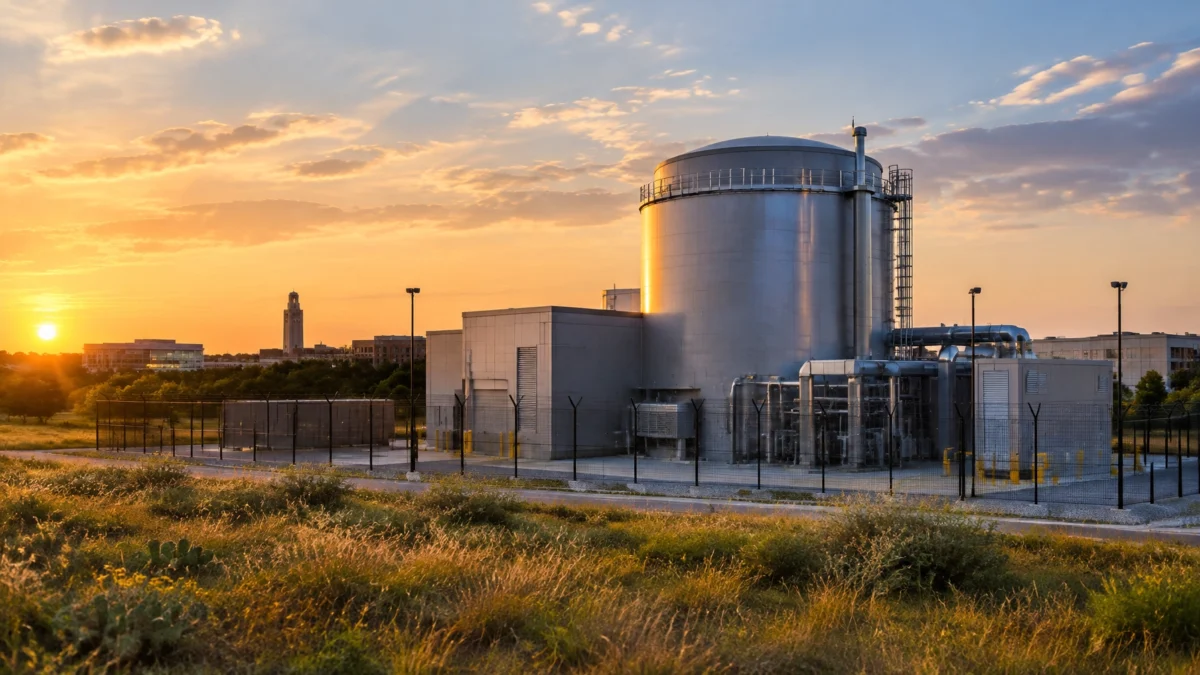
Last Energy announced on October 7 that the U.S. Department of Energy approved the final Documented Safety Analysis for the company’s PWR-5 pilot reactor at Texas A&M–RELLIS. The Last Energy PWR-5 approval moves the project into DOE’s readiness review, the last step before the department could authorize startup activities involving criticality and reactor operations.
The approval is a significant regulatory milestone for the project, but it is not permission to operate. The reactor has not received startup authorization, and Last Energy has not yet demonstrated power generation at the RELLIS site. The duration and scope of DOE’s readiness review have not been specified publicly.
According to the company, the DSA is the final and most comprehensive safety analysis in the DOE authorization process. It builds on the Preliminary Documented Safety Analysis, or PDSA, which DOE approved in May 2026. The sequence matters because each stage addresses a different question about whether the facility is sufficiently defined, analyzed and prepared for operation.
The DOE authorization ladder
A Documented Safety Analysis is the formal safety basis for a DOE facility. It identifies hazards, safety-class systems, required controls, operating limits and credible accident scenarios. It also explains how those controls will be maintained during construction, testing, startup and operation.
For the RELLIS pilot, the authorization sequence now stands as follows:
- PDSA approval in May 2026. The preliminary analysis established the initial safety basis for the project and gave DOE a structured foundation for reviewing the facility’s hazards, design features and proposed controls.
- DSA approval in October 2026. The final analysis provides a more complete account of how the reactor and facility are expected to be operated safely. It is intended to resolve or document the safety questions that remain after preliminary design and planning work.
- DOE readiness review. This review examines whether the facility, personnel, procedures, equipment and safety programs are ready to support startup. DSA approval does not by itself demonstrate that the site is ready to load fuel, reach criticality or begin reactor operations.
- Startup authorization. If DOE determines that the project has satisfied the readiness requirements, it could issue authorization for startup activities, including criticality and reactor operations. That authorization has not yet been issued.
The process is distinct from commercial nuclear licensing. The Texas A&M–RELLIS project is being advanced under DOE’s Reactor Pilot Program, in which DOE authorizes and oversees a demonstration reactor through its own process. Last Energy was selected for the program in August 2025, following the executive order establishing a framework for accelerating reactor testing at DOE-authorized sites.
A future commercial PWR-20 deployed for an industrial customer or data center would require a separate licensing pathway through the Nuclear Regulatory Commission. The RELLIS DSA approval does not transfer to commercial projects, does not constitute NRC licensing and does not eliminate the need for site-specific environmental, construction, security and operating reviews.

Why the full-scale core matters
Last Energy says the RELLIS pilot uses the same full-scale reactor core as its commercial reactor design. That choice could make the demonstration more relevant to the company’s commercial plans than a test involving a substantially scaled-down core.
Data from a full-scale core may provide more direct information about reactor behavior, operating procedures, maintenance requirements and system integration. It could also help the company identify issues that would not appear in a smaller test article.
That similarity has limits. A common core design does not mean the pilot and commercial plants will have identical buildings, site conditions, security arrangements, electrical systems, staffing models or operating procedures. A university research campus also presents a different operational environment from a data center, industrial facility or private energy park.
The pilot should therefore be understood as a research and demonstration project rather than commercial power generation. Its value will depend not only on whether DOE authorizes startup, but also on what the project demonstrates during testing and whether those results can support later commercial licensing and deployment.
The PWR-20 and the scale question
Last Energy describes its commercial product as the PWR-20, a 20-megawatt-electric micro modular nuclear plant designed for factory fabrication, standard road transport and rapid on-site assembly. The company is targeting industrial customers, data centers and other users that require continuous electricity.
Twenty megawatts electric is a small fraction of the output of a conventional large nuclear unit, which commonly produces hundreds or more than 1,000 megawatts. A PWR-20 would not replace a major regional power station by itself. Its proposed role is more distributed: supplying firm power near a high-demand customer or operating as part of a cluster of modular units.
That model is becoming more relevant as electricity demand rises from data centers, advanced manufacturing, hydrogen production and industrial electrification. It also competes with other sources of firm power, including natural gas generation, larger nuclear plants, hydroelectric resources, geothermal projects and battery-backed renewable systems.
The commercial question is not simply whether a 20 MWe reactor can produce electricity. It is whether the plant can be licensed, financed, manufactured, transported, secured, operated and maintained at a cost that customers will accept. The RELLIS demonstration may provide evidence for some of those questions, but it cannot answer all of them.
LEU offers supply-chain advantages with tradeoffs
The pilot uses conventional low-enriched uranium, or LEU. Nearly all fuel used by the existing commercial reactor fleet is enriched to between 3% and 5% uranium-235. High-assay low-enriched uranium, or HALEU, contains more than 5% but less than 20% uranium-235.
LEU is strategically important because it is the established fuel type for the existing commercial reactor fleet and has a broader supply chain than HALEU. Many advanced-reactor developers have selected HALEU because higher enrichment can support longer fuel cycles, smaller cores or other design objectives. However, HALEU production capacity remains more limited.
Last Energy’s decision to use LEU is therefore a deliberate supply-chain choice. It may reduce dependence on a still-developing fuel market and support the company’s stated objective of repeatable fleet deployment using off-the-shelf commercial fuel. The tradeoff is that a design using conventional LEU may not obtain every performance benefit associated with higher-assay fuel.
The fuel decision also connects the RELLIS project to broader domestic nuclear policy. DOE’s efforts to develop advanced-reactor fuel supplies, including the Centrus HALEU contract and domestic fuel supply chain, are aimed at supporting technologies that require fuel beyond the specifications of the current commercial fleet. Last Energy is pursuing a different risk-reduction path by emphasizing conventional fuel availability.

Integrated containment brings manufacturing questions
Last Energy identifies integrated reactor containment as a central feature of its design. The company describes a 1,000-ton hermetically sealed steel structure that integrates the primary reactor systems and is intended for factory fabrication and no-access operation.
The proposed approach could simplify repeat manufacturing by moving more work into a controlled factory environment. Standardized production may also help reduce variation between units if the design can be manufactured, transported and installed repeatedly.
At the same time, the concept raises questions that the pilot and its regulatory reviews will need to address. A large sealed unit must be transportable through existing infrastructure or through a logistics plan that can be repeated at multiple sites. “No-access operation” also requires a clear maintenance philosophy, including how inspections, repairs and component replacement would be handled.
Regulators and customers will need confidence that important systems can be monitored and inspected over the plant’s operating life. A sealed containment strategy may reduce certain construction and operational activities, but it does not remove the need for surveillance, testing, material qualification and long-term aging management.
Where the project fits in the wider energy system
The RELLIS milestone comes as the United States tests several approaches to rebuilding nuclear capacity. DOE’s pilot framework is intended to shorten the path from design to demonstration, while other projects are pursuing criticality milestones, commercial licensing and fuel development.
Recent coverage of the Nuclear Energy Launch Pad’s second round and the July 4 reactor criticality milestone illustrates the range of demonstration strategies being pursued. Some projects are focused on national laboratory testing, while others are intended to validate designs in commercial or university environments.
The potential benefits extend beyond nuclear developers. Reliable zero-carbon generation could help data centers and industrial facilities reduce exposure to gas and power-market volatility, while firm generation can complement wind, solar and storage. Nuclear projects could also support grid resilience in regions where transmission expansion is slow or where large industrial loads are locating faster than new power infrastructure can be built.
The limitations are equally important. Nuclear facilities require long development timelines, regulatory oversight, security planning, specialized labor and a reliable fuel supply. They must also compete with natural gas generation, renewable resources, storage and efficiency investments on cost and delivery schedules. Demonstration success alone will not establish commercial competitiveness.
The connection between firm generation and large electricity users is also visible in the Crusoe and Aalo nuclear powered data center demonstration at INL, while the DOE’s nuclear capacity expansion strategy provides broader policy context for efforts to increase reactor deployment.
What to watch next
The immediate question is whether Last Energy completes DOE’s readiness review and receives startup authorization. Observers should also watch for information about the review’s duration, the conditions attached to any authorization and the sequence of fuel loading, testing, criticality and power-operation activities.
Beyond startup, the important evidence will be operational. That includes reactor performance, reliability, maintenance requirements, inspection methods, staffing needs and the ability to demonstrate the claimed factory-to-site deployment model.
The RELLIS project could become an important data point for microreactor commercialization, but its regulatory significance should be stated precisely. DOE DSA approval means that the company’s final safety analysis has cleared a major step in the DOE authorization process. It does not mean that the reactor is operating, that the commercial PWR-20 is licensed or that future deployments have been approved.
Those distinctions will determine how much weight the milestone ultimately carries in the broader effort to add nuclear power to the U.S. electricity system.
Keep In Touch with Shale Magazine
As the new era of energy unfolds, you can bet we’ll be the boots on the ground to keep you informed. Subscribe to Shale Magazine for sharp insight into the arenas that matter most to your life. And don’t forget to listen to our riveting podcast, The Energy Mixx Radio Show, where our very own Kym Bolado interviews the most extraordinary thought leaders, business innovators, and industry experts of our time.