Major Investment Targets Alaska’s Transmission Infrastructure
The Trump administration announced major plans in October to address shortcomings in Alaska’s transmission infrastructure, supported by up to $150 million in federal funding to enhance the state’s grid. The investment is expected to strengthen Alaska’s grid, reducing the risk of power cuts and directly benefiting Alaskans and utilities alike.
Alaska Transmission Infrastructure Challenges
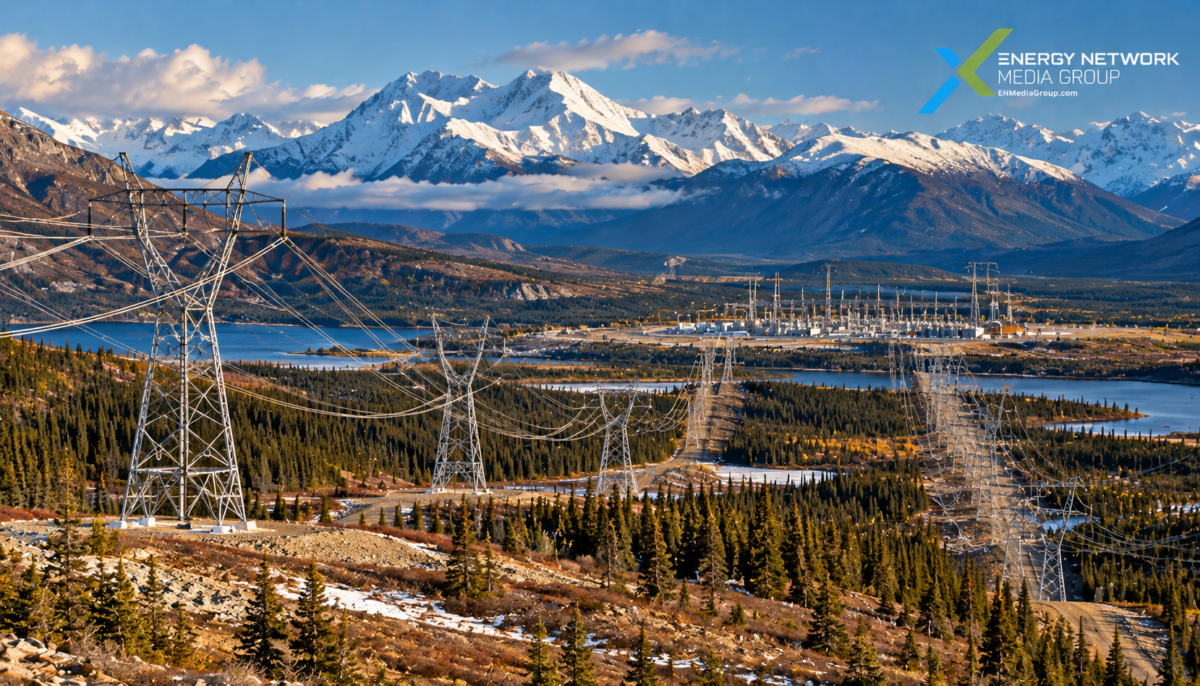
At present, Alaska’s Railbelt grid operates largely as a fragile, single linear string. This means that if any part of the system is knocked offline by extreme weather, wildfires, or structural issues, the entire grid can split, leading to widespread power outages.
This was seen in 2019, when a wildfire near Cooper Landing shut down part of the Sterling-to-Quartz Creek transmission line for four months during the summer. This increased reliance on natural gas and caused the water at the dam to overflow, wasting energy. The four-month outage forced utilities to rely more heavily on natural gas and cost Railbelt ratepayers an estimated $12 million.
Years of underinvestment in Alaska’s aging transmission infrastructure have also led to severe capacity constraints. In addition, the length of the system also contributes to significant transmission losses. Up to one-fifth of the energy sent from Bradley Lake to Fairbanks is thought to be lost at certain times of the year due to this issue.
The Beluga-Healy Transmission Project
On October 5, the United States Department of Energy (DoE) announced plans to deploy Defense Production Act (DPA) funding to build a second high-voltage connection between Southcentral and Interior Alaska. DOE announced its intent to provide up to $150 million in DPA funding for the Alaska Energy Authority’s (AEA) Beluga-Healy Transmission Project, with a further $268 million in non-federal funding required to complete the project, for a total investment of $418 million in Alaska’s grid.
The project will include the development of 223 miles of new transmission line connecting Beluga and Healy, providing grid operators with an additional connection to transport power between Alaska’s most densely populated communities and major military installations. This is expected to drive down electricity costs and strengthen grid reliability for approximately 75% of Alaska’s population, according to the DoE.
U.S. Secretary of Energy Chris Wright stated, “Supporting improvements to Alaska’s transmission infrastructure with Defense Production Act funds reflects the Trump Administration’s commitment to strengthening national security, improving grid reliability, and lowering electricity costs.”
Wright said that a meeting with the Alaska Energy Authority confirmed the need to support an expansion of Alaska’s energy infrastructure. He added that “This project will not only support the major U.S. military expansion currently underway in Alaska, but also mining and other resource development critical to our national security.”
The DPA funding reflects the administration’s view that Alaska’s transmission system is a national-security asset, particularly because the Railbelt serves major military installations.
Making the Beluga-Healy Transmission Project a Reality
To construct the new transmission line, developers must consider the vast array of environmental challenges. Building 223 miles of high-voltage lines through Alaska’s sub-Arctic interior requires navigating permafrost, mountain passes, and dense wilderness. Project approval will also ultimately depend on the proposal clearing complex environmental reviews and securing right-of-way permits across a patchwork of federal, state, municipal, and Alaska Native Corporation lands.
In addition, while the funding announcement demonstrates the Trump administration’s commitment to strengthening Alaska’s transmission network, a large proportion of the total projected development cost still needs to be found. It remains uncertain whether this funding gap will be covered by alternative federal grants, state appropriations, or loans taken out by the AEA.
Initial DPA funding will contribute to planning, engineering, and permitting costs, with construction of the second line not expected to commence until after 2030. Meanwhile, Southcentral Alaska, the state’s most populous region, is facing a natural gas shortage. This suggests that in addition to strengthening Alaska’s transmission network, the government must also find or develop alternative energy sources to connect to the updated grid once it comes online.
In early October, President Trump announced a broader $200 billion South Korean investment package and said it would include support for an Alaska liquefied natural gas pipeline. However, South Korean President Lee Jae Myung said that South Korea’s participation in the development depended on the project meeting commercial viability and domestic legal requirements. The joint statement issued by the two countries’ governments said the Alaska project was subject to “commercial reasonableness” and included no investment figures.
While there are significant hurdles to overcome, the October DoE funding announcement addresses the need to strengthen Alaska’s highly vulnerable grid system. The federal commitment could make the project more attractive to additional public or private financing. However, achieving regulatory approval for the Beluga-Healy Transmission Project could take several years, during which time the region will likely remain prone to power cuts.
Keep In Touch with Shale Magazine
As the new era of energy unfolds, you can bet we’ll be the boots on the ground to keep you informed. Subscribe to Shale Magazine for sharp insight into the arenas that matter most to your life. And don’t forget to listen to our riveting podcast, The Energy Mixx Radio Show, where our very own Kym Bolado interviews the most extraordinary thought leaders, business innovators, and industry experts of our time.