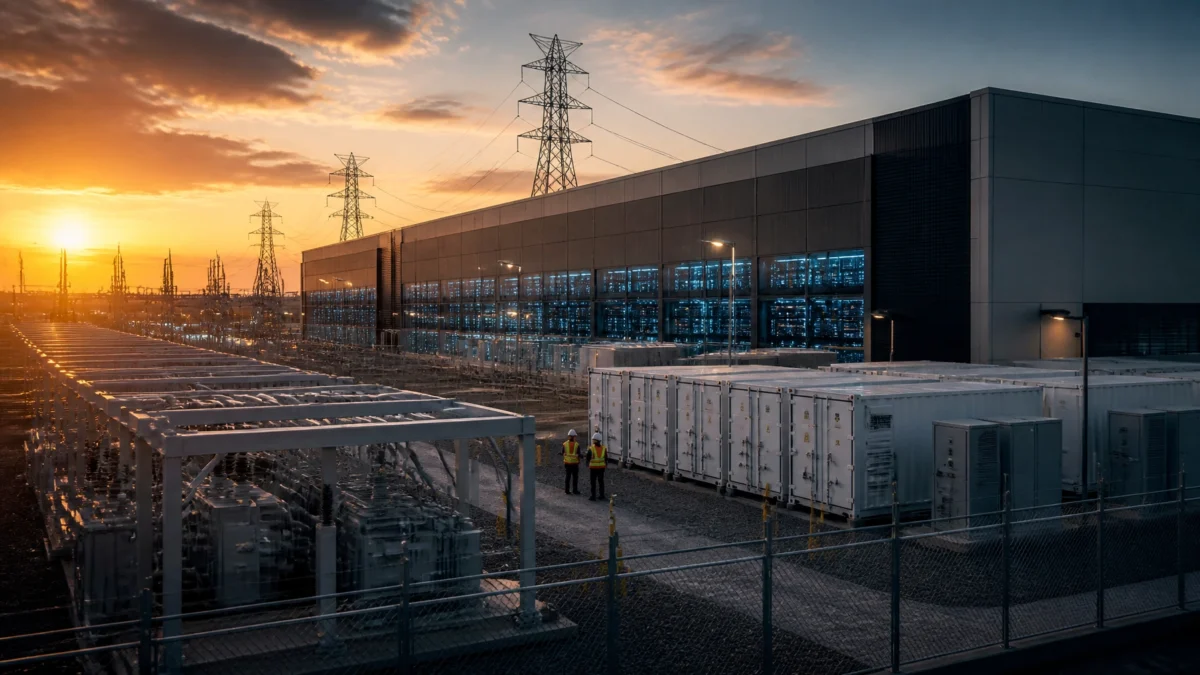
Artificial intelligence is turning data centers into some of the fastest-growing electricity loads in the United States. National laboratories are now examining how these facilities can do more than consume power. By coordinating computing workloads, batteries, cooling systems, backup generation, and grid controls, researchers are testing whether AI data centers can become flexible participants in power-system operations.
The objective is not to eliminate the need for new generation and transmission. Instead, flexible interconnection could help utilities connect large loads more safely while longer-term infrastructure is planned and built.
Flexible interconnection starts with a different view of load
Traditional interconnection studies often treat a large customer as a relatively predictable block of demand. That approach becomes more difficult when the customer operates thousands of GPUs, power-electronic converters, cooling systems, uninterruptible power supplies, and backup resources.
AI training and inference can change electricity demand quickly. The Idaho National Laboratory’s 2025 workshop report, Bridging the Gap for Powering Data Centers, identifies dynamic load behavior, voltage sensitivity, power quality, and rapid demand growth as important challenges for grid operators and data center developers.
INL’s report also emphasizes that the industry lacks standardized data, models, and interconnection procedures for these facilities. Developers need reliable power and predictable schedules. Utilities and regional grid operators need accurate forecasts, clear operating limits, and confidence that a large facility will not destabilize the system during a disturbance.
Flexible interconnection addresses that gap by linking permission to connect with specific operating capabilities. A data center might agree to:
- Reduce or delay noncritical computing during grid emergencies.
- Limit the speed at which demand increases.
- Provide detailed load forecasts to the utility or grid operator.
- Use batteries or other onsite resources during constrained periods.
- Ride through short voltage or frequency disturbances.
- Operate as part of a microgrid during an outage.
- Coordinate reconnection so the facility does not create a second system disturbance.
Those commitments could give utilities more information and control without treating every new data center as an entirely inflexible load.
A note on RADDiT: The supplied brief references RADDiT as a national-laboratory tool. Publicly available DOE, NREL, and INL materials reviewed for this article did not verify RADDiT as an official project or software name. The analysis below therefore uses documented research on electromagnetic-transient modeling, flexible interconnection, data center controls, workload shifting, and grid-interactive design.
EMT models reveal what standard studies can miss
A central part of the national-laboratory work involves electromagnetic-transient, or EMT, modeling. In simple terms, EMT models simulate electrical behavior at very short time intervals, often down to milliseconds or less. That level of detail can show how power converters, UPS systems, batteries, protection equipment, and rapidly changing digital loads interact.
This matters because a data center may appear stable in a conventional steady-state study while still producing difficult behavior during a fault, voltage sag, rapid workload change, or reconnection event.
NREL’s work on large-scale power-system simulation and data center integration supports the use of high-fidelity models to test these interactions. The laboratory has also developed platforms for hardware-in-the-loop testing, allowing real controllers to operate against simulated grid conditions before deployment.
The Department of Energy and Pacific Northwest National Laboratory are developing detailed EMT models for data center equipment, including UPS systems and power-conversion interfaces. ERCOT has separately published work on dynamic modeling of AI data center loads in PSCAD. Together, these efforts are helping utilities and developers move beyond the assumption that a data center can be represented as a fixed megawatt value.

What the models need to represent
| Data center or grid element | Why it matters in an EMT study |
|---|---|
| AI workload profile | Shows how training and inference change electrical demand |
| UPS and power converters | Determines response to voltage disturbances and grid faults |
| Battery energy storage system | Provides fast load reduction or power injection |
| Cooling equipment | Adds an auxiliary load that may offer limited flexibility |
| Protection and reconnection controls | Determines whether the facility disconnects or rides through an event |
| Point of interconnection | Shows how the entire facility interacts with the utility system |
| Onsite generation | Establishes how the facility behaves when grid supply is limited or unavailable |
The models do not guarantee that a data center will support the grid. They provide a way to test whether proposed controls will work under realistic conditions.
NREL is testing data centers as flexible grid assets
NREL’s work with the Verrus architecture offers one of the clearest examples of this approach. At the 70-megawatt Vulcan test platform, NREL researchers examined a medium-voltage system that integrated data center loads, battery storage, and grid-aware controls.
According to NREL’s published project material, the test platform demonstrated rapid demand flexibility, with utility requests addressed within approximately 10 seconds. The system also supported uninterrupted transitions to islanded operation during grid disturbances while maintaining data center service requirements.
A related NREL study on coordinated control examined how batteries, UPS systems, and point-of-interconnection protection settings could help a facility remain connected during voltage events. The concept included reducing imports during undervoltage conditions, absorbing additional power during overvoltage conditions, and restoring normal imports after the disturbance.
These capabilities are different from conventional backup power. A diesel generator that starts only after a utility outage provides resilience to the facility, but it does not necessarily function as a resource that can support the broader grid during normal operations. A grid-interactive battery and control system can potentially provide services before an outage occurs, subject to interconnection rules, market design, emissions requirements, and commercial agreements.
NREL has also studied distributed edge data centers of up to roughly 20 megawatts. Its framework combines feeder hosting-capacity analysis with building efficiency, flexible building loads, and waste-heat reuse. In a worked example, those measures increased available feeder capacity by about 10 megawatts. The result illustrates an important principle: reducing or shifting demand can sometimes create interconnection headroom without immediately building a new substation or transmission line.
Workload shifting gives operators a software-based flexibility tool
Not every AI task requires immediate execution. Model training, data backups, batch analytics, software updates, and some inference workloads may be delayed or moved to another location if service agreements permit.
The DOE Secretary of Energy Advisory Board’s 2024 recommendations on powering AI and data center infrastructure called for research into both temporal and geographic flexibility. Temporal flexibility shifts computing to another time. Geographic flexibility moves workloads among data centers in different regions.
A grid-aware data center could use several signals when scheduling work:
- System conditions such as reserve margins or transmission congestion.
- Electricity prices in day-ahead or real-time markets.
- Local renewable output from wind, solar, or hydroelectric resources.
- Frequency and voltage conditions at the point of interconnection.
- Operational limits established by the utility, data center owner, and computing customer.
Workload shifting is not unlimited. Customer latency requirements, data sovereignty rules, cybersecurity concerns, network capacity, and the availability of suitable GPUs can restrict how much computing operators can move. A facility serving real-time applications may have far less flexibility than a site focused on model training.
ASHRAE’s AI Data Center Energy Performance Framework describes this flexibility as partial and situational. Operators must establish verifiable baselines, response times, maximum event durations, and recovery procedures before utilities can rely on the resource.
Batteries and behind-the-meter generation add physical flexibility
Software controls can reduce demand, but batteries can respond more quickly and can support critical systems while workloads change. A battery energy storage system may charge during periods of lower demand or strong renewable generation and discharge during a constrained period.
A data center can also combine batteries with solar, wind, natural gas generation, hydroelectric purchases, or other firm resources. The appropriate combination depends on site conditions, reliability requirements, fuel availability, permitting, emissions rules, and the cost of grid upgrades.
INL’s workshop report identifies behind-the-meter generation, microgrids, and storage as potential ways to reduce transmission constraints and improve deployment schedules. Participants also discussed nuclear energy and small modular reactors as possible sources of firm power. However, INL noted that nuclear integration faces significant questions involving licensing, supply chains, cost, community acceptance, and commercial timelines.
For that reason, small modular reactors should be viewed as a potential medium- to long-term option rather than a universal near-term answer to data center demand. Natural gas, batteries, renewable generation, existing nuclear and hydroelectric resources, transmission upgrades, and efficiency measures may all remain part of the supply mix.

The broader grid still carries the responsibility
Flexible interconnection can reduce stress, but it cannot substitute for adequate generation, transmission, distribution equipment, and fuel infrastructure. If data center demand continues to grow, the power system will still need new resources.
The approach also creates difficult questions about cost and accountability. Utilities may need to reserve transmission capacity for a data center even if the facility promises to curtail during a limited number of hours. A data center may need full grid support while its onsite generator undergoes maintenance. Ratepayers and regulators will want assurance that required upgrades are assigned fairly.
The environmental effects also extend beyond electricity. Data centers can affect water supplies through cooling requirements, increase local noise, and compete for industrial land. Onsite generation can reduce transmission dependence but may introduce emissions, fuel-supply, safety, and permitting issues. A flexible facility must therefore be evaluated as part of the entire energy system rather than as an isolated technology project.
What to watch next
The next stage of development will likely focus on five areas:
- Standardized dynamic models for AI and high-performance computing loads.
- Common definitions for response speed, duration, ramp rate, and availability.
- Utility protocols for sharing confidential load forecasts.
- Demonstrations that combine workload controls, BESS, UPS systems, and onsite generation.
- Regulatory rules that determine how flexible facilities receive compensation or faster interconnection treatment.
National laboratories can provide neutral testing environments, validated models, and technical guidance. Utilities and grid operators must define the services they actually need. Data center operators must demonstrate that flexibility commitments will not compromise uptime. Regulators will need to determine how benefits and costs are allocated.
The central conclusion is measured rather than automatic. AI data centers can become more responsive grid participants, but flexibility depends on facility design, software capability, contractual incentives, accurate models, and reliable communications. NREL, INL, DOE, and other research institutions are building the tools needed to evaluate those conditions. Whether flexible interconnection becomes a widely used pathway will depend on how effectively the industry converts laboratory demonstrations into enforceable, bankable, and regionally appropriate operating practices.
Keep In Touch with Shale Magazine
As the new era of energy unfolds, you can bet we’ll be the boots on the ground to keep you informed. Subscribe to Shale Magazine for sharp insight into the arenas that matter most to your life. And don’t forget to listen to our riveting podcast, The Energy Mixx Radio Show, where our very own Kym Bolado interviews the most extraordinary thought leaders, business innovators, and industry experts of our time.
Subscribe to get more posts from Amanda Jenkins