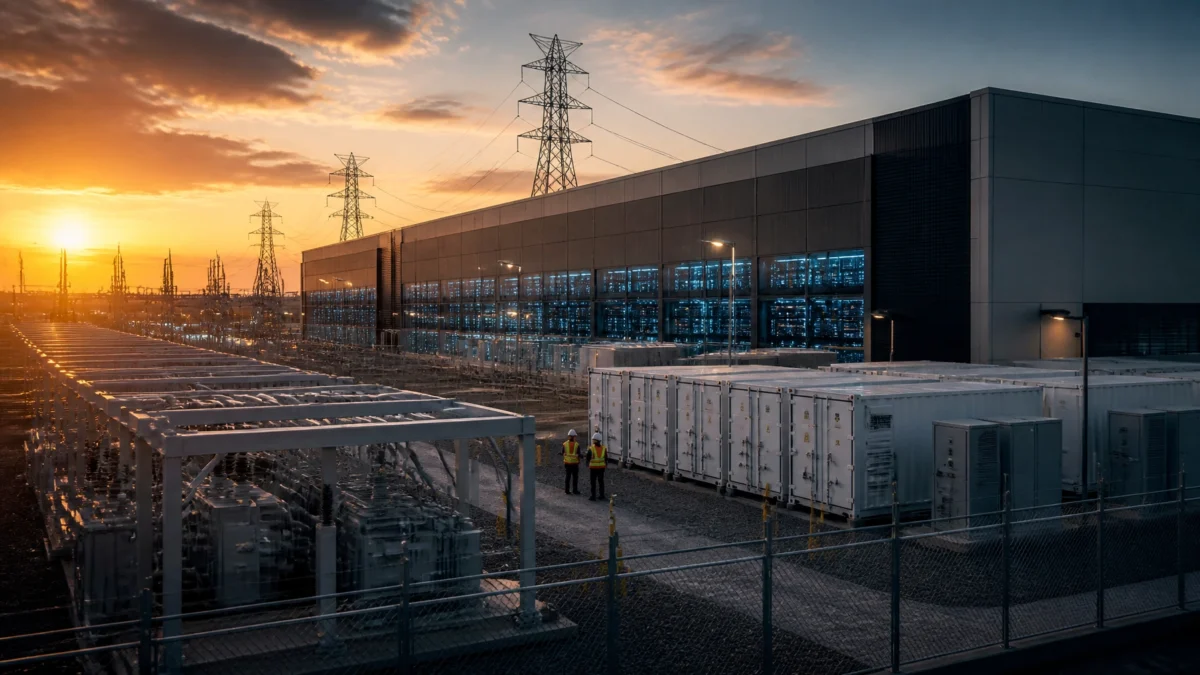
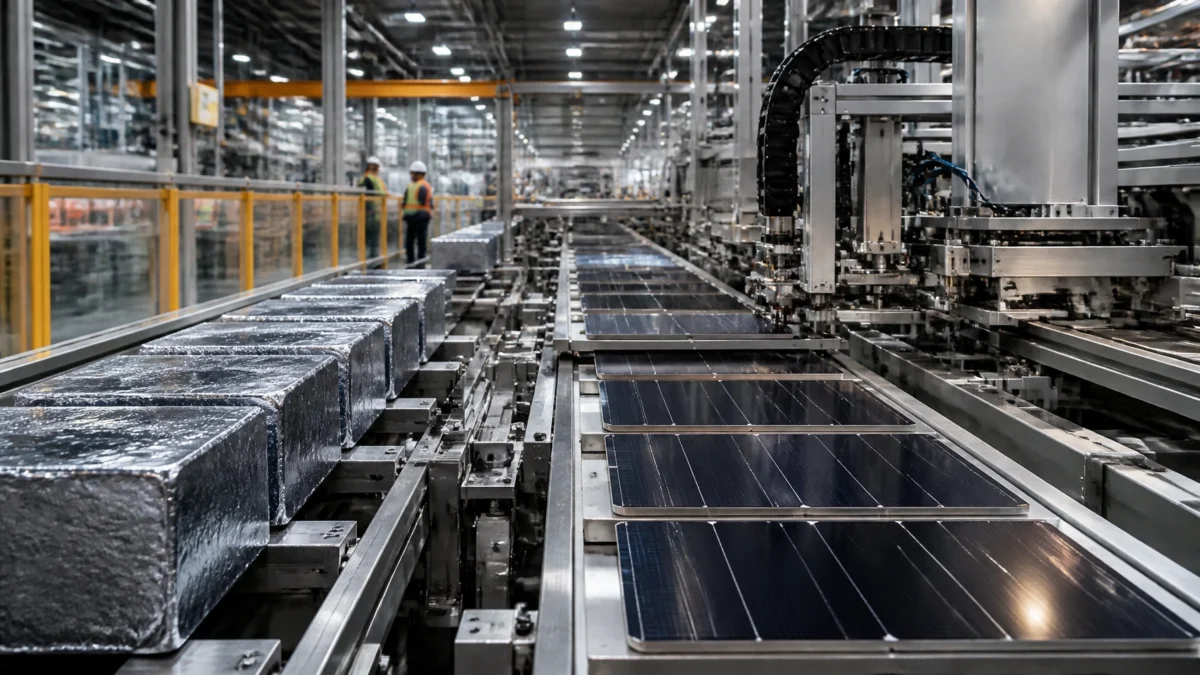
The United States will impose minimum import prices and new tariffs on polysilicon and selected downstream products beginning December 4, 2026. The policy aims to support domestic manufacturing, but it will also change sourcing decisions and could raise costs for solar developers, manufacturers, and other companies that rely on imported materials.
The White House issued the proclamation on August 6 following a national security investigation under Section 232 of the Trade Expansion Act of 1962. Reuters reported that the action is intended to counter foreign state-supported production, particularly in China, and strengthen U.S. supply chains serving both solar power and semiconductors.
What the proclamation changes
The policy establishes minimum import prices, or MIPs, for four categories of products:
| Covered product | Minimum import price |
|---|---|
| Polysilicon | $21 per kilogram |
| Polysilicon ingots and wafers | $100 per kilogram |
| Solar cells | $0.22 per watt |
| Solar modules | $0.38 per watt |
The MIP program applies to covered goods entered for consumption, or withdrawn from a warehouse for consumption, on or after 12:01 a.m. Eastern Time on December 4, 2026.
The proclamation also imposes an additional 15% ad valorem tariff on covered ingots and downstream polysilicon derivatives listed in the government’s annexes, including wafers, cells, and modules. The duty applies in addition to other applicable duties, taxes, and fees unless the proclamation provides an exception.
Products from Japan, South Korea, Taiwan, Switzerland, Liechtenstein, and European Union member states receive special treatment. The combined total of the new Section 232 duty and the standard Column 1 tariff rate will equal 15% for covered products from those jurisdictions. Products from the United Kingdom face a 10% additional Section 232 duty under the proclamation.
Companies will need to review the detailed product classifications in Annex I and Annex II before determining how the policy affects individual shipments.
How the minimum import price works
The MIP is not simply a rule requiring every imported product to be sold at a particular retail price. It operates through import documentation and duties.
Importers must provide evidence showing that the first arm’s-length sale in the United States will occur at or above the applicable MIP. They may also rely on fixed terms in contracts signed before the August 6 proclamation, provided they submit the required documentation.
If an importer does not provide the required documentation, U.S. Customs and Border Protection may apply a specific tariff equal to the applicable MIP. If the importer submits documentation but the entered value remains below the MIP, the importer must pay a duty equal to the difference between the entered value and the price floor.
For example, if a covered shipment has an applicable MIP of $0.38 per watt but an entered value of $0.30 per watt, the importer could owe a specific duty equal to the $0.08-per-watt gap, in addition to the applicable ad valorem tariff and other charges.
The White House proclamation authorizes the Secretary of Commerce to adjust the MIPs over time to reflect market conditions and estimated fair value under what the administration describes as nondistorted, free-market conditions.
That adjustment authority creates an important source of uncertainty. The December thresholds are known, but future changes could affect supply contracts, project models, and investment decisions.
Why polysilicon matters beyond solar panels
Polysilicon sits near the beginning of two strategically important industrial chains.
In solar manufacturing, the chain generally runs from:
Polysilicon → ingots → wafers → solar cells → modules
In semiconductor manufacturing, highly purified polysilicon becomes a feedstock for electronic-grade silicon and wafer production. Those wafers support integrated circuits used in consumer electronics, industrial systems, communications equipment, artificial intelligence infrastructure, and defense applications.
The White House said global polysilicon production has increased by more than 270% since 2020 and that inventories reached approximately 400,000 tons by the end of 2024. The proclamation also said the U.S. share of global polysilicon production capacity fell from 50% in 2005 to less than 2% in 2024.
The administration connects that decline to national security because semiconductors support radar, communications, electronic warfare, cybersecurity, missile guidance, and unmanned systems. It also argues that a commercially viable solar-grade polysilicon market helps sustain the broader domestic industry, including semiconductor-grade production.
This is the central policy logic. Solar demand provides the volume needed to support polysilicon manufacturing, while semiconductor demand provides strategic value and higher-purity applications.

The intended beneficiaries
The immediate beneficiaries are U.S. producers that compete with lower-priced imported materials. The policy is designed to improve the economics of domestic polysilicon and downstream manufacturing, including facilities operated by companies such as Hemlock Semiconductor and Wacker in the United States.
Domestic ingot, wafer, cell, and module producers could also gain protection from imported products priced below the new thresholds. Higher import costs may allow U.S. manufacturers to compete more effectively for contracts with utilities, developers, and technology companies seeking domestic or allied supply.
The proclamation also creates a potential onshoring incentive. The Secretary of Commerce may approve company-specific plans for companies that commit to building, refurbishing, or expanding U.S. facilities producing polysilicon, ingots, wafers, or cells.
Approved companies could receive relief from applicable Section 232 duties on certain production equipment and covered products during the construction period. The proclamation requires approved projects to begin construction by January 20, 2029, and allows the government to rescind benefits if companies fail to meet their commitments.
That framework could encourage investment, but the commercial response will depend on more than tariff protection. Producers will still need access to electricity, skilled labor, financing, equipment, transportation, and long-term customers.
The cost pressure for solar projects
The downside is that the policy raises the cost floor for imported solar components. Solar developers and utilities that purchase modules from foreign suppliers may face higher landed costs after December 4, especially when products come from countries without preferential treatment.
Those costs can affect:
- Utility-scale solar project capital budgets
- Power-purchase agreement pricing
- Residential and commercial installation costs
- Procurement schedules and inventory decisions
- Financing assumptions and project returns
- The competitiveness of solar paired with battery storage
The effect on any individual project will depend on module origin, contract timing, existing tariffs, the product’s classification, and the amount of polysilicon content in the supply chain. A higher module price does not automatically translate into a specific increase in the cost of electricity because developers may offset some of the impact through engineering changes, supplier negotiations, tax incentives, or changes in project design.
However, the policy could still influence the pace and composition of new generation. If solar costs rise, utilities may reassess the balance among solar, natural gas, nuclear power, hydropower, storage, and transmission investments. That does not mean one technology will replace another, but it may change the relative economics of projects competing to meet load growth.

Semiconductor effects may emerge more slowly
The semiconductor impact is less direct than the solar impact because polysilicon is generally a smaller portion of the total cost of an advanced chip. Still, the policy could affect semiconductor manufacturers and wafer suppliers through higher input costs, revised contracts, or changes in sourcing.
The administration’s argument is primarily about resilience rather than immediate chip prices. A more diversified domestic and allied supply chain could reduce exposure to disruptions in concentrated foreign production. That may matter for advanced computing, defense systems, and the data-center infrastructure supporting artificial intelligence.
The trade-off is that supply-chain redundancy often costs more than highly concentrated production. Companies may accept higher near-term costs in exchange for greater control over origin, reliability, and compliance. Whether that trade-off is commercially sustainable will depend on demand growth and the ability of U.S. producers to expand efficiently.
KPMG’s analysis emphasizes the need for companies to assess classification, valuation, documentation, contracts, and possible onshoring opportunities before the effective date. Importers should not treat the December deadline as only a purchasing issue. It is also a customs, tax, legal, and supply-chain planning event.
What companies should do before December 4
Companies that import or use covered products should take several practical steps:
- Map the supply chain. Identify where polysilicon, ingots, wafers, cells, and modules originate and determine whether they fall under the annexes.
- Review contracts. Check whether fixed-price agreements signed before August 6 qualify for the treatment described in the proclamation.
- Validate customs data. Confirm tariff classifications, entered values, country-of-origin records, and first-sale documentation.
- Model multiple scenarios. Include the MIP adjustment, the 15% duty, existing tariffs, freight, and possible supplier changes.
- Evaluate alternate suppliers. Compare U.S. producers and suppliers in jurisdictions receiving preferential tariff treatment.
- Monitor implementation guidance. Customs procedures, Federal Register notices, and Commerce Department rules may clarify how the program will work in practice.
What to watch next
The next phase will depend on implementation. CBP must establish how importers will document first arm’s-length sales and how it will enforce the MIP requirements. Commerce must also determine whether and how to approve onshoring plans.
Trading partners may seek substantially equivalent price-floor arrangements that could change the treatment of their exports. Companies may challenge parts of the policy in court, while solar developers and manufacturers will continue negotiating supply contracts ahead of the effective date.
The policy presents a clear tension. Higher import prices may help preserve U.S. manufacturing capacity and reduce dependence on concentrated foreign supply chains. At the same time, those measures can increase downstream costs for solar projects and create additional compliance obligations for businesses.
The outcome will depend on whether domestic production expands quickly enough to provide reliable, competitively priced alternatives. Until that capacity appears, the December 4 rules are likely to function less as an immediate replacement for imported supply and more as a new cost and planning framework for the U.S. solar and semiconductor industries.
For continued reporting on energy markets, policy, industry, and finance, visit SHALE Magazine’s Business coverage, Industry coverage, and Energy Minute.
Sources
- The White House proclamation on polysilicon and its derivatives
- KPMG analysis of the U.S. polysilicon import price and tariff rules
- Reuters reporting on the Section 232 action
- Bloomberg coverage of the tariffs and minimum import prices
Policy timeline
| Date | Development |
|---|---|
| August 6, 2026 | White House signs the Section 232 proclamation |
| Before December 4, 2026 | Companies review contracts, classifications, sourcing, and compliance systems |
| December 4, 2026 | MIPs and new covered-product tariffs begin applying to qualifying entries |
| January 20, 2029 | Approved onshoring plans must begin construction by this date |
Keep In Touch with Shale Magazine
As the new era of energy unfolds, you can bet we’ll be the boots on the ground to keep you informed. Subscribe to Shale Magazine for sharp insight into the arenas that matter most to your life. And don’t forget to listen to our riveting podcast, The Energy Mixx Radio Show, where our very own Kym Bolado interviews the most extraordinary thought leaders, business innovators, and industry experts of our time.
Subscribe to get more posts from Amanda Jenkins