
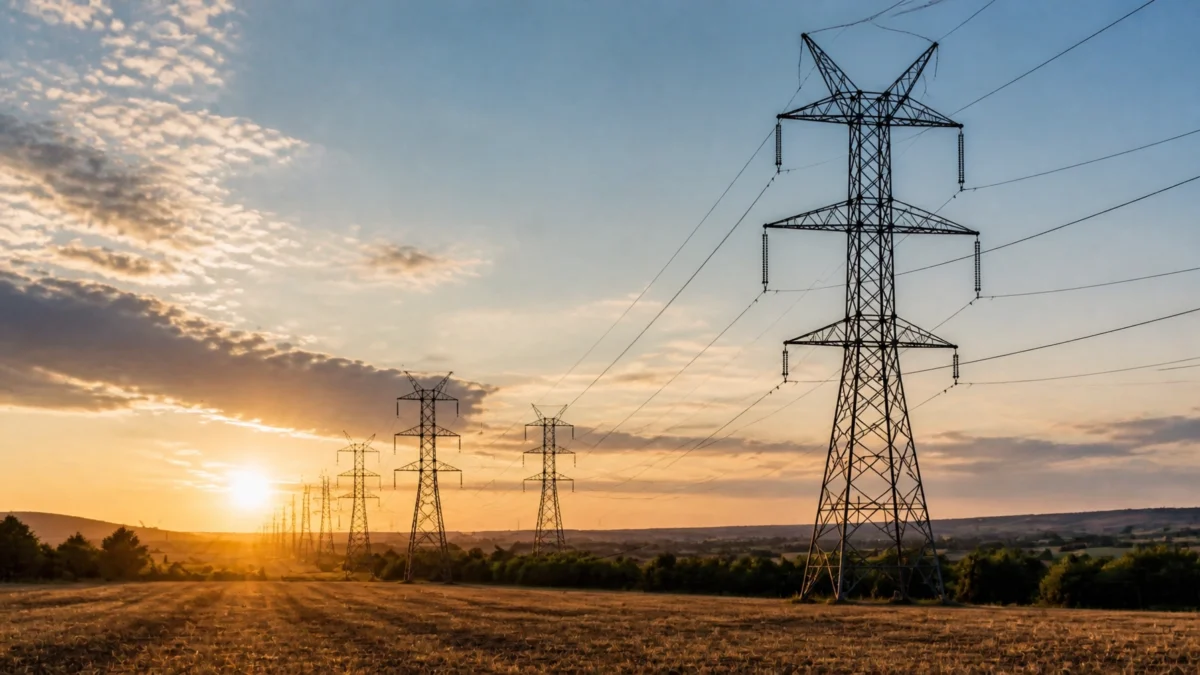
The U.S. Department of Energy has stopped the designation process for three proposed National Interest Electric Transmission Corridors, reversing a major transmission policy initiative launched under the Biden administration. Energy Secretary Chris Wright announced the decision on August 12, saying the corridors did not demonstrate that they would improve reliability or reduce electricity costs.
The decision affects the Southwestern Grid Connector Corridor, the Lake Erie–Canada Corridor, and the Tribal Energy Access Corridor. It does not cancel a specific transmission line under construction, but it removes a potential federal pathway for projects that might have been developed within those areas.
What DOE decided
According to the DOE announcement, the department conducted an “extensive review” that included public feedback and stakeholder input before deciding not to advance the three corridors.
Secretary Wright framed the decision as a rejection of what he called a “climate-alarmist agenda.” He said transmission policy should instead prioritize grid reliability, affordable electricity, energy security, and local community concerns.
E&E News and Politico reported that the move comes as federal and state officials face growing concern about electricity prices and rapidly rising demand ahead of the November midterm elections. The timing also reflects a broader debate over who should pay for new transmission and how much federal authority should be used when states or local communities oppose projects.
The three proposed corridors were:
| Proposed corridor | General geographic focus | Potential policy significance |
|---|---|---|
| Southwestern Grid Connector Corridor | Colorado, New Mexico, and western Oklahoma | Could have supported additional regional transfer capacity in the Southwest |
| Lake Erie–Canada Corridor | Lake Erie and parts of Pennsylvania | Could have supported additional cross-border and regional transmission connections |
| Tribal Energy Access Corridor | Parts of North Dakota, South Dakota, Nebraska, and Tribal reservations | Intended to address transmission access and energy development needs in Tribal communities |
The corridors had been selected in December 2024 to advance into a later review phase. DOE’s decision means the proposed areas will not receive NIETC designations through that process.

Why NIETC designations matter
Congress created the National Interest Electric Transmission Corridor program through Section 216 of the Federal Power Act, which was added by the Energy Policy Act of 2005. The bipartisan infrastructure law later amended the statute and strengthened the potential role of the Federal Energy Regulatory Commission.
A designation does not automatically approve a transmission line or determine its final route. Instead, it can provide access to federal financing and permitting tools for qualifying projects. It can also create a path for FERC to exercise backstop siting authority under specific circumstances, including when a state denies a permit or does not act within the statutory timeframe.
The DOE’s NIETC guidance explains that a designation identifies an area where transmission constraints or congestion may be harming consumers. The FERC explanation of interstate transmission siting makes clear that federal authority remains subject to additional findings and does not eliminate the need for regulatory review.
That distinction is important. The August 12 decision removes a potential federal tool, but it does not prevent utilities, states, regional grid operators, or private developers from pursuing transmission projects through other channels.
The transmission policy timeline
| Year | Development | Why it matters |
|---|---|---|
| 2005 | Energy Policy Act creates Section 216 | Establishes the NIETC framework and limited federal backstop authority |
| 2021 | Bipartisan Infrastructure Law amends Section 216 | Expands and clarifies FERC’s potential role in certain state permitting disputes |
| 2023 | DOE publishes a national transmission needs study | Identifies areas where transmission constraints may affect consumers and reliability |
| December 2024 | Three proposed corridors advance for further review | Begins the process that could have led to formal designations |
| August 12, 2026 | DOE ends the designation process | Removes the three proposals from the federal NIETC pipeline |
The reliability argument
DOE’s position is that the proposed framework did not demonstrate clear benefits for reliability or electricity affordability. Wright also said the process created confusion in some communities about the scope of federal authority and the potential effect on local land use.
Rural communities and other opponents of large transmission projects welcomed the decision. Their concerns generally focus on property rights, land use, potential eminent domain, visual impacts, environmental reviews, and the possibility that local ratepayers could be required to help finance projects designed to serve broader regional markets.
Those concerns are significant because transmission lines often cross multiple jurisdictions. A project can produce systemwide benefits while imposing direct costs on a relatively small number of landowners or communities. The policy challenge is determining how those costs and benefits should be measured and allocated.
At the same time, transmission advocates and renewable energy developers argue that removing the NIETC pathway could make it more difficult to build infrastructure needed to connect new generation. The Clean Air Task Force, for example, criticized the decision and said it could weaken efforts to develop a stronger and more reliable national grid.
The competing arguments reflect two different risks. One is that federal transmission authority could shift costs or land-use decisions away from affected communities. The other is that slow or fragmented siting processes could prevent new generation and storage from reaching customers when demand is increasing.
Why the decision matters for the broader energy system
The United States is entering a period of higher electricity demand after years of relatively modest growth. The Energy Information Administration expects data center server electricity use to rise substantially through 2050 as artificial intelligence, cloud computing, and digital services expand.
In its Annual Energy Outlook 2026 analysis, EIA projects that data center servers could consume between 446 billion kilowatt-hours and 818 billion kilowatt-hours by 2050, depending on assumptions about server efficiency, installations, and demand growth.

EIA data center electricity projection
Projected U.S. data center server electricity use in 2050

Counterfactual baseline   446 BkWh | ████████████████████
High electricity demand   818 BkWh | █████████████████████████████████████
Source: U.S. Energy Information Administration, Annual Energy Outlook 2026. BkWh means billion kilowatt-hours.
More electricity demand does not automatically require one particular generation source. Natural gas, nuclear, hydroelectric power, wind, solar, battery storage, and demand-side flexibility can all contribute to the system. But every resource depends on transmission and distribution infrastructure to reach customers, especially when generation is located far from major load centers.
The Lawrence Berkeley National Laboratory’s interconnection-queue research has documented more than 2,000 gigawatts of proposed generation and storage waiting for grid studies and connection agreements. Much of that capacity will not be built, but the size of the queue illustrates the gap between planned projects and available transmission capacity.
Congestion can limit the ability of lower-cost generation to reach consumers. It can also increase dependence on local, more expensive, or less efficient resources during periods of high demand. In extreme conditions, transmission constraints can become a reliability concern rather than simply a market-pricing issue.
The decision does not resolve the transmission backlog
Ending the three NIETC proceedings may reduce uncertainty for communities that opposed the corridors, but it does not resolve the underlying need for grid expansion. State regulators, utilities, regional transmission organizations, and independent system operators will still need to decide how to plan and pay for new infrastructure.
FERC’s Order 1920 transmission planning rule requires regional planners to evaluate transmission needs over at least a 20-year horizon, consider multiple scenarios, measure benefits, and establish cost-allocation methods for selected long-term projects.
That framework could become more important after DOE’s decision. If the federal NIETC pathway becomes less available, regional planning and state-level agreements may carry more responsibility for building lines that serve multiple markets.
ENMG’s previous coverage of large-load interconnection reform and flexible interconnection for data centers examined another part of the challenge. Faster studies, readiness requirements, flexible load arrangements, grid-enhancing technologies, and better cost recovery may help some projects connect before major new lines are completed. Those tools, however, are not substitutes for additional regional transmission where the grid lacks adequate capacity.
What to watch next
Several developments will determine the practical effect of DOE’s decision.
First, state-level transmission proceedings will show whether developers can advance projects without a federal corridor designation. States may pursue regional agreements, but multistate projects can face lengthy and uneven permitting processes.
Second, FERC’s implementation of Order 1920 will shape how regional planners identify long-term needs and assign costs. The rule’s effectiveness will depend on whether planning regions can reach agreement on benefits, priorities, and rate treatment.
Third, electricity markets will provide an important test. If congestion increases, wholesale price differences widen, or generation projects remain stuck in interconnection queues, pressure for new transmission authority may grow. If state and regional processes deliver projects while protecting ratepayers and local interests, federal intervention may appear less necessary.
The August 12 decision therefore represents more than the cancellation of three proposed corridors. It signals a preference for state and local control, affordability safeguards, and targeted grid investment over a broader federal transmission designation strategy. Whether that approach can keep pace with data center growth, new generation, interconnection demand, and reliability requirements will become clearer as the next generation of transmission projects moves through state, regional, and federal reviews.
Keep In Touch with Shale Magazine
As the new era of energy unfolds, you can bet we’ll be the boots on the ground to keep you informed. Subscribe to Shale Magazine for sharp insight into the arenas that matter most to your life. And don’t forget to listen to our riveting podcast, The Energy Mixx Radio Show, where our very own Kym Bolado interviews the most extraordinary thought leaders, business innovators, and industry experts of our time.
Sources and related coverage
- DOE announces cancellation of three proposed NIETCs
- DOE NIETC designation process and frequently asked questions
- FERC explanation of interstate electric transmission siting
- FERC Order 1920 transmission planning and cost allocation
- EIA data center server energy-use projections
- SHALE Magazine coverage of large-load interconnection reform
- SHALE Magazine coverage of flexible interconnection