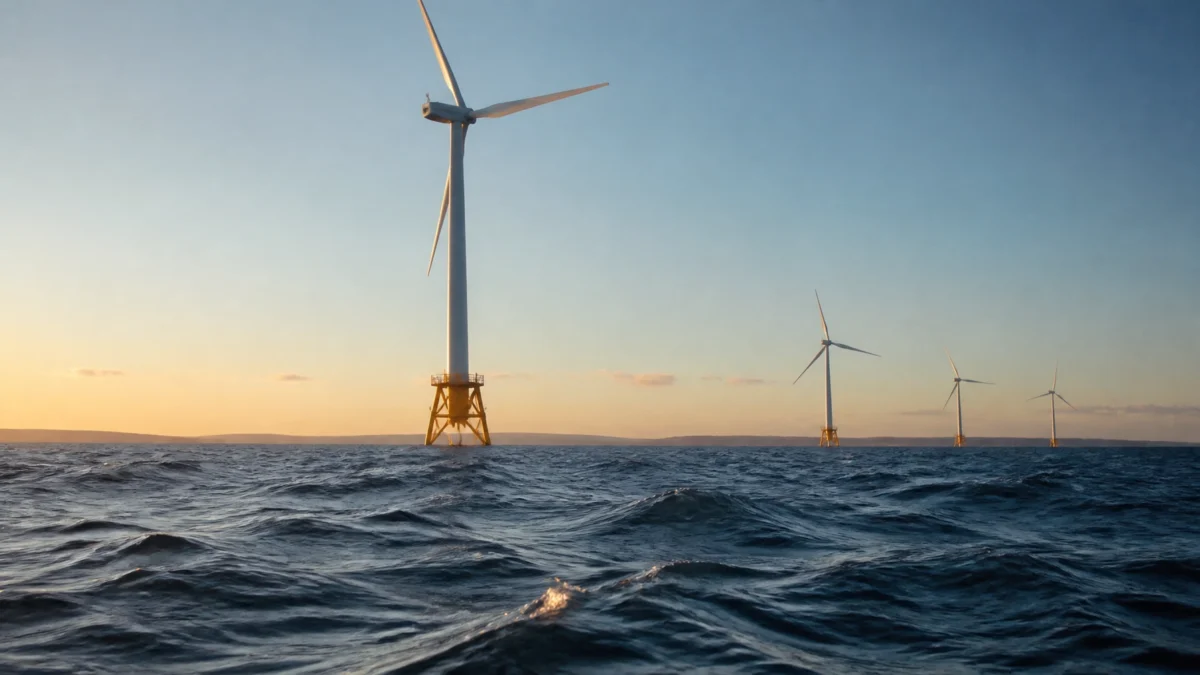
The federal government has now committed nearly $4 billion to end offshore wind lease agreements across U.S. waters. The latest deal pays German energy company RWE $1.22 billion to relinquish leases off New York, California, and Louisiana, while directing much of the company’s replacement investment toward liquefied natural gas and natural gas power generation.
The agreements represent a significant change in the direction of U.S. energy policy. They also raise questions about public spending, permitting risk, regional electricity supply, and whether replacing planned offshore wind projects with conventional energy infrastructure will produce equivalent benefits for the same markets.
The buyback program at a glance
The Trump administration has used settlement agreements to terminate offshore wind leases and reimburse developers for lease-related costs. Reporting from TechCrunch places the total at approximately $3.93 billion for 12 leases. The Associated Press has described the total as nearly $4 billion.
The program’s reported major transactions include the following:
| Developer | Reported settlement or reimbursement | Leases or projects affected | Reported replacement investment |
|---|---|---|---|
| RWE | $1.22 billion | New York Bight, California, and Louisiana | Louisiana LNG and natural gas peaking plants |
| TotalEnergies | $928 million | New York Bight and Carolina Long Bay | LNG, upstream oil, and gas projects |
| Invenergy | $765 million | New York Bight, Gulf of Maine, and California | Natural gas and geothermal projects |
| Duke Energy | $129 million | Carolina Long Bay | Nuclear, natural gas, or related generation investments |
| Golden State Wind and Bluepoint Wind | Nearly $900 million combined | California, New York, and New Jersey waters | Conventional energy projects |
The totals do not always appear consistently across reports because some coverage counts proposed settlements, related agreements, or commitments at different stages. TechCrunch’s $3.93 billion figure provides the clearest current estimate for the program as a whole.
Reported settlement amounts
RWE                         $1.22B  ████████████████████████
TotalEnergies               $0.928B ██████████████████
Invenergy                   $0.765B ███████████████
Golden State and Bluepoint  ~$0.90B █████████████████
Duke Energy                 $0.129B ██
The chart compares reported settlement values and uses rounded figures. It is not a measure of electricity capacity or completed investment.
RWE deal moves the largest amount of capital
On August 6, RWE announced that its U.S. offshore subsidiary had reached a $1.22 billion settlement with the U.S. Department of the Interior. According to RWE’s statement, the agreement resolves the company’s legal claims against the federal government and ends its offshore wind lease interests in the New York Bight, off California, and off Louisiana.
RWE said it had invested more than $1 billion in acquiring the leases and advancing the associated projects. The company also said it concluded that there was “no path forward to permit these projects in the U.S. for the foreseeable future.”
The settlement will allow RWE to redirect its capital. The company said approximately $900 million will support an indirect 16% stake in the Louisiana LNG Project. Another $300 million will fund a turbine reservation agreement connected to a pipeline of approximately 15 natural gas peaking plants.
RWE characterized the replacement projects as investments that can respond to rising U.S. electricity demand and move forward with greater certainty. RWE also continues to develop offshore wind projects outside the United States, including capacity secured in the United Kingdom’s latest offshore wind auction.
That distinction matters. RWE’s decision is not a rejection of offshore wind as a global technology. It is an exit from the U.S. market under current permitting and policy conditions.

How the earlier settlements established the pattern
The RWE agreement follows several earlier transactions.
The administration reached a reported $928 million arrangement with TotalEnergies covering leases in the New York Bight and Carolina Long Bay. AP reporting described the agreement as requiring the company to invest the money in fossil fuel projects rather than continue developing the offshore wind leases. Reported destinations included LNG and conventional oil and gas investments.
Invenergy agreed to terminate four early-stage offshore wind leases in exchange for approximately $765 million in reimbursements, according to AP reporting. The company said it would direct the money toward natural gas facilities in the Midwest and geothermal development in the western United States.
The Invenergy agreement illustrates why the administration and developers describe the arrangements as a reallocation of capital rather than a simple cancellation. Invenergy said the replacement projects could serve customers on a more commercially reasonable timeline. Offshore wind projects, by contrast, face long development schedules involving federal approvals, state decisions, transmission planning, vessel availability, turbine procurement, and coastal stakeholder negotiations.
Duke Energy’s reported $129 million settlement is associated with the Carolina Long Bay lease. Coverage of the agreement has linked the redirected investment to new nuclear and natural gas projects or other generation infrastructure in the Carolinas. Because the status and accounting of individual agreements have varied, readers should distinguish between fully executed settlements and announced or proposed arrangements.
Golden State Wind and Bluepoint Wind add nearly $900 million to the broader tally. Those agreements ended planned projects off California and the New York-New Jersey coast, with replacement investment requirements tied to conventional energy.
Why the policy matters to the wider energy system
The most immediate effect is a reduction in the U.S. offshore wind development pipeline. The canceled leases represented potential gigawatts of future generation, although potential capacity is not the same as power that had reached financial close, entered construction, or secured a final operating permit.
Offshore wind projects can provide electricity near major coastal demand centers, particularly in the Northeast and Mid-Atlantic. Removing those projects may increase the need for other sources of capacity, transmission, demand response, storage, or efficiency investments in those regions.
The replacement projects address different parts of the energy system.
Natural gas peaker plants can provide dispatchable capacity during periods of high demand or low output from other generators. They can support reliability, but they generally operate at lower utilization rates than baseload or combined-cycle plants and can have higher costs per megawatt-hour when used frequently. Their value depends on local grid conditions, fuel availability, transmission constraints, and the number of hours they operate.
LNG infrastructure serves a different purpose again. An export terminal can increase U.S. capacity to sell natural gas into global markets, potentially supporting domestic producers and strengthening relationships with overseas buyers. It can also increase exposure to global gas prices and require large, long-lived capital commitments. The project’s commercial performance will depend on construction, permitting, financing, shipping, offtake contracts, and international demand.
Nuclear energy, geothermal power, solar, battery storage, hydroelectric generation, and transmission could also play roles in replacing lost offshore wind capacity. The appropriate mix will vary by region. A gas plant in the Midwest or an LNG terminal on the Gulf Coast does not automatically provide the same local capacity, transmission value, or fuel-diversification benefit as a coastal wind project.

The central dispute is over public risk and permitting authority
The administration has framed the buybacks as a way to move investment toward reliable and affordable conventional energy. Interior officials have argued that the canceled offshore wind projects faced economic and permitting challenges and that the settlements can accelerate infrastructure capable of serving growing electricity demand.
Developers have offered a related argument. RWE said the settlements resolve legal claims and give the company a path to redeploy capital toward projects that can advance with greater certainty. Invenergy similarly pointed to supply-chain difficulties, changing regulatory requirements, and the need to serve customers on realistic timelines.
Critics, including state officials and offshore wind advocates, dispute whether the agreements provide a legitimate one-for-one replacement. In AP’s reporting, Turn Forward executive director Hillary Bright argued that natural gas or geothermal projects in other regions do not necessarily address reliability or affordability concerns in the Northeast and Mid-Atlantic.
Legal challenges also remain important. Opponents have questioned whether the Interior Department has authority to reimburse competitively awarded federal leases through settlement agreements and whether the government can condition those payments on investment in preferred energy technologies. The outcome of those challenges could affect the durability of the current agreements and the willingness of developers to enter future federal leasing rounds.
What to watch next
Energy professionals should monitor five developments.
First, courts may determine whether the federal government can terminate and reimburse offshore wind leases through the settlement structure now being used.
Second, the actual construction progress of the replacement projects will show whether the program accelerates new generation or primarily shifts capital from one development pipeline to another.
Third, turbine availability could constrain the natural gas projects. TechCrunch noted that turbine orders already face a backlog extending into the early 2030s, creating a potential gap between announced investment and operational capacity.
Fourth, coastal states and regional grid operators will need to evaluate how canceled offshore wind projects affect resource adequacy, transmission plans, capacity markets, and long-term reliability.
Finally, the program’s effect on future investment will extend beyond offshore wind. Developers in LNG, gas generation, nuclear, geothermal, solar, batteries, and transmission will assess whether federal lease rights and permits remain durable across changes in administration.
The nearly $4 billion buyback program is therefore more than a series of canceled leases. It is a test of how the United States manages energy transitions, federal permitting risk, and long-lived infrastructure. The conventional energy projects may deliver useful capacity and investment, while the loss of offshore wind could narrow regional options for electricity supply and diversification. The long-term outcome will depend less on the announcements themselves than on which replacement projects reach construction, connect to the grid, and perform for consumers.
Sources
- Associated Press on the RWE-related offshore wind buyback total
- Associated Press on the Invenergy settlement
- TechCrunch analysis of the $3.93 billion total
- RWE announcement on the $1.22 billion settlement
- Bureau of Ocean Energy Management lease and grant information
Keep In Touch with Shale Magazine
As the new era of energy unfolds, you can bet we’ll be the boots on the ground to keep you informed. Subscribe to Shale Magazine for sharp insight into the arenas that matter most to your life. And don’t forget to listen to our riveting podcast, The Energy Mixx Radio Show, where our very own Kym Bolado interviews the most extraordinary thought leaders, business innovators, and industry experts of our time.