Researchers at Los Alamos National Laboratory have reached an important milestone in advanced nuclear development after successfully bringing the experimental ZiaCore microreactor to zero-power criticality at temperatures exceeding 800°C. The achievement provides new validation for compact reactor designs that could eventually supply reliable electricity to data centers, industrial facilities, military installations, and remote communities.
The achievement, realized during a four-week experimental campaign on the Deimos testbed at the National Criticality Experiments Research Center (NCERC) in Nevada, represents a crucial proof-of-principle demonstration for advanced fission engineering. By operating at high temperatures while maintaining a controlled nuclear chain reaction at zero power, LANL researchers validated core reactor physics, temperature coefficients of reactivity, and thermal-hydraulic models without the complications of high fuel burnup or intensive radiation fields.
As industrial electricity demand surges under the weight of artificial intelligence data center expansion, advanced manufacturing growth, and ongoing grid reliability challenges, the successful testing of modular, factory-fabricated microreactors offers a potential pathway toward resilient, carbon-free baseload power.
Engineering the ZiaCore Architecture
Developed entirely within LANL’s internal Laboratory Directed Research and Development (LDRD) program, ZiaCore is intended to address the economic and logistical barriers that have historically limited nuclear deployment. Traditional large reactors typically require long construction schedules, extensive site work, and high upfront capital commitments. Microreactors are being designed around a different commercial model: factory manufacturing, standardized components, transportable modules, and shorter installation timelines that could reduce both project risk and financing pressure for customers.

The ZiaCore design still relies on established nuclear engineering principles, including low-enriched fuel, compact moderation, and passive heat removal. But the larger commercial point is that these systems are being developed to simplify deployment in locations where large conventional reactors or new transmission infrastructure may be impractical.
For potential end-users, that matters because deployment flexibility can directly affect economics. Data center operators, mining companies, industrial manufacturers, and defense installations are increasingly looking for generation assets that can be delivered on predictable schedules, operate independently of congested grids, and provide long-duration power with lower fuel logistics exposure than diesel-based alternatives.
“The objective of the ZiaCore project was to design a microreactor that marries robust safety physics with commercial fuel accessibility,” LANL representatives noted regarding the development roadmap.
Inside the NCERC High Temperature Campaign
The recent experimental campaign took place at NCERC, a specialized nuclear facility operated by LANL in the Nevada desert that serves as the nation’s premier center for critical experiments and advanced reactor physics testing.
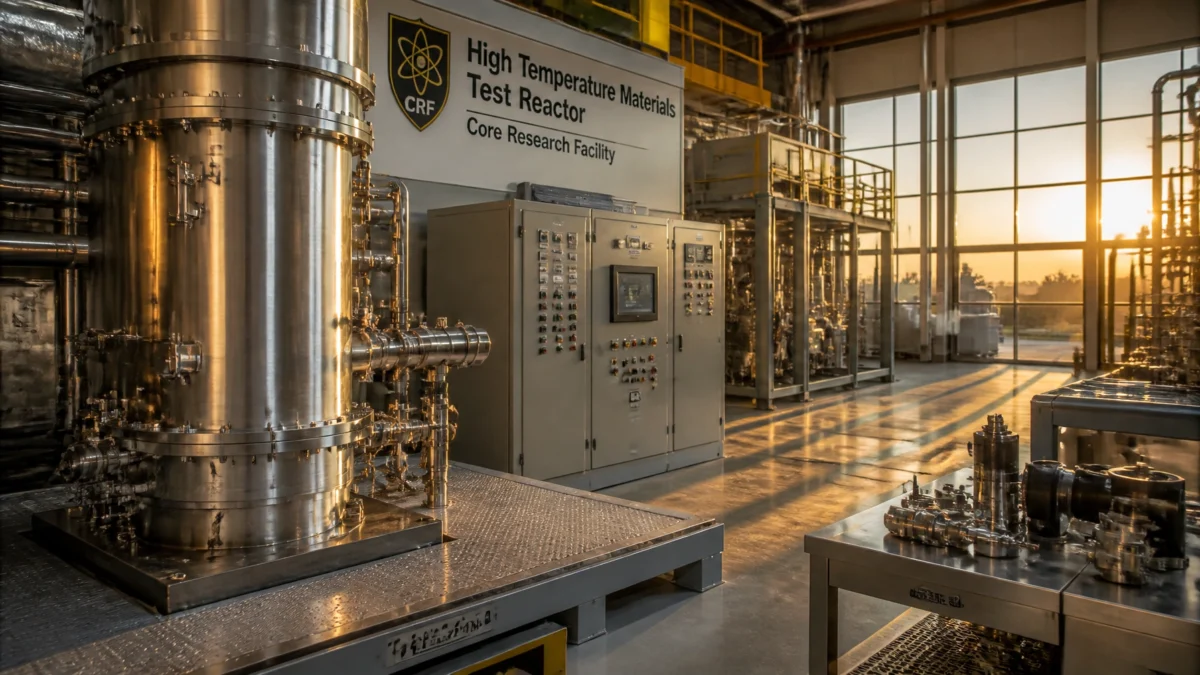
During the test series conducted on the Deimos electrically heated vacuum-chamber testbed, researchers brought the ZiaCore assembly to sustained, controlled zero-power criticality while maintaining the central core above 800°C. In reactor physics, “zero-power” testing means that a sustained fission chain reaction is achieved, but at a microscopic power level that generates virtually no net thermal energy. This allows scientists to measure exact neutronics, reactivity feedback mechanisms, and structural behavior at operating temperatures without generating high-level radioactive waste or stressing structural materials prematurely.
Christopher Stanek, Director of the LANL Nuclear Energy Program Office, emphasized that the campaign provided critical empirical data necessary to bridge theoretical design models with physical reality. Topher Matthews, principal investigator for the ZiaCore project, highlighted that the tests successfully verified the predicted temperature coefficients of reactivity: the mathematical measure of how a reactor’s power output naturally stabilizes as internal temperatures rise.
According to project updates from LANL, the data confirmed that during the Deimos test campaign the reactor physics models underlying ZiaCore perform exactly as anticipated under high-temperature operating conditions. Analysts following advanced nuclear development noted, “This empirical validation is a necessary prerequisite before attempting non-zero power operations with active heat generation.”
Policy Momentum and Federal Energy Strategy
The successful testing of the ZiaCore microreactor occurs against a backdrop of federal policy initiatives designed to revitalize domestic nuclear technology. Building upon recent executive orders issued under the Trump administration aimed at accelerating advanced nuclear deployment, the Department of Energy and related agencies have increasingly prioritized projects that strengthen domestic energy security and manufacturing capabilities.
Recent Department of Energy policy documents and executive actions have emphasized that grid reliability cannot be sustained solely through variable renewable generation and battery storage. As industrial electrification accelerates, dispatchable, zero-emission generation sources capable of operating independently of weather conditions are viewed by Department of Energy officials and industry leaders as vital components of the national energy grid.
The Department of Energy describes its broader advanced reactor initiatives as a cornerstone of national competitiveness, connecting federal laboratory research directly to commercial industry partnerships. By leveraging national testbeds like NCERC, government researchers can de-risk early-stage engineering concepts, allowing private-sector developers to commercialize designs with greater confidence in regulatory approval.
That national laboratory role is especially relevant for the private sector. Companies including Westinghouse, BWXT, Oklo, X-energy, TerraPower, and NuScale are pursuing different advanced reactor strategies, but they broadly share an interest in proving fuel performance, passive safety behavior, materials durability, and licensing pathways. In that context, Department of Energy research is not the commercial market itself; it is foundational science that can support a wider deployment effort across multiple reactor developers and end-use markets.
Implications for the Broader Energy Ecosystem
The maturation of microreactor technology like ZiaCore carries significant implications for the broader energy mix:
- Grid Reliability and Industrial Co-Location: Unlike large gigawatt-scale reactors that require massive transmission interconnects, microreactors in the 1 to 20 megawatt range can be co-located directly behind-the-meter at heavy industrial facilities, data center campuses, or remote military installations, bypassing transmission congestion.
- Synergy with Natural Gas and Renewables: Advanced nuclear systems provide continuous baseload power that complements natural gas peaking units and variable wind and solar generation, enhancing overall system resilience.
- National Security and Remote Power: Communities and installations isolated from main transmission grids: including remote mining operations and Arctic military outposts: stand to benefit from reliable energy supplies that eliminate reliance on diesel fuel logistics.
Why the Energy Industry Should Care
For energy professionals, the commercial appeal of microreactors is tied less to laboratory novelty and more to where they could fit within real operating markets. AI data centers are driving rapid growth in electricity demand and are increasingly searching for reliable, 24/7 behind-the-meter power that does not depend entirely on strained regional grids. Mining operations and other remote industrial sites need dependable off-grid electricity that can reduce exposure to diesel fuel transport costs and supply disruptions.
Military installations are another closely watched use case because resilient on-site power can support energy security during grid outages or physical disruptions. Industrial facilities may also see value in microreactors if the technology can eventually deliver dependable electricity and process heat with predictable operating profiles. At the same time, growing transmission congestion in several U.S. regions is increasing the value of generation resources that can be deployed directly at or near the point of consumption rather than waiting years for major grid upgrades.
At the same time, experts caution that significant hurdles remain before commercial microreactors become commonplace. Supply chain constraints for HALEU fuel, regulatory licensing timelines established by the Nuclear Regulatory Commission (NRC), and initial capital cost competitiveness against natural gas generation will all influence market adoption rates.
Outlook and Future Milestones
The successful high-temperature critical demonstration at NCERC marks a definitive end to the initial proof-of-principle research phase for the ZiaCore concept. According to program updates, LANL researchers are now analyzing the comprehensive dataset generated during the Deimos campaign to refine subsequent prototype iterations.
Whether the ZiaCore design: and similar advanced microreactor concepts currently progressing through national laboratories and private ventures: ultimately achieves widespread commercial success will depend not only on continued federal research funding and favorable policy frameworks, but also on rigorous manufacturing scale-up, regulatory efficiency, and verified economic performance in real-world operating environments.
Future testing, regulatory licensing, manufacturing readiness, and commercial deployment will determine whether microreactors evolve from successful laboratory demonstrations into economically competitive energy assets. Those milestones, rather than the initial research achievements alone, will ultimately determine their role within the future U.S. energy system.
Keep In Touch with Shale Magazine
As the new era of energy unfolds, you can bet we’ll be the boots on the ground to keep you informed. Subscribe to Shale Magazine for sharp insight into the arenas that matter most to your life. And don’t forget to listen to our riveting podcast, The Energy Mixx Radio Show, where our very own Kym Bolado interviews the most extraordinary thought leaders, business innovators, and industry experts of our time.
Subscribe to get more posts from Amanda Jenkins