The White House is preparing to extend the Jones Act shipping waiver as part of a federal strategy to ease refined fuel logistics and curb rising gasoline prices.
According to reporting by Reuters, the administration is weighing a fresh extension of the maritime waiver beyond its scheduled mid-August expiration. The policy response comes as ongoing geopolitical conflict with Iran and resulting shipping bottlenecks around the Strait of Hormuz continue to strain global crude supplies and drive up retail pump prices across the United States.
While the administration views the shipping relief as a vital signal of action, energy analysts and maritime data emphasize that the practical impact on consumer prices will likely remain modest, highlighting the complex realities governing domestic fuel logistics and international petroleum trade.
Understanding the Jones Act Waiver and Logistics
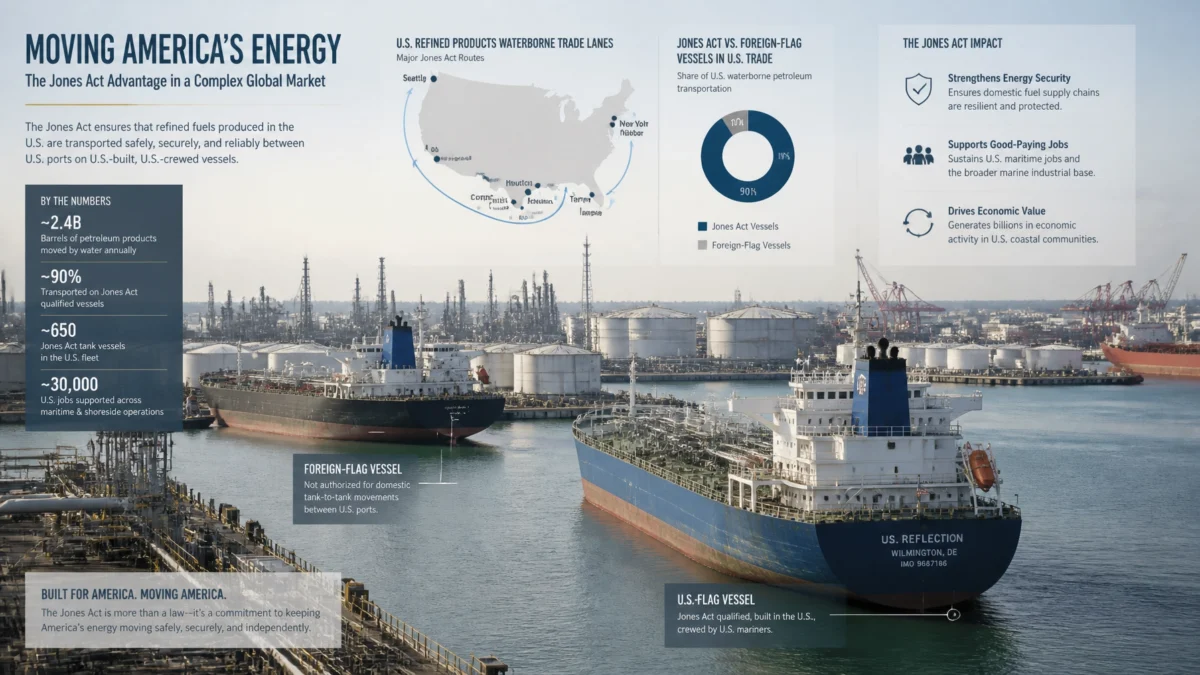
Enacted in 1920, the Merchant Marine Act: commonly known as the Jones Act: requires that all goods transported by water between U.S. ports be carried on vessels that are built in the United States, fly the U.S. flag, and are crewed by American citizens. Under normal market conditions, this statutory framework protects domestic maritime manufacturing and labor. However, during acute energy supply shocks, the White House holds executive authority to temporarily waive these restrictions.
President Trump initially suspended Jones Act restrictions for 60 days on March 17, 2026, to facilitate energy and agricultural shipments amid supply disruptions linked to Iran. In late April, the administration approved a 90-day extension, pushing the expiration date to August 16. With that deadline approaching, Reuters reported that the administration is actively preparing a further extension, making this the longest uninterrupted suspension in the program’s history, with nearly 200 individual waiver uses recorded over four and a half months through July.
By allowing foreign-flagged tankers to move refined petroleum products: such as gasoline and diesel: between U.S. coastal ports, the Department of Homeland Security and the Department of Energy aim to alleviate regional bottlenecks and expand the pool of available vessels.
Geopolitical Pressures and the Strait of Hormuz
The necessity for continuous shipping waivers stems directly from military and diplomatic friction in the Middle East. The conflict involving Iran has triggered near-closure conditions in the Strait of Hormuz, a critical maritime chokepoint through which more than 20 million barrels of petroleum per day: roughly 20% of global oil consumption: normally moves.
| Metric / Indicator | Pre-Crisis Level | Peak Crisis Level (May 2026) | Market Implication |
|---|---|---|---|
| Strait of Hormuz Flow | ~20 Million bpd | Heavily Disrupted | Constrained global crude supply |
| U.S. National Average Gasoline | ~$3.20 / gallon | $4.49 / gallon | Increased transportation and refining costs |
| California Retail Gasoline | ~$4.80 / gallon | $6.11 / gallon | Severe regional import dependency |
| Waiver Cargo Volume | 0 bpd (Protected) | ~84,000 bpd | Modest coastal relief |
The war and resulting maritime threats have spiked global crude prices and disrupted tanker routing. Many international vessels found themselves either trapped inside the Persian Gulf or demanding exorbitant premium rates to service volatile routes. As gasoline prices surged nationwide: climbing from a pre-crisis national average to $4.49 per gallon by late May, with California averaging $6.11 per gallon: the White House faced mounting political pressure to deploy every available federal tool.

Quantifying the Impact on Consumer Prices
Despite the widespread utilization of foreign-flagged tankers under the waivers, energy analysts and data providers caution that maritime policy changes cannot fully offset global commodity price shocks.
Reuters analysis of cargo movements under the waiver program indicates that combined shipments reached approximately 84,000 barrels per day. While meaningful for specific regional logistics, this figure represents a small fraction of total U.S. gasoline consumption, which exceeds 8.75 million barrels daily.

Regional impacts have varied sharply across U.S. markets:
- California and West Coast: California received more than 60% of all gasoline and blendstock cargoes moved under the waivers: totaling approximately 3 million barrels, or 2.1 million gallons per day (roughly 6% of the state’s daily consumption). Energy analysts calculated that substituting Jones Act vessels with foreign-flagged tankers saved consumers approximately 6.6 cents per gallon, amounting to a roughly 1% reduction in retail prices.
- U.S. East Coast: On the Atlantic seaboard, high international tanker rates driven by competing Asian demand meant that it was frequently cheaper for fuel distributors to utilize domestic Jones Act tankers rather than foreign vessels, muting the waiver’s utility in that market.
Energy analyst Robert McNally told Reuters that the Jones Act waiver successfully increases tanker availability for moving fuel but will likely reduce gasoline prices by only “pennies per gallon.” Similarly, GasBuddy analyst Patrick De Haan noted that while waivers can slow the velocity of price spikes in import-dependent coastal hubs by roughly 5 cents per gallon per day, broader retail trends remain inextricably linked to Middle Eastern crude supply dynamics.
Broader Energy System and Policy Context
The administration’s decision to extend shipping waivers does not occur in a vacuum. It forms part of a multi-pronged federal response that includes coordinating strategic petroleum inventory releases and pursuing diplomatic engagements to secure safe passage through the Strait of Hormuz.
At the same time, the administration has navigated competing domestic pressures. While consumer advocates and coastal governors welcomed any measure to trim fuel costs, domestic maritime labor unions and U.S. shipbuilders have consistently voiced concerns over the long-term precedent of suspending domestic shipping laws. Furthermore, President Trump’s recent public criticism of major oil refiners over corporate margins: while simultaneously resisting calls for direct crude export bans: reflects a delicate balancing act between encouraging domestic production and offering immediate relief to retail consumers.
From an infrastructure perspective, the episode underscores the vulnerability of domestic refined product distribution networks. Refining capacity concentrations on the U.S. Gulf Coast mean that coastal consuming states rely heavily on efficient maritime logistics. When tanker availability tightens, regional price spreads widen dramatically, exposing structural bottlenecks in pipeline and marine transport networks.

Market Outlook and What to Watch Next
As the White House moves toward formalizing a further extension of the Jones Act waiver beyond August 16, industry stakeholders and market analysts are monitoring several critical indicators:
- Diplomatic Developments: Progress in negotiations to normalize maritime transit through the Strait of Hormuz remains the single most influential variable governing global crude benchmarks and tanker freight rates.
- Refinery Turnarounds and Seasonal Demand: As the summer driving season transitions into autumn refinery maintenance schedules, regional inventory levels will dictate whether coastal price spreads remain elevated.
- Freight Rate Adjustments: Observers are tracking international tanker charter rates to determine whether foreign-flagged vessels maintain a cost advantage over domestic U.S. tonnage.
- Legislative and Agency Scrutiny: Lawmakers in both parties are evaluating the long-term efficacy of emergency maritime waivers versus permanent investments in domestic pipeline capacity and strategic fuel reserves.
Whether the continued deployment of shipping waivers ultimately delivers meaningful relief to consumers will depend not only on administrative decisions but also on broader geopolitical stability, regional refinery output, and global tanker fleet availability. As trade flows adapt, the effectiveness of federal logistics interventions will be judged by measurable market outcomes rather than policy announcements alone.
Keep In Touch with Shale Magazine
As the new era of energy unfolds, you can bet we’ll be the boots on the ground to keep you informed. Subscribe to Shale Magazine for sharp insight into the arenas that matter most to your life. And don’t forget to listen to our riveting podcast, The Energy Mixx Radio Show, where our very own Kym Bolado interviews the most extraordinary thought leaders, business innovators, and industry experts of our time.
Subscribe to get more posts from Amanda Jenkins