
ENMG Analysis
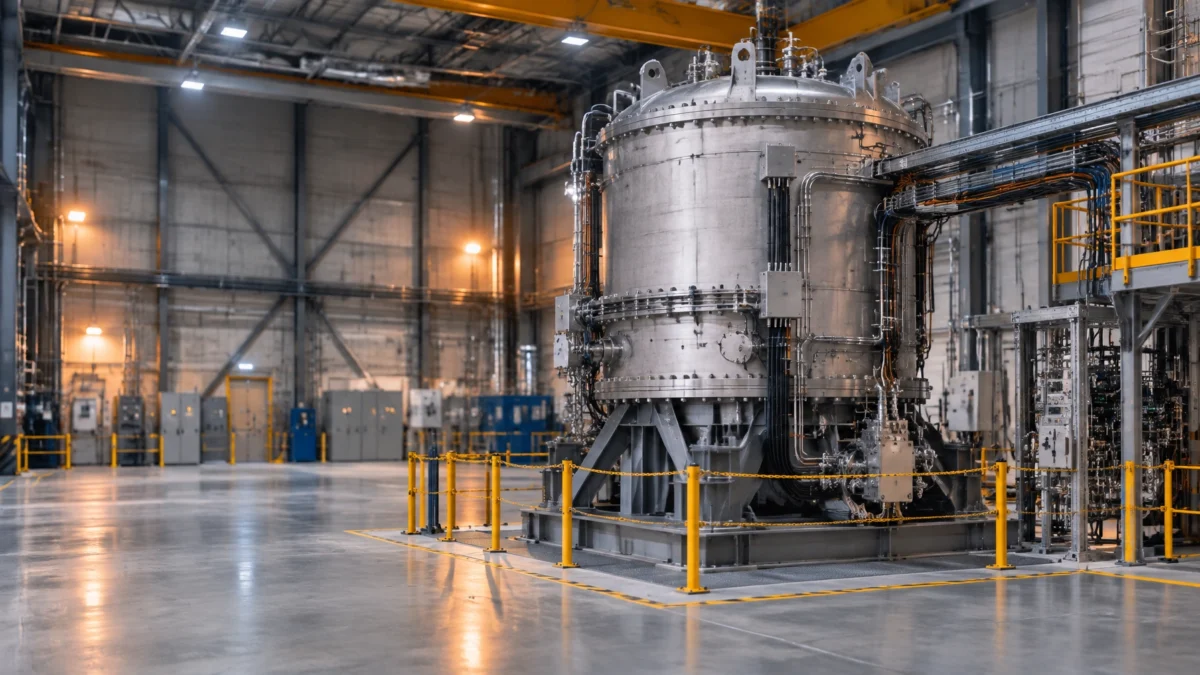
Deployable Energy has been selected to conduct the second reactor trial at the Demonstration of Microreactor Experiments, or DOME, facility at Idaho National Laboratory in 2027. The Houston-based company plans to test its 1-megawatt-electric Nuclear Unity Battery, a transportable microreactor that uses light-water moderation and helium cooling.
The National Reactor Innovation Center announced the selection after evaluating applications submitted during the latest competitive process. The campaign will be self-funded and follows Radiant’s inaugural DOME test earlier in 2026.
The selection matters because it moves Deployable Energy’s design from an earlier criticality milestone toward a higher-power demonstration in a dedicated, contained facility. It also places the Unity reactor within a broader federal effort to create test pathways for advanced reactors before they enter the commercial licensing process.
From criticality to power operation
Deployable Energy’s Unity reactor achieved criticality late on June 30, 2026, with the Department of Energy announcing the milestone on July 1. The company was one of the reactors that met the July 4 criticality target established under Executive Order 14301.
Criticality is an important nuclear engineering milestone, but it does not mean that a reactor is producing electricity for customers. In a zero-power or low-power criticality test, operators establish and measure a self-sustaining nuclear chain reaction while keeping thermal power near the minimum needed to evaluate reactor physics and system behavior.
Such a test can provide information about fuel behavior, neutron distribution, control systems, instrumentation and predicted operating margins. It does not, by itself, demonstrate sustained heat removal, electricity generation, power-conversion performance or long-duration operation.
That distinction is central to the next phase. The DOME campaign is intended to move the Unity design toward higher-power operation in a facility built to manage fueled microreactor experiments. The result should be a more demanding test of the reactor’s controls, heat-transfer systems, safety procedures and integration with electrical equipment.

What a nuclear battery actually is
The term “nuclear battery” can create confusion because it does not describe an electrochemical battery like those used in electric vehicles or grid-scale energy storage systems.
In this context, a nuclear battery is a sealed, transportable reactor designed for long periods of operation with limited onsite intervention. It generates heat through fission and uses a power-conversion system to turn that heat into electricity. The reactor is intended to be moved as a packaged unit or in large transportable components, depending on the final design and applicable regulations.
A conventional microreactor also produces relatively small amounts of power compared with a large commercial nuclear plant. The distinction is that “microreactor” describes the reactor’s scale and deployment concept, while “nuclear battery” emphasizes the Unity system’s sealed, transportable and potentially long-duration operating model.
Neither term should be confused with a grid-scale battery. An electrochemical battery stores electricity produced elsewhere and releases it later. A nuclear battery generates electricity continuously from nuclear fuel, subject to operating limits, maintenance requirements, fuel management and regulatory controls.
That distinction affects the markets the technology could serve. A transportable reactor could eventually be considered for remote industrial sites, isolated communities, military installations, maritime applications or high-value commercial loads. But those applications would require more than a successful reactor test. They would also depend on transportation approvals, security arrangements, fuel logistics, site licensing and economics.
Understanding the power numbers
Deployable Energy’s Nuclear Unity Battery is designed to produce 1 MWe, or one megawatt of electric output. DOME, meanwhile, is designed to host fueled experiments producing up to 20 MWt, or 20 megawatts of thermal energy.
Those are different measurements.
- MWt measures heat produced by the reactor.
- MWe measures electricity delivered after the heat passes through a power-conversion system.
A reactor’s thermal output is higher than its electric output because no heat engine converts all reactor heat into electricity. Some energy is rejected through cooling systems, while additional power is consumed by pumps, controls and other plant equipment. The precise relationship depends on the reactor’s operating temperature, coolant, turbine or power-conversion technology and overall plant design.
For that reason, a 1-MWe reactor does not represent a 1-MWt thermal system, and the 20-MWt DOME limit is not the amount of electricity the facility can deliver to the grid. Instead, the DOME limit defines the maximum thermal scale of experiments the test bed is designed to accommodate. Deployable Energy’s planned unit would operate well below that ceiling based on its stated electric rating, although the reactor’s final thermal rating and test conditions will determine the exact operating profile.

Why the Unity design is technically unusual
The Unity reactor is described as light-water moderated and helium cooled. Each term refers to a different function inside the reactor system.
A moderator slows neutrons produced by fission. Slower neutrons can increase the likelihood of further fission in certain fuel and core arrangements, helping sustain the chain reaction. Light water, or ordinary water, is widely used as a moderator in commercial nuclear reactors.
The coolant performs a separate job. It carries heat away from the reactor core and transfers that heat to a power-conversion system or another heat-transfer loop. In the Unity design, helium serves as the coolant. Helium is chemically inert and has a low tendency to become radioactive through neutron activation. However, the radiological behavior of a helium coolant system still depends on impurities, tritium production, operating conditions and interactions with reactor materials.
Combining light-water moderation with helium cooling is an unusual arrangement because the moderator and coolant are not the same material. That separation can provide design flexibility, but it also creates additional engineering requirements. The reactor must control water placement and behavior in the core while maintaining reliable helium circulation and heat transfer. The test campaign will be important for determining how those systems perform together outside a physics-only demonstration.
What DOME provides and what it does not
DOME opened in April 2026 inside a repurposed containment structure at Idaho National Laboratory. The facility is designed to host fueled microreactor experiments producing up to 20 MWt in a controlled environment.
NRIC describes DOME as a test capability for advanced reactor developers seeking operational data before commercial deployment. The facility provides containment, instrumentation, safety systems and a federal research setting in which developers can conduct experiments under DOE authorization.
That pathway is different from commercial licensing by the Nuclear Regulatory Commission. A reactor tested at a DOE national laboratory is operating under the authorization, safety analysis and site controls established for that federal facility. A commercial reactor deployed at a private industrial site, data center or maritime location would require a separate regulatory pathway involving the NRC and potentially other federal, state and local authorities.
Testing under DOE authorization can reduce some barriers to obtaining early data, but it does not constitute commercial approval. Results from DOME could support future licensing work, but they will not eliminate the need for site-specific reviews, environmental analysis, security planning, emergency preparedness and fuel controls.

A broader test program is taking shape
Deployable Energy’s DOME campaign is one part of a broader development program. The DOME experiment is the company’s planned full-power demonstration at INL. Deployable Energy has also been selected for a separate maritime demonstration with Hornbeck Offshore under the second round of the Nuclear Energy Launch Pad.
The two demonstrations could allow Deployable Energy to examine the Unity technology in different operating contexts. The contained DOME experiment can evaluate reactor performance, electricity production, heat removal, controls and system integration at full power. The maritime demonstration would introduce different requirements involving vessel integration, space constraints, motion, maintenance access, emergency response and offshore security.
The company’s criticality milestone and the broader July 4 reactor achievements are discussed in ENMG’s coverage of the July 4 criticality milestone. The next tests will need to show whether initial reactor physics results can translate into reliable power production.
The development also arrives as federal policymakers examine ways to expand nuclear capacity to support rising electricity demand. The DOE’s nuclear capacity expansion strategy focuses heavily on existing nuclear assets and larger capacity additions, while microreactors represent a separate pathway based on modular manufacturing and distributed deployment.
What to watch in 2027
Several issues will determine the significance of the DOME test:
- Whether the Unity reactor reaches and maintains its planned power level
- How effectively helium removes heat under operating conditions
- Whether the power-conversion system produces usable electricity
- How the reactor responds to startup, shutdown and load changes
- What fuel and component performance data the campaign produces
- Whether the results support the company’s full-power and maritime demonstrations
- How DOE and NRC authorities treat data from the federal test environment
- What transportation, security and siting requirements emerge for commercial deployment
The potential benefit of a transportable reactor is not simply its size. The value would come from combining reliable generation with a deployment model that can serve locations where transmission expansion, fuel delivery or conventional plant construction is difficult.
The limitations are equally important. A reactor that can be transported still requires a controlled supply chain, secure handling, trained operators, regulatory approval and a plan for fuel management and eventual decommissioning. It must also compete with natural gas generation, renewable power paired with storage, grid upgrades and other firm-power options.
Deployable Energy’s 2027 DOME trial will not settle those questions. It will, however, provide an opportunity to test whether a nuclear battery can move beyond criticality and toward sustained power operation in a contained, federally authorized environment. For the advanced nuclear sector, that transition is one of the most consequential steps between a working reactor concept and a commercially deployable energy system.
Keep In Touch with Shale Magazine
As the new era of energy unfolds, you can bet we’ll be the boots on the ground to keep you informed. Subscribe to Shale Magazine for sharp insight into the arenas that matter most to your life. And don’t forget to listen to our riveting podcast, The Energy Mixx Radio Show, where our very own Kym Bolado interviews the most extraordinary thought leaders, business innovators, and industry experts of our time.