
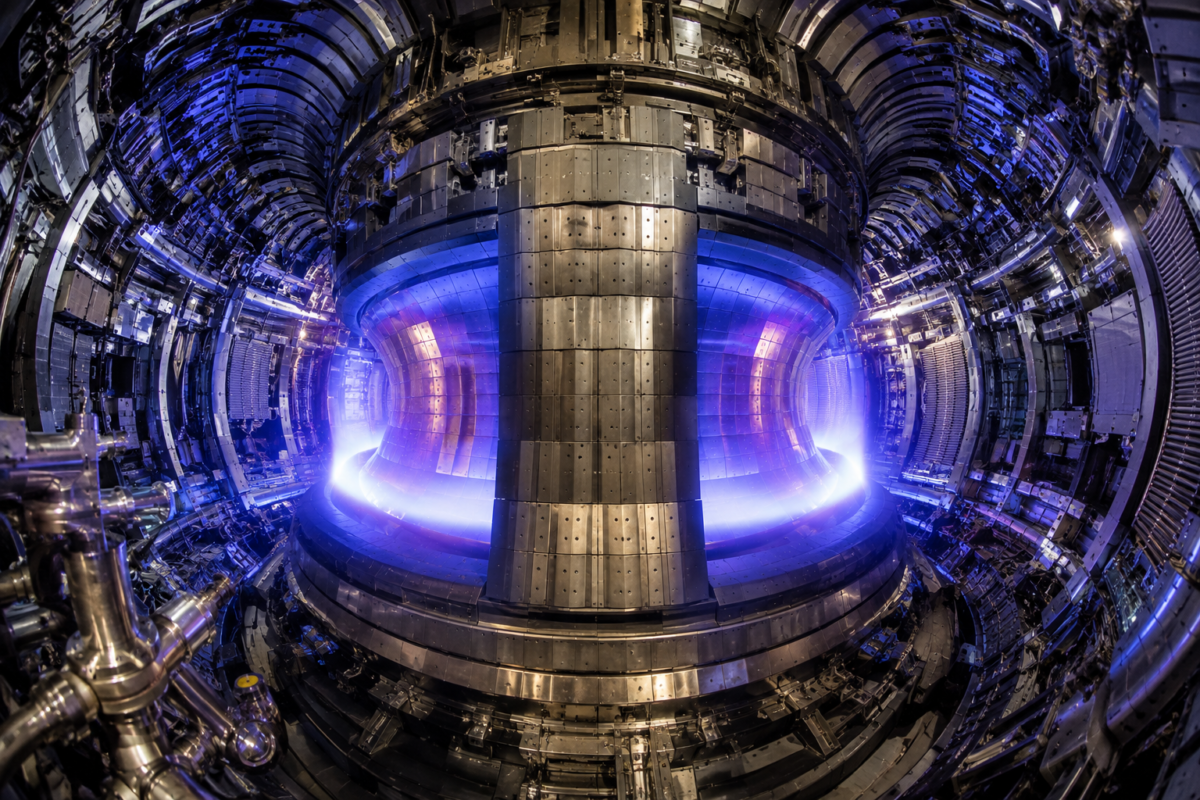
Researchers have been racing to achieve commercial nuclear fusion for decades, aiming to produce abundant clean power without relying on fossil fuels or intermittent energy sources.
Following several laboratory breakthroughs in recent years, there is greater hope that fusion may finally be achieved. With the world’s power demand projected to rise in line with the rapid deployment of power-hungry data centers, this could not come at a better time.
Fission versus Fusion – What’s the Appeal?
Nuclear fusion takes place when two atomic nuclei combine to form a heavier nucleus, releasing a large amount of energy. To make that happen on Earth, scientists must recreate some of the extreme conditions found inside stars, particularly temperatures high enough for atomic nuclei to overcome their natural repulsion and fuse.
By contrast, nuclear fission, the process used in today’s commercial nuclear power plants, releases energy by splitting the nucleus of a heavy atom into smaller nuclei, some of which are radioactive. The reaction also releases additional neutrons, which can split other atoms and sustain a controlled chain reaction. That process allows fission reactors to produce large amounts of reliable electricity, but it also creates highly radioactive spent fuel that must be carefully handled, stored and isolated for long periods. Concerns about that radioactive waste, along with the possibility of severe reactor accidents, remain among the most persistent public objections to nuclear power.
Fusion would have a different risk profile. The reaction is not a self-sustaining chain reaction, so if the conditions needed for fusion are lost, the process stops rather than continuing toward a meltdown. Fusion would not eliminate radioactivity altogether; high-energy neutrons can make reactor components radioactive, and some proposed systems would use radioactive tritium. However, fusion is expected to produce far less long-lived radioactive waste than conventional fission and would not generate the same kind of spent nuclear fuel.
Approaching a “Critical Moment”
There is currently no functional fusion power plant or prototype. For decades, researchers have repeatedly said that achieving commercial fusion power will take “another 30 years”, due to limitations to progress. However, recent laboratory breakthroughs in various parts of the world, led by the European Union, the United States, Russia, and Japan, suggest that this timeline may finally have improved.
The Fusion Industry Association 2026 report on The Global Fusion Industry showed that private fusion companies raised $4.5 billion between January and July 2026, bringing total investment since its first survey in 2021 to $14.2 billion across the 56 companies who responded.
This year, scientists at UC Davis and Lawrence Berkeley National Laboratory have made significant advances in fusion reactor construction by focusing on materials that help maximize efficiency and reduce the temperature at which fusion can reliably occur, according to a July research paper.
“Instead of designing materials just to survive the harsh conditions of fusion, researchers might be able to design materials that boost the reaction in specific conditions, similar to the way catalysts speed up chemical processes,” the scientists stated in a press release.
A Nuclear Regulatory Commission Framework
The U.S. Nuclear Regulatory Commission (NRC) proposed a new framework to regulate fusion machines in February, following calls from fusion developers for fusion-specific regulations. Until now, they have been required to adhere to regulations created for fission reactors, even though they do not pose meltdown risks.
If approved, new NRC regulations could make it easier for developers to progress faster. Andrew Proffitt, the Senior Director of Regulatory Policy at nuclear fusion company Helion Energy, explained that under the new rules, “licensing happens on the scale of months to a year rather than the years or even a decade a fission reactor can face, because the focus is on safely controlling the material, not reviewing a reactor design.”
Advances in Deployment
Several U.S. companies are now aiming to achieve the commercial rollout of nuclear fusion operations within the next decade. Helion aims to deploy its first fusion plant by 2028 and has signed a deal with Microsoft for 50 megawatts (MW) of power from the project.
Massachusetts-based Commonwealth Fusion Systems expects to launch its first “commercially relevant” demonstration plant online in 2027, and to achieve grid-scale fusion generation in service in Virginia by the early 2030s. Commonwealth has already signed a 200-MW power purchase agreement with Google.
Meanwhile, Inertia raised $450 million in a funding round in February and aims to break ground on its first commercial-scale fusion pilot plant by 2030.
Is the United States Prepared for Fusion Power?
While several companies are making significant advancements, the question now is whether the Trump administration is prepared for the commercial rollout of fusion power plants. Several nuclear fusion companies are urging the federal government to support the sector with higher levels of public funding to help make the U.S. more competitive with countries such as China.
Representatives from Commonwealth reportedly told POLITICO Magazine that without a more robust cost-sharing investment from the federal government to help fusion companies develop pilot power plants and establish a supply chain, the industry will not be able to scale. Trent Bauserman, a former Biden staffer who now runs federal relations for Commonwealth, explained, “We’re at the limits of what private capital can support.”
The breakthroughs in fusion power that have taken place over the last decade have spurred greater optimism about the commercial rollout of fusion operations over the coming decade. However, several energy firms believe that a higher level of public funding is required to make the progress needed to achieve commercial nuclear fusion ahead of other nuclear powers, such as China.
Keep In Touch with Shale Magazine
As the new era of energy unfolds, you can bet we’ll be the boots on the ground to keep you informed. Subscribe to Shale Magazine for sharp insight into the arenas that matter most to your life. And don’t forget to listen to our riveting podcast, The Energy Mixx Radio Show, where our very own Kym Bolado interviews the most extraordinary thought leaders, business innovators, and industry experts of our time.
Subscribe to get more posts from Amanda Jenkins