

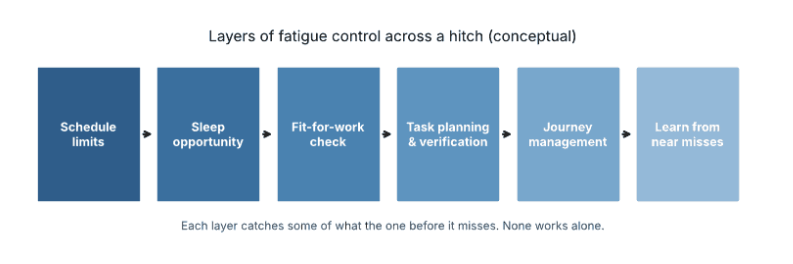
Abstract. Long hitches, 12-hour shifts and long drives are normal in oilfield work, and so is fatigue. This article looks at what investigators found when fatigue went unmanaged, from the 2005 BP Texas City refinery explosion to highway crashes after long shifts, and sets out six practical controls supervisors can put in place: schedule limits, protected sleep, fit-for-work checks, task planning, journey management and learning from near misses.
It is day twelve of a fourteen-day hitch. The crew has been on nights since the rig move. At four in the morning, a hand walks out to re-check a valve line-up he has checked a hundred times before. He probably gets it right. The problem with fatigue is that nobody on the pad, including him, can say that for sure.
Tired crews are so normal in field operations that the risk fades into the background. The investigation record says it should not.
What the investigations found
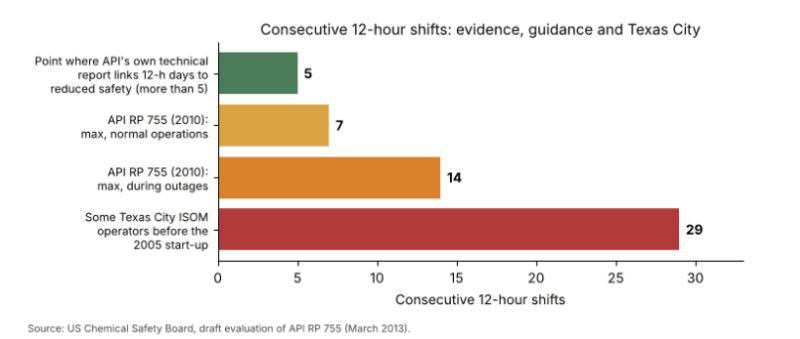
On 23 March 2005, the isomerization unit at BP’s Texas City refinery exploded during start-up, killing 15 people and injuring 180. The US Chemical Safety Board (CSB) concluded that the unit’s operators were likely fatigued. They had been working 12-hour shifts, some for as many as 29 consecutive days during the turnaround. The CSB said their judgment and problem-solving were likely degraded, which made it harder for them to see that the tower was overfilling and act in time.
The CSB asked the industry to write a fatigue standard, and API published Recommended Practice 755 in 2010. In a 2013 draft evaluation, the CSB pointed out a gap: API’s own technical report linked more than five consecutive 12-hour days, or more than 60 hours a week, to reduced safety, yet the RP allowed seven consecutive 12-hour days in normal operations and fourteen during outages. Figure 1 puts those numbers side by side.
The UK Health and Safety Executive (HSE) lists fatigue as a root cause in major accidents including Texas City, Clapham Junction and the Exxon Valdez. It notes that accidents and injuries are more frequent on night shifts, after a run of consecutive shifts, on long shifts and where breaks are inadequate. It also warns that meeting working-time rules alone does not manage fatigue.
Then there is the drive home. NIOSH says motor vehicle crashes are the leading cause of death in US oil and gas extraction. Its fact sheet on fatigued driving describes three workers who set off on a 10-hour trip home after a 20-hour shift. About 25 miles down the road the driver fell asleep, the vehicle rolled, and two of the three were killed. None was wearing a seat belt.
The physiology is not subtle. In a 1997 study in Nature, Dawson and Reid found that after 17 hours awake, performance on a tracking task fell to the level seen at a blood alcohol concentration of 0.05 percent; after 24 hours awake, it matched 0.10 percent. Most sites would never let someone work at 0.05. Plenty let people work after 17 hours awake.
Six controls that work on a pad
1. Put hard limits into the schedule
Decide before the hitch starts how many consecutive shifts, how many hours of holdover and how many back-to-back extensions are acceptable, and who can approve an exception. HSE advises a written policy that sets limits on working hours, overtime and shift-swapping, backed by a system that records them. If the records show overtime creeping up week after week, that usually points to a staffing gap, not a scheduling one.
2. Protect the sleep opportunity
A schedule only gives people the chance to sleep; the camp decides whether they get it. HSE notes that night workers’ daytime sleep is often lighter, shorter and easily disturbed by noise and daylight. Dark, quiet rooms for day sleepers, sensible changeover times and limits on calls to off-shift crews cost little and pay back every night of the hitch.
3. Make “I’m not fit for this” a normal thing to say
Add a short fatigue question to the pre-shift toolbox talk: hours slept in the last 24, hours awake now. Supervisors should know the signs HSE lists, such as slower reactions, memory lapses, absent-mindedness and underestimating risk, and act on them without blame. A worker who reports being too tired to work safely has done exactly what the system needs.
4. Plan critical tasks around the low points
Where operations allow, keep safety-critical jobs such as line breaks, heavy lifts and complex start-up steps out of the early-morning hours on night shift. Where they cannot be moved, add an independent check on the critical steps. The Texas City operators were not careless people; they were tired people doing a hard job at a bad time.
5. Manage the drive home
Treat the journey as part of the shift. Journey management should cover rest before any long drive after a long shift, shared driving or overnight lodging when that is not possible, seat belts every time, and a check-in on arrival. The NIOSH case above is a reminder that the most dangerous part of a hitch can happen after the last tour ends.
6. Treat fatigue as a hazard in its own right
HSE’s position is simple: fatigue should be managed like any other hazard. IOGP and IPIECA take the same line in their guidance on managing fatigue in the workplace (IOGP Report 626), which places fatigue risk management inside the wider safety management system. In practice that means fatigue appears in the risk assessment, near misses are checked for fatigue as a factor, and the findings change the next roster.
Where the supervisor fits
Most of these controls are set by management, but they succeed or fail at shift level. The supervisor is the person who sees the yawning at the permit desk, approves the extra shift and decides whether the 4 a.m. line-up gets a second pair of eyes. Training supervisors to recognise fatigue and giving them clear authority to act on it is one of the cheapest safety investments a field operation can make.
Fatigue will never be removed from rotational work. It can be planned for, measured and kept out of the jobs where one slip costs lives.
This article was submitted by a guest contributor and reflects the author’s professional experience, analysis, and opinions. It was reviewed by ENMG for editorial quality, accuracy, and adherence to our publication standards. Any affiliations, disclosures, or potential conflicts of interest identified by the author are noted within the article where applicable.
Sources
- US Chemical Safety Board, Draft evaluation of API RP 755 (March 2013)
- UK HSE, Human factors: Fatigue
- NIOSH, Oil and Gas Workers: How to Prevent Fatigued Driving at Work (Pub. 2018-126)
- Dawson D, Reid K. Fatigue, alcohol and performance impairment. Nature 388, 235 (1997)
- IOGP/IPIECA Report 626, Managing fatigue in the workplace
About the author
Talha Nasir is Senior Web Developer & SEO at BGMC Group in Lahore, Pakistan, a NEBOSH Gold Learning Partner that delivers health and safety courses such as the NEBOSH International General Certificate to supervisors, engineers and site teams. He writes on practical workplace safety and on building competence in new field staff. Profile photo: Google Drive