South Korea Commits Up to $120 Billion for Eight U.S. Nuclear Reactors
ENMG Analysis
South Korea has committed up to $120 billion to a U.S. nuclear power program involving eight large reactors, creating a potential pipeline of nearly 9.5 gigawatts of nameplate capacity while deepening commercial ties between Westinghouse and South Korea’s nuclear industry.
The U.S. Department of Commerce announced the agreement on September 30 as part of a broader $200 billion South Korean investment package covering three energy projects. The nuclear initiative, known as Project Power, is the largest of the three. The package also includes a $22.3 billion natural gas power plant in Texas and an Alaska liquefied natural gas project reported by multiple outlets to be worth approximately $50 billion.
The $200 billion energy package is itself part of a larger $350 billion South Korean investment plan that includes $150 billion earmarked for U.S. shipbuilding. As the Commerce Department announced, the nuclear framework is intended to support energy production, industrial capacity, national security, and the expansion of the U.S. nuclear supply chain.
The announcement is consequential, but it is not yet equivalent to eight final investment decisions or eight fully licensed construction projects.
What Project Power includes
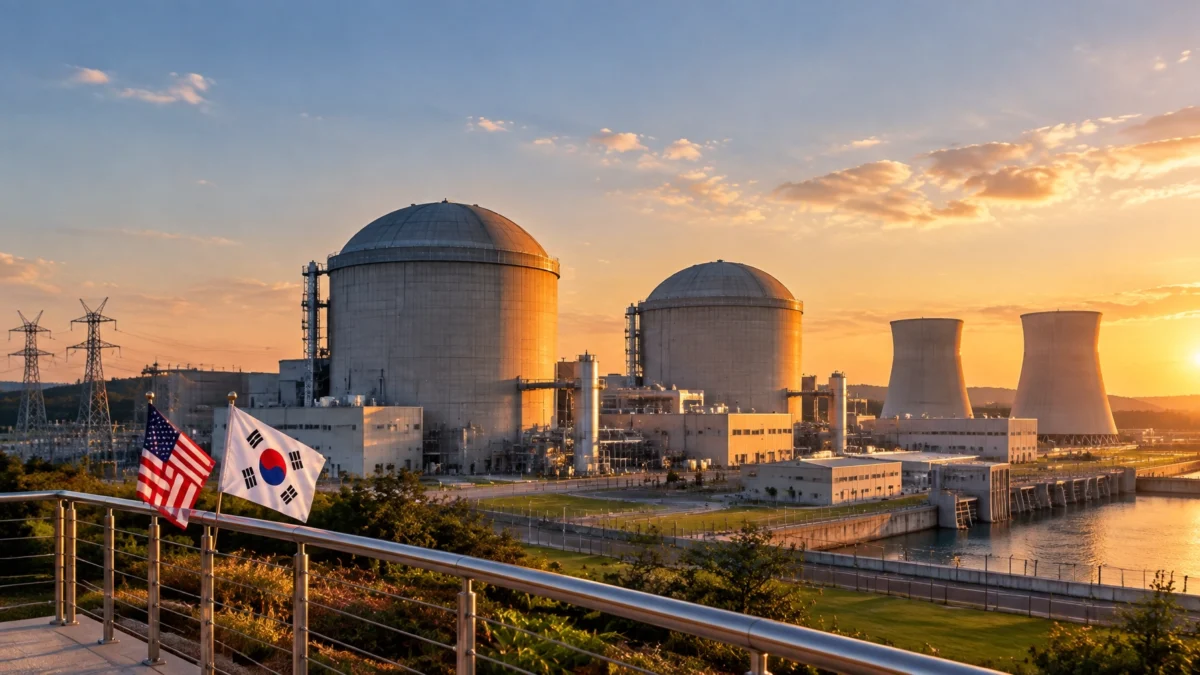
The United States and South Korea agreed to a “comprehensive cooperation framework” covering two APR1400 reactors and six Westinghouse AP1000 reactors. The signatories include both governments, Westinghouse, Korea Electric Power Corporation, or KEPCO, and Korea Hydro & Nuclear Power, or KHNP.
Brookfield Asset Management, which is part owner of Westinghouse, said the six AP1000 reactors are expected to be deployed as twin units across three federal sites. The two APR1400 reactors would also be built at federal sites. However, specific locations, construction schedules, ownership arrangements, and commercial contracts have not been finalized.
Commerce Secretary Howard Lutnick identified Ohio, Tennessee, South Carolina, and Kentucky during a September 30 briefing. Those states may therefore become central to the program, but the public announcement did not identify exact plant sites.
Nuclear Newswire reported that $100 billion of the Project Power commitment would be directed toward construction costs, while $20 billion would be reserved for contingencies. The two countries also agreed to transfer a $10 billion advance payment by the end of 2026, subject to applicable domestic legal requirements. That payment is intended to support the immediate purchase of long-lead equipment.
The advance payment would be an important early step, particularly for components that can require years of manufacturing, but it would not mean that reactor construction has begun. Procurement, site preparation, licensing, financing, and final contracting would still remain ahead.
The reactor mix and its potential output
The AP1000 and APR1400 are both gigawatt-scale pressurized water reactors, but they are different designs developed through separate industrial and national programs.
The Westinghouse AP1000 has a nameplate capacity of 1,110 megawatts electric, or MWe. Six units would represent approximately 6,660 MWe of nameplate capacity. The Korean APR1400 is rated at 1,400 MWe, so two units would add another 2,800 MWe. Together, the proposed fleet would total approximately 9,460 MWe of nameplate capacity.
That figure describes the maximum rated output under specified operating conditions. It does not guarantee that the reactors would produce 9,460 megawatt-hours, or MWh, in every hour. Actual generation would depend on capacity factors, refueling outages, maintenance, grid dispatch, regulatory requirements, and operating performance. If all eight units operated at full nameplate output for one hour, they could produce 9,460 MWh, but annual production would be lower than a simple multiplication of capacity by every hour of the year.
The designs also have operating histories outside the proposed program. Eight APR1400 reactors are currently online, including four in South Korea and four in the United Arab Emirates. Six AP1000 reactors are online, including two in the United States and four in China.

Licensing is a central difference
The AP1000 already has an operating presence in the United States, but additional units would still require project-specific regulatory approvals. Site reviews, environmental evaluations, construction authorization, inspections, and operating approvals would remain part of the Nuclear Regulatory Commission process.
The APR1400 presents a different regulatory question. Although the NRC certified the standard APR1400 design in 2019, no APR1400 has been built in the United States. A domestic project would still require site-specific licensing, environmental review, construction verification and operating authorization under U.S. requirements. The fact that APR1400 units operate in South Korea and the UAE provides operating experience, but foreign operating experience does not substitute for the remaining U.S. licensing steps.
That distinction reportedly contributed to the delay preceding the September 30 announcement. One reported concern involved the proposed domestic deployment of KHNP’s APR1400 design, which has NRC certification but no U.S. construction history. The framework therefore creates a commercial pathway for the technology, but it does not settle how long the U.S. regulatory process will take or whether the two APR1400 projects will advance on the same schedule as the AP1000 units.
The agreement also includes the possibility that KEPCO and KHNP could acquire a “significant minority” stake in Westinghouse. Brookfield said the framework provides for a potential Korean “cornerstone equity investment” of between 5% and 10% in Westinghouse, with final terms to be negotiated.
That ownership possibility could align Korean capital, engineering capabilities, and project development interests more closely with Westinghouse’s U.S. and international reactor pipeline. It also introduces additional questions about governance, intellectual property, export controls, and the allocation of commercial returns.
Why the investment matters to the U.S. energy system
Project Power arrives as utilities and policymakers assess how to meet rising electricity demand from data centers, advanced manufacturing, semiconductor production, hydrogen projects, and wider electrification.
Large nuclear plants can provide continuous generation, but they require substantial capital, lengthy permitting, specialized labor, and long-lead equipment. The program’s $20 billion contingency reserve recognizes that construction risk is a major part of nuclear project economics. Whether the reserve is sufficient will depend on site conditions, design maturity, supply-chain capacity, labor availability, financing terms, and regulatory timing.
Federal financing will likely be part of the broader discussion. The Office of Energy Dominance Financing’s more than $289 billion in available loan authority illustrates how federal credit support is being positioned to assist nuclear infrastructure, transmission and other firm-power projects. That figure describes authority available to lend, not capital already committed or deployed. Federal loans or guarantees can improve project bankability, but they do not remove construction risk or shift all costs away from taxpayers and customers.
The projects would also affect the natural gas and LNG sectors. Project Star would add a major gas-fired generation asset in Texas, while Project North would expand Alaska’s LNG ambitions. Together with the nuclear investment, the three-project package indicates that South Korea’s U.S. energy strategy is not limited to one technology. Nuclear could provide firm electricity over the long term, gas could offer dispatchable generation during the construction and transition periods, and LNG would support an export-oriented fuel project.
The effect on wind, solar, storage, and transmission would depend on where the reactors are ultimately located and how regional grid planners treat their capacity. Nuclear generation can reduce the amount of new gas-fired capacity required in some markets, but large reactors also need robust transmission connections and a system capable of managing planned outages. They are not substitutes for every form of grid infrastructure.
The relationship between large reactors and major electricity consumers will also be important. ENMG’s coverage of nuclear capacity expansion and the UPRISE policy framework has examined how reactor projects could be paired with data centers and other large loads. Long-term power contracts could help support financing, but they would need to address transmission costs, reliability obligations, outage planning, and the risk that projected load growth does not materialize as expected.

Who benefits and who carries the risk
U.S. reactor manufacturers, engineering firms, construction companies, uranium suppliers, component manufacturers, organized labor, and host communities could benefit if Project Power advances into construction. The program could also provide a stronger domestic market for nuclear-grade steel, forgings, pumps, instrumentation, electrical equipment, and other specialized components.
South Korean companies would gain access to U.S. projects and potentially a larger role in the American nuclear supply chain. Westinghouse could benefit from additional AP1000 orders and a closer commercial relationship with KEPCO and KHNP. The arrangement could also support the broader U.S. objective of exporting nuclear technology.
The limitations are substantial. The framework provides for up to $120 billion, and that is an announced commitment rather than capital already deployed. No final investment decision has been announced for all eight reactors. Exact sites and schedules remain open, and the APR1400 design, while NRC-certified, has no U.S. construction history. The $10 billion advance payment is directed toward long-lead items, not a guarantee that every planned unit will reach commercial operation.
Ratepayers and taxpayers could face exposure if projects experience delays, cost overruns, or changes in electricity demand. Host communities would need to evaluate land use, water requirements, emergency planning, workforce needs, spent-fuel management, and the economic effects of large construction projects. Competing power projects could also be affected if limited transmission capacity, skilled labor, or federal financing is concentrated in the Project Power pipeline.
Westinghouse President and CEO Dan Sumner said the announcement marked “a defining moment for the future of U.S. nuclear energy and for the longstanding partnership between the United States and the Republic of Korea.” Commerce Secretary Lutnick said the goal was to build the supply chain needed for the United States to become “the exporter of the world of nuclear.” Those statements describe the strategic ambition. The next phase will determine whether the framework can be converted into licensed, financed, and constructible projects.
What to watch next
The most important indicators will be the identification of federal sites, the structure of the $10 billion advance payment, and the signing of binding engineering, procurement, and construction agreements.
Observers should also watch for NRC actions involving the APR1400, formal financing commitments, ownership negotiations involving Westinghouse, supplier contracts, workforce agreements, and transmission planning in Ohio, Tennessee, South Carolina, and Kentucky.
Project Power has the potential to expand the U.S. nuclear fleet and rebuild parts of its supply chain. Its present status, however, is best understood as a large and strategically important framework whose commercial and regulatory tests have only begun.
Keep In Touch with Shale Magazine
As the new era of energy unfolds, you can bet we’ll be the boots on the ground to keep you informed. Subscribe to Shale Magazine for sharp insight into the arenas that matter most to your life. And don’t forget to listen to our riveting podcast, The Energy Mixx Radio Show, where our very own Kym Bolado interviews the most extraordinary thought leaders, business innovators, and industry experts of our time.