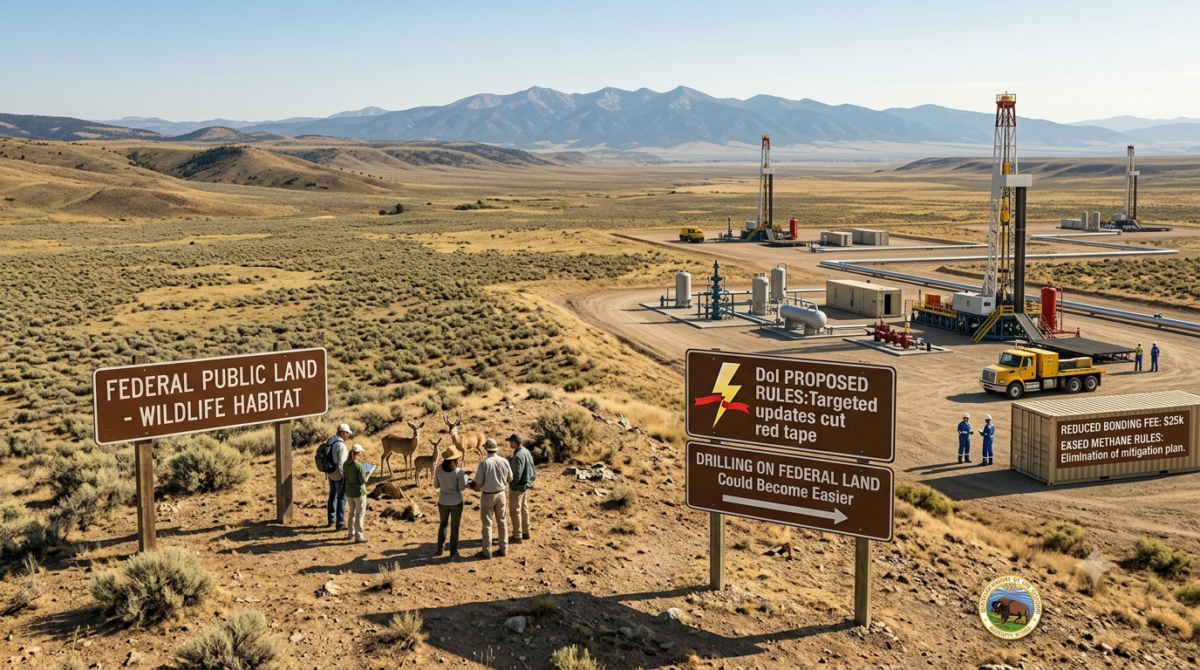
Drilling on federal land could become less costly under two proposed Bureau of Land Management rules that would lower oil and gas bonding requirements and revise federal waste-prevention regulations.
The Interior Department says the changes would reduce financial barriers and regulatory uncertainty. Critics argue that weaker financial assurances and fewer waste-control requirements could increase environmental risks and leave the public more exposed to cleanup costs.
The proposals were announced June 22, 2026, and published June 24. Their stated comment deadline was August 24. The official documents reviewed for this article describe proposed—not final—rules. Interior’s announcement.
What Would Change?
The proposals address separate parts of the federal oil and gas system.
The leasing proposal covers bonding and leasing procedures. The waste-prevention proposal addresses lost oil and natural gas, including royalty treatment and requirements associated with venting, flaring and leaks.
These are not interchangeable policies. Bonding addresses the financial consequences of unfinished obligations, while waste rules address resource losses during operations.
Nor should the proposals be described as a general relaxation of coal-mining requirements. Their principal subjects are onshore oil and gas.
They fit within the administration’s broader push to encourage domestic development, discussed in ENMG’s coverage of Trump’s energy-policy actions.
Lower Bonds, Unchanged Cleanup Obligations
BLM proposes returning minimum bonds to pre-2024 levels:
| Bond category | Minimum established by the 2024 rule | Proposed minimum |
|---|---|---|
| Individual federal lease | $150,000 | $10,000 |
| Statewide federal lease coverage | $500,000 | $25,000 |
These are financial-assurance amounts, not land-purchase prices or necessarily equivalent cash payments. BLM would retain authority to require higher coverage following bond-adequacy reviews. Federal Register leasing proposal.
A bond provides financial backing if required work is not completed. It does not make the government the routine payer for plugging and reclamation, and reducing its minimum does not erase the responsible parties’ obligations.
The policy question is what happens when those obligations cannot be collected—for example, after a business fails and recoverable assets prove insufficient.
A lower bond can reduce an operator’s financing burden. It can also leave less secured funding available if that operator defaults. Whether the proposed system adequately protects taxpayers therefore depends partly on how effectively BLM identifies risk and adjusts individual bonds.
Why Operators Support the Changes
Supporters argue that high minimum bonds can restrict access to capital, particularly for smaller companies and marginal-well operators.
The National Stripper Well Association supports both proposals, presenting them as improvements for small and independent producers. It argues that BLM should focus its waste-related work on mineral management and royalty determinations. Association’s public-comment materials.
Interior also estimates that the waste-rule revisions would reduce annual compliance costs by nearly $17 million. That is an agency estimate, not a measured saving. Interior’s announcement.
Lower compliance costs may improve the economics of some operations. They do not, by themselves, establish how much additional oil or gas would be produced. Prices, geology, infrastructure and company investment decisions still influence development.
Why Cleanup Costs Remain Central
Concerns about insufficient bonding predate the current proposals.
A 2019 Government Accountability Office report found that BLM needed to address risks from inadequate bonds. That historical finding helps explain the rationale for stronger financial assurances; it should not be presented as a new measurement of today’s bond coverage. GAO’s review.
The cost of closing a well also varies substantially.
A 2021 study by researchers affiliated with Resources for the Future analyzed data from up to 19,500 wells. It estimated median costs of approximately:
- $20,000 for plugging alone
- $76,000 for plugging and surface reclamation
Some cases exceeded $1 million per well. These are historical estimates from the study—not current contractor quotes or a uniform price for every federal well. Original research summary.
In August 2026 comments on the leasing proposal, researchers Daniel Raimi and Catherine Hausman argued that the changes would have little effect on domestic production while substantially increasing taxpayer exposure to decommissioning costs. That is their assessment, rather than an established outcome of a rule that has not yet been finalized. Researchers’ comments.
The distinction matters: lower bonds would not automatically force taxpayers to pay for every abandoned well. They could increase the shortfall when responsible parties fail to perform and available financial security does not cover the work.
ENMG examines the broader cleanup challenge in Plug Methane Leaks in the US: Tackling the Potent Oil & Gas Legacy.
What Would Happen to Methane-Waste Requirements?
The second proposal would remove waste-minimization plans and self-certification requirements from drilling applications. It would also remove BLM-specific leak-detection-and-repair provisions and revise standards governing royalties on lost oil and gas.
BLM proposes renaming the rule “Royalty for Oil and Gas Lost From Onshore Federal and Indian Leases.” Federal Register waste-rule proposal.
That scope is broader than eliminating one piece of application paperwork.
It also does not mean every emissions requirement applicable to an operation would disappear. This is a BLM rulemaking; other applicable air-quality requirements must be evaluated separately.
The regulatory baseline is already complicated. In its June proposal, BLM described a court injunction affecting implementation of the 2024 waste rule in North Dakota, Wyoming, Montana, Texas and Utah. The proposal therefore should not be portrayed as replacing an identical operating framework everywhere. BLM’s legal-background discussion.
Why Methane Losses Matter
Methane is the primary component of natural gas and a powerful greenhouse gas. EPA identifies oil and gas systems among the major sources of methane from human activities. EPA’s methane overview.
Leaks consequently have both environmental and commercial significance: gas escaping into the atmosphere is also a potentially marketable resource that was not sold.
The practical debate is whether the proposed framework would adequately discourage avoidable losses while reducing duplicative or unnecessarily costly requirements.
The article should not assume a specific emissions increase without supporting analysis. Nor should it treat a reduction in paperwork as proof that environmental performance would remain unchanged. Both claims require evidence.
Public Participation Would Change at the Leasing Stage
The leasing proposal would remove two prescribed 30-day participation periods and reduce the lease-sale protest period from 30 days to 10 days. It would also shorten advance notice of a competitive lease sale from 60 to 45 days. Proposed leasing procedures.
That is more precise than saying a drilling-permit comment period would fall from 90 to 10 days.
BLM argues that shorter procedures would improve efficiency. The trade-off is less prescribed time for stakeholders to review and challenge proposed lease offerings.
Leasing and drilling authorization remain distinct decisions. A change to the leasing process is not, by itself, permission to drill any selected parcel.
What Happens Next?
Both notices listed August 24, 2026, as the public-comment deadline. That deadline has passed; the notices should not be described as invitations to a future comment period. Leasing notice; waste-rule notice.
A final rule would need to specify the adopted requirements and effective date. A policy announcement or proposed timetable does not establish either.
The central question is not simply whether federal development becomes easier. It is whether lower operating barriers are paired with sufficient protection against unpaid reclamation costs and avoidable resource losses.
Lower upfront costs and lower total costs are not necessarily the same thing. The final rules—and their implementation—will determine how much of that difference remains with operators and how much risk remains with the public.
Frequently Asked Questions
Are the new requirements already final?
The documents reviewed describe proposals. Publication of a proposed rule does not make its provisions effective.
Are oil and gas bonds land-purchase fees?
No. They provide financial assurance for obligations associated with lease operations, including plugging and reclamation.
Would lower bonds eliminate companies’ cleanup responsibilities?
No. The issue is whether sufficient funding remains available when responsible parties do not meet those responsibilities.
Was $20,000 the maximum cost of plugging a well?
No. It was an approximate median for plugging alone in a 2021 study.
Does the 10-day proposal concern drilling permits?
It concerns the lease-sale protest period, alongside other proposed changes to leasing participation procedures.
Keep In Touch with Shale Magazine
As the new era of energy unfolds, you can bet we’ll be the boots on the ground to keep you informed. Subscribe to Shale Magazine for sharp insight into the arenas that matter most to your life. And don’t forget to listen to our riveting podcast, The Energy Mixx Radio Show, where our very own Kym Bolado interviews the most extraordinary thought leaders, business innovators, and industry experts of our time.
Subscribe to get more posts from Felicity Bradstock