
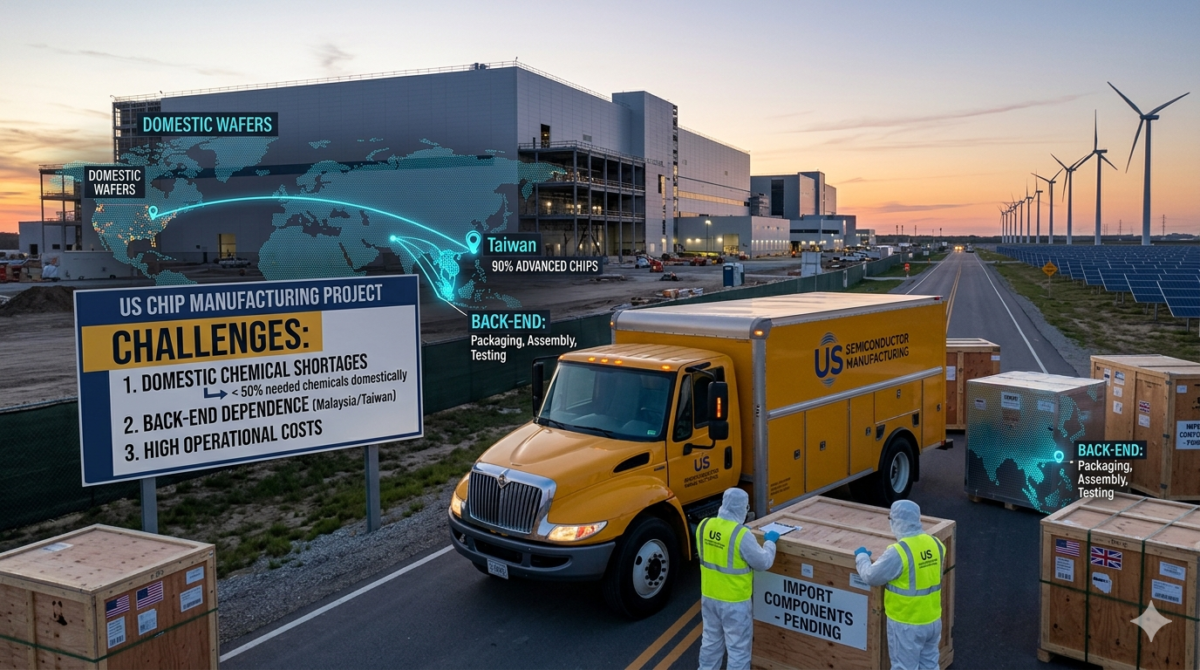
The United States is investing heavily in semiconductor manufacturing, but building fabrication plants alone will not create a self-sufficient domestic supply chain.
Semiconductors require specialized materials, chemicals, manufacturing equipment, skilled workers, wafer fabrication, assembly, advanced packaging and testing. The United States remains a global leader in several of these areas, particularly chip design and manufacturing technology, but it still relies heavily on Taiwan and other Asian economies for leading-edge fabrication and back-end production.
Federal incentives and private investment are expanding U.S. capacity. However, recreating every stage of a supply chain developed across several countries over decades will require more than new factories—and complete domestic control may neither be practical nor economically desirable.
Key Takeaways
- The United States remains a major semiconductor innovator but has lost a substantial share of global manufacturing capacity.
- Taiwan continues to play an outsized role in leading-edge chip fabrication.
- TSMC began high-volume production using its N4 process in Arizona in late 2024.
- The CHIPS and Science Act provides $50 billion for domestic semiconductor manufacturing incentives and research.
- U.S. supply-chain gaps extend beyond fabrication to chemicals, materials, substrates, packaging, assembly and testing.
- Manufacturing costs, workforce shortages and lengthy facility-development timelines complicate domestic expansion.
- A resilient semiconductor strategy will require domestic capacity, allied suppliers and diversified production—not total national self-sufficiency.
What Are Semiconductors?
A semiconductor is a material whose ability to conduct electricity falls between that of a conductor and an insulator. Manufacturers can precisely control this electrical behavior, allowing semiconductor devices to regulate, switch or amplify electrical signals.
Silicon is the most widely used semiconductor material, although materials such as silicon carbide and gallium nitride are increasingly important for power electronics, electric vehicles, telecommunications, aerospace and energy systems.
Microchips—also called integrated circuits—are manufactured by placing networks of microscopic transistors and other components onto semiconductor material. Different chips perform different functions, including:
- Processing data
- Storing information
- Managing electrical power
- Controlling vehicles and industrial equipment
- Enabling wireless communication
- Accelerating artificial-intelligence workloads
- Operating military and aerospace systems
Semiconductors therefore underpin far more than computers and smartphones. They are essential to power infrastructure, automobiles, medical equipment, communications networks, industrial systems and national defense.
They also connect directly to the energy sector. AI processors are increasing electricity demand from data centers, while power semiconductors help manage electricity in grid equipment, renewable-energy systems, batteries and electric vehicles.
ENMG has examined the electricity side of this technology expansion in The AI Energy Demand Surge Behind the Boom.
The Semiconductor Supply Chain Is Global by Design
Semiconductor manufacturing is not one industrial process contained inside a single factory.
The supply chain begins with research and chip architecture before moving through several highly specialized stages:
- Design: Engineers create a chip’s architecture and electronic functions.
- Materials production: Suppliers produce silicon wafers, specialty gases, photoresists and other high-purity inputs.
- Equipment manufacturing: Companies build lithography, deposition, etching, inspection and testing equipment.
- Wafer fabrication: Fabrication plants, commonly called fabs, build layers of circuits onto wafers.
- Assembly and packaging: Finished dies are cut from wafers, connected and placed into protective packages.
- Testing: Manufacturers inspect chips for performance, reliability and defects.
- Electronics integration: Chips are incorporated into servers, vehicles, phones and other products.
No country dominates every stage.
The United States is especially strong in chip design, intellectual property, research and several categories of manufacturing equipment. Taiwan is the leading center for contract chip fabrication. South Korea is a major producer of memory and advanced logic chips. Japan supplies important chemicals, materials and equipment. The Netherlands is home to ASML, the only commercial supplier of extreme-ultraviolet lithography systems required for the most advanced chips.
China, Malaysia, Vietnam, Singapore and the Philippines also participate in manufacturing, assembly, packaging or testing.
This specialization increases efficiency, but it also creates points of vulnerability. A disruption affecting one country, supplier or material can slow production across the entire system.
Why Taiwan Matters
Taiwan’s position in advanced semiconductor production is largely the result of a deliberate industrial strategy and TSMC’s foundry business model.
Morris Chang founded Taiwan Semiconductor Manufacturing Company in 1987. Rather than developing branded consumer products, TSMC focused on manufacturing chips designed by other companies.
That approach allowed “fabless” semiconductor firms to develop chips without spending billions of dollars to build and operate their own fabrication plants. It also reassured customers that their manufacturer was not attempting to sell competing finished chips.
Companies including Nvidia, AMD, Apple and Qualcomm have relied on TSMC to manufacture some of their most advanced designs.
Industry estimates have frequently placed approximately 90% of sub-10-nanometer manufacturing capacity in Taiwan. That figure describes Taiwan’s share of a particular category of advanced capacity at the time of the estimate—not TSMC’s share of every semiconductor produced worldwide.
That distinction matters because “advanced semiconductor” does not have one universal definition. Market shares vary depending on the process node, chip category, company and measurement year.
Taiwan nevertheless remains extraordinarily important to leading-edge production. A prolonged disruption involving the island could affect artificial intelligence, consumer electronics, telecommunications, automobiles and defense systems across the global economy.
Is Taiwan’s Semiconductor Industry a “Silicon Shield”?
Taiwan’s semiconductor importance has contributed to a geopolitical theory commonly called the “silicon shield.”
The theory holds that other countries have a powerful economic incentive to preserve Taiwan’s stability because a conflict or blockade could disrupt the supply of advanced chips. Under this argument, Taiwan’s importance to the global economy may strengthen international support for its security.
However, semiconductor dependence is not a formal defense guarantee. It may also create risk by making Taiwan’s industrial capacity strategically valuable to both allies and adversaries.
Governments and companies are responding by expanding production in the United States, Japan and Europe. This diversification may reduce the economic consequences of a future disruption, but new facilities will not quickly replace the scale, workforce and supplier network Taiwan has developed over decades.
What Is the United States Doing?
The CHIPS and Science Act, signed in August 2022, established the most significant recent federal effort to expand U.S. semiconductor capacity.
The law provided the Department of Commerce with $50 billion for semiconductor programs, including $39 billion in manufacturing incentives and approximately $11 billion for research and development.
By early 2025, the Commerce Department had announced more than $33 billion in incentive awards. Those projects covered leading-edge logic chips, memory, mature-node semiconductors, compound semiconductors, materials and advanced packaging.
The program has supported facilities associated with companies including:
- Intel
- Samsung
- TSMC
- Micron
- GlobalFoundries
- Texas Instruments
- Amkor
- SK hynix
- Corning
- Hemlock Semiconductor
The CHIPS Act also established a 25% investment tax credit for qualifying semiconductor-manufacturing facilities and equipment.
These incentives were designed to address a central economic problem: fabrication plants are extraordinarily expensive, and operating costs in the United States can be higher than in established Asian manufacturing centers.
ENMG previously examined the broader federal manufacturing effort in The U.S. Aims to Become a Major Global Competitor in Microchip Manufacturing.
TSMC Is Already Manufacturing Advanced Chips in Arizona
The original argument needs an important update: advanced semiconductor production is no longer merely planned in the United States.
According to TSMC, its first Arizona fabrication plant began high-volume production using N4 process technology during the fourth quarter of 2024. The company says its second Arizona fab is targeting N3 production during the second half of 2027, while a third fab is expected to produce N2 and A16 technologies by the end of the decade.
In July 2026, the Commerce Department announced that TSMC planned to increase its total U.S. investment to $265 billion and expand its proposed Arizona footprint to 12 semiconductor manufacturing and packaging facilities.
Those plans are substantial, but announcements should not be confused with completed production capacity. Projects must still move through construction, equipment installation, workforce development, qualification and commercial ramp-up.
TSMC’s expansion also demonstrates a nuance frequently lost in political discussion: increasing domestic production does not necessarily mean replacing foreign companies. In this case, U.S. capacity is expanding through investment by a Taiwanese manufacturer.
Fabrication Is Only One Part of the Problem
Federal policy has devoted considerable attention to wafer fabrication, but a processed wafer is not a finished chip.
After fabrication, wafers must be inspected, cut into individual dies, assembled, packaged and tested. These stages are often grouped under the term assembly, testing and packaging, or ATP.
Much of this capacity is located in Asia, where companies have established large supplier networks and experienced workforces. A 2025 Government Accountability Office report cited Department of Defense estimates that 98% of microelectronics assembly, packaging and testing occurred outside the United States, primarily in Taiwan, South Korea and China.
The CHIPS program is beginning to address the gap. According to another GAO review, eight of 40 semiconductor incentive projects examined as of July 2025 involved assembly, testing or packaging.
Projects include:
- An Amkor advanced-packaging facility in Arizona
- Intel packaging investments in New Mexico
- An SK hynix advanced-packaging project in Indiana
- Packaging capabilities associated with GlobalFoundries and other recipients
The Department of Commerce also finalized approximately $1.4 billion in research awards under the National Advanced Packaging Manufacturing Program in January 2025.
These investments represent progress, but the U.S. packaging ecosystem remains much smaller than the established network in Asia.
Chemicals and Materials Create Additional Vulnerabilities
A semiconductor fab depends on hundreds of specialized inputs.
These may include:
- High-purity silicon wafers
- Photoresists
- Specialty gases
- Wet-process chemicals
- Chemical-mechanical planarization materials
- Advanced substrates
- Copper and other metals
- Packaging polymers
- Quartz components
- Silicon carbide and related materials
Even a relatively inexpensive material can halt production if it does not meet exact purity standards or cannot be delivered on time.
The supply challenge is therefore not simply whether the United States can produce a chemical. It must produce the correct material, at semiconductor-grade purity, in sufficient volume and near facilities that require dependable delivery.
The CHIPS program has supported several projects involving materials and manufacturing equipment. In October 2025, the Commerce Department also reopened and amended a funding opportunity for facilities producing semiconductor materials and equipment.
However, domestic suppliers may hesitate to build expensive new capacity before customer demand is guaranteed. Chipmakers, in turn, may be reluctant to depend on new suppliers until those suppliers have proven their reliability. Industrial policy occasionally resembles a very expensive game of “you go first.”
Workforce and Operating Costs Remain Obstacles
Semiconductor facilities need far more than construction labor.
They require:
- Electrical and mechanical engineers
- Process technicians
- Equipment specialists
- Chemical-handling professionals
- Software and automation experts
- Cleanroom operators
- Packaging engineers
- Maintenance personnel
Training these workers takes time. Companies expanding in the same geographic clusters may also compete for a limited pool of experienced employees.
Higher U.S. wages, construction expenses, regulatory requirements and operating costs can make domestic production more expensive than manufacturing in established Asian centers. Federal incentives can offset part of that difference, but subsidies do not eliminate it permanently.
Automation may reduce the labor intensity of certain processes, particularly in advanced packaging and testing. Nevertheless, facilities still need experienced workers capable of operating extraordinarily complex equipment and maintaining high production yields.
Tariffs Do Not Solve Every Supply-Chain Gap
Tariffs and threatened import restrictions may encourage companies to locate production in the United States. They may also raise the cost of imported chips before sufficient domestic capacity exists.
ENMG examined this tension in U.S. Semiconductor Tariffs: Trump’s 100% Import Plan.
The effect of a tariff depends on several factors:
- Which chips and countries are covered
- Whether exemptions apply to companies investing in U.S. production
- How quickly domestic capacity becomes available
- Whether downstream manufacturers can absorb higher costs
- Whether trading partners retaliate
- Whether the policy applies to chips embedded in finished products
Tariffs can influence investment decisions, but they cannot create trained workers, qualified chemical suppliers or advanced-packaging capacity overnight.
Can the United States Become Semiconductor Self-Sufficient?
Complete self-sufficiency is improbable and may not be necessary.
The semiconductor industry has become globally integrated because each production stage requires enormous capital, technical expertise and scale. Reproducing every supplier and capability within one country would increase costs and could still leave individual facilities vulnerable to natural disasters, equipment failures or regional power disruptions.
A more realistic strategy would seek to:
- Expand domestic production of strategically important chips.
- Develop advanced packaging and testing capacity.
- Increase domestic supplies of critical materials and equipment.
- Strengthen workforce-development programs.
- Maintain reliable trade with allies.
- Diversify production across multiple trusted countries.
- Protect research, intellectual property and manufacturing systems.
- Build sufficient inventories for defense and critical infrastructure.
- Ensure new fabs have reliable electricity, water and transportation infrastructure.
This approach would not eliminate foreign dependence. It would reduce the risk that a disruption in one location could disable entire industries.
The Energy Requirements of Semiconductor Manufacturing
Semiconductor production is also an energy-infrastructure issue.
Fabs operate continuously and require exceptionally reliable electricity for cleanrooms, vacuum systems, temperature control, process equipment and water treatment. Power interruptions can damage products under fabrication and produce costly delays.
The development of artificial intelligence creates demand on both sides of this equation. AI expansion requires more advanced processors, while the data centers using those processors require enormous amounts of electricity.
ENMG explores the broader energy implications in On-Site Gas Generation for AI Data Centers.
Semiconductor clusters will therefore compete with data centers, manufacturing plants and growing communities for power infrastructure. Expanding chip production without planning for generation, transmission and water would simply move the bottleneck from one supply chain to another.
What Comes Next?
The United States has made measurable progress in rebuilding semiconductor manufacturing.
Advanced N4 production is underway in Arizona. New fabrication, packaging, materials and research projects are moving forward. Federal incentives have attracted significant private commitments, while companies are developing additional capacity across Arizona, Texas, New York, Ohio, Idaho, New Mexico and Indiana.
But announced investments are not the same as completed factories, and completed factories are not the same as a fully qualified supply chain.
The next test will be whether the United States can:
- Complete projects on schedule
- Achieve competitive manufacturing yields
- Develop enough skilled workers
- Build domestic supplier networks
- Expand advanced packaging
- Provide reliable power and water
- Maintain consistent industrial policy
- Preserve cooperation with trusted international partners
The United States does not need to manufacture every chip or chemical within its borders. It does need enough domestic and allied capacity to prevent one disruption from becoming an economic and national-security crisis.
That is a less dramatic goal than “controlling the entire supply chain.” It is also far more achievable—and far more useful.
Frequently Asked Questions
Why does the United States depend on Taiwan for advanced chips?
Taiwan developed a highly specialized semiconductor-manufacturing ecosystem led by TSMC. Many U.S. companies design advanced chips but contract with TSMC to manufacture them.
Does TSMC produce 90% of all semiconductors?
No. Older estimates have attributed roughly 90% of certain leading-edge manufacturing capacity to Taiwan. That does not mean TSMC produces 90% of every semiconductor worldwide.
Are advanced chips now being manufactured in the United States?
Yes. TSMC says its first Arizona fab began high-volume production using N4 technology in late 2024. Other U.S. and foreign-owned companies also manufacture chips domestically.
What does the CHIPS and Science Act fund?
The law provided $50 billion for semiconductor manufacturing incentives and research, including $39 billion in manufacturing incentives and approximately $11 billion for research and development.
What happens after a semiconductor wafer is fabricated?
The wafer must be inspected, cut into individual dies, assembled, packaged and tested before the chips can be incorporated into finished products.
Can the United States become completely semiconductor-independent?
Complete independence is unlikely because the supply chain spans many highly specialized countries and companies. The more practical objective is resilient domestic and allied production.
Keep In Touch with Shale Magazine
As the new era of energy unfolds, you can bet we’ll be the boots on the ground to keep you informed. Subscribe to Shale Magazine for sharp insight into the arenas that matter most to your life. And don’t forget to listen to our riveting podcast, The Energy Mixx Radio Show, where our very own Kym Bolado interviews the most extraordinary thought leaders, business innovators, and industry experts of our time.
Subscribe to get more posts from Felicity Bradstock