The United States’ ambitious plans to develop a strong semiconductor manufacturing industry are being hindered by several hurdles that prevent it from controlling the entire production supply chain.
Meanwhile, Taiwan continues to dominate global semiconductor production, making the global economy highly vulnerable to any supply chain disruption.
What are Semiconductors and Why are they Important?
According to IBM, a semiconductor is a material that can act as either a conductor or an insulator of electricity, making it an essential building block of computers, electronic devices, integrated circuits, and other modern digital technologies. In most modern technologies, semiconductors act as tiny electrical switches, turning off and on repeatedly to enable the flow of electricity.
Semiconductors can both conduct and resist electricity, making them suitable for a range of applications, including computer chips, artificial intelligence (AI) chips, and Internet of Things (IoT) devices, all of which require the efficient transfer of large amounts of power over a small area. Microchips, or integrated circuits, are the hardware components constructed from semiconductor materials.
The global microchip market size was valued at $199.48 billion in 2025 and is projected to grow from $216.75 billion in 2026 to $421.25 billion by 2034, expanding at a compound annual growth rate of 8.66%.
Global Semiconductor Powers
In recent years, several countries have prioritized semiconductor production to support supply chain diversification. The United States has introduced several federal policies aimed at sectoral development, including the Bipartisan Infrastructure Law, the CHIPS Act, and the Inflation Reduction Act. Governments across Europe, India, Japan, Mainland China, Southeast Asia, and South Korea have also introduced favorable semiconductor policies.
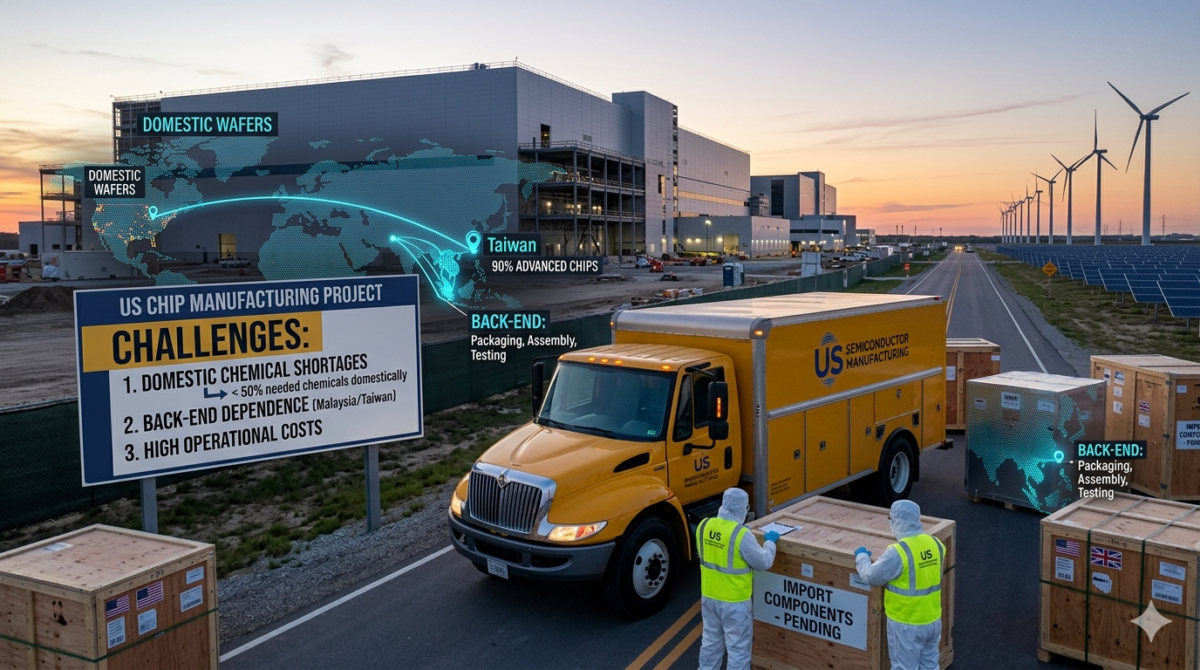
However, one company, Taiwan Semiconductor Manufacturing Company (TSMC), manufactures over 90% of the world’s advanced semiconductor chips. This means that every country and company that uses advanced chips relies on Taiwan for its supply, so any production disruption can affect supply or drive up prices.
Taiwan has been planning this dominance for decades. Knowing that it could not compete with the production might of other major Asian powers, policymakers have focused on building capabilities in precision manufacturing since the 1970s.
In 1987, the U.S.-trained engineer Morris Chang founded TSMC. The firm did not focus on designing and producing its own branded chips, unlike other firms; instead, it manufactured chips for other companies, which assured U.S. and European semiconductor companies that it would not compete with them. This encouraged major tech companies, such as Qualcomm and Nvidia, to outsource chip production to Taiwan with little fear of intellectual property leakage or strategic rivalry.
Taiwan’s semiconductor industry has acted as a “silicon shield” to help prevent Chinese invasion. The world’s dependence on Taiwan’s advanced chips means that its allies are encouraged to defend it against threats and supply chain disruptions, which would significantly disrupt the global economy.
Challenges to U.S. Production
As Taiwan has become the biggest global producer of advanced chips, the world’s overreliance on a single market has become increasingly evident. This has led the United States to introduce several policies and funding opportunities to accelerate the development of its semiconductor manufacturing industry.
Between 2021 and 2024, U.S. semiconductor and electronics companies invested an estimated $450 billion. However, the semiconductor industry relies on more than just vast quantities of funding for its development.
Semiconductor manufacturing depends on a wide array of chemicals and materials, and if any input is missing or delayed, the whole process is disrupted. According to a McKinsey analysis of U.S. semiconductor supply chains, there is currently insufficient domestic supply of more than half the chemicals needed to produce semiconductors to meet projected 2030 demand.
There are also challenges to other parts of the U.S. semiconductor supply chain, such as wafer testing, cutting the wafers into individual chips – or “singulation”, packaging, and testing finished chips. Many companies moved these types of labor-intensive operations abroad in the 1970s and continue to rely on other countries, mainly in Asia, for these activities.
In a recent interview with managers at eight major companies across the semiconductor supply chain, they cited the high cost of operating in the United States as the reason for moving these activities offshore. While U.S. policy has focused on advancing domestic semiconductor manufacturing, less attention has been paid to other parts of the supply chain.
According to an April article in Harvard Business Review, “A processed wafer is not a finished product. It still needs to be tested, sliced into individual chips, and packaged into the modules that are then assembled into phones, servers, and a wide range of electronic products. This work takes place in the back end. Almost all that work is still done in China, Taiwan, Malaysia, and Vietnam.”
Despite significant investment in U.S. semiconductor manufacturing, the country must still overcome several hurdles to dominate the entire supply chain and reduce reliance on Taiwanese chips.
Keep In Touch with Shale Magazine
As the new era of energy unfolds, you can bet we’ll be the boots on the ground to keep you informed. Subscribe to Shale Magazine for sharp insight into the arenas that matter most to your life. And don’t forget to listen to our riveting podcast, The Energy Mixx Radio Show, where our very own Kym Bolado interviews the most extraordinary thought leaders, business innovators, and industry experts of our time.
Subscribe to get more posts from Felicity Bradstock