
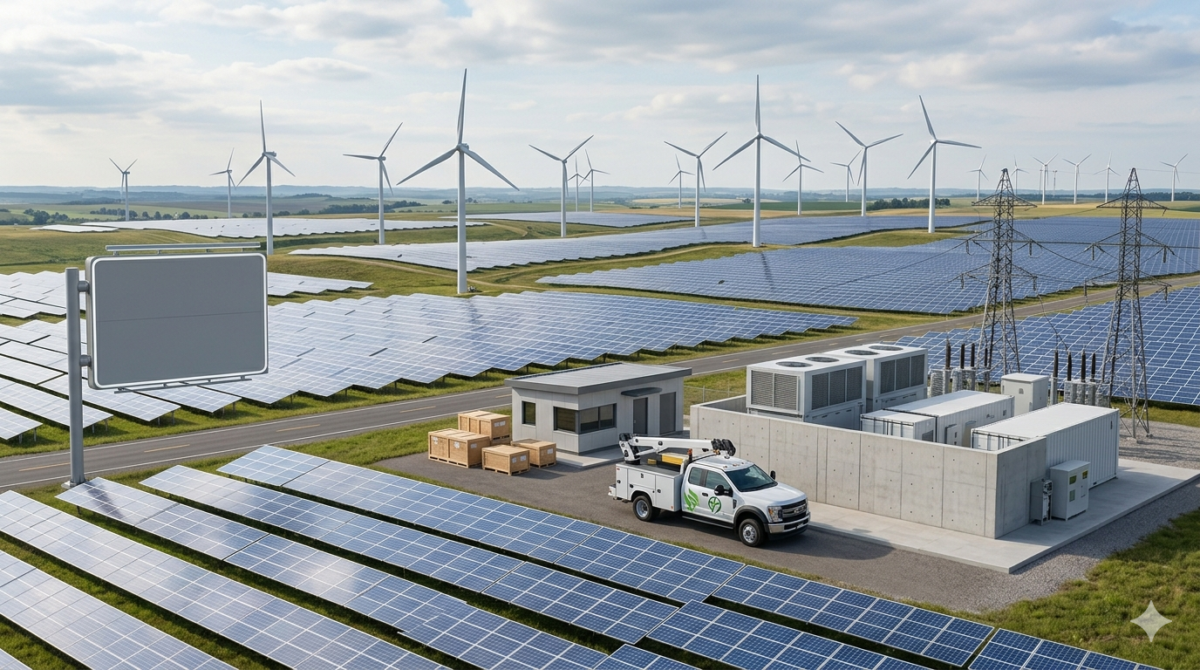
The United States renewable energy industry has continued to strengthen, despite strong pushback from President Trump over the last year and a half, with wind and solar breaking several records.
Since coming into office, President Trump has called for greater fossil fuel expansion while introducing policies to restrict renewable energy deployment. However, with such a strong domestic green energy pipeline already in place, several new projects came online last year, with many more expected to follow in 2026, advancing the share of renewable energy in the U.S. energy mix.
Renewable Energy Expansion
Renewable energy accounted for a quarter of U.S. electricity in 2015, up 10% from the previous year, according to the U.S. Energy Information Administration (EIA). Despite having their tax credits cut by the Trump administration, solar and wind power remained the fastest-growing electricity source.
While rising energy demand, driven by the rapid deployment of data centers, is prolonging the country’s reliance on fossil fuels, renewable energy has still accelerated beyond that increase.
Energy companies have increasingly favored renewable energy production as the prices of solar and wind energy components have fallen sharply over the last decade, while both solar panel and wind turbine efficiency have improved. This has made renewable energy much cheaper to produce than many alternatives, particularly coal, even without government subsidies.
This has resulted in the development of a strong U.S. renewable energy pipeline, with 80% of the power plant capacity planned over the next 10 years coming from renewable sources.
Wind Sector Expansion
The U.S. was expected to increase wind installations by 7 GW in 2025, a 36% increase over the previous year. Despite significant opposition to wind energy development from the Trump administration, the U.S. remains on track to add 46 GW of new wind capacity between 2025 and 2029, according to a report by Wood Mackenzie and the American Clean Power Association, published in December
The U.S. wind turbine intake rebounded to levels seen before the release of the One Big Beautiful Bill Act quarter-over-quarter, the report stated, demonstrating the wind industry’s commitment to domestic development.
Together, wind and solar energy generated a record 17% of U.S. electricity in 2025, according to EIA data, rising from just 1% in 2005. In 2025, wind power generated 464,000 GWh of electricity, 3% more than in 2024.
According to the U.S. Department of Energy, wind energy capacity is expected to reach 404.25 GW across 48 states by 2050, growing from 180.15 GW in 2030.
Record Solar Power Production
Solar energy has rapidly expanded across the United States over the last decade, with several large-scale projects planned for various states, including the ambitious Golden State Clean Energy 21 GW solar farm in California. This has been driven by a decrease in the price of solar components, greater solar panel efficiency, and broad policy support for solar energy expansion under the Biden administration.
In 2025, utility-scale solar power generation totaled 296,000 GWh, 34% more than in 2024, according to the EIA. Electricity generation from utility-scale solar has increased every year since 2006, while small-scale solar generation totaled 93,000 GWh last year.
In May, solar contributed more U.S. electricity generation than coal for the first time, according to a report by the energy think tank Ember, accounting for 12.8% of production, compared to coal’s 12.2%. Ember stated that a record 45.5 terawatt-hours (TWh) of solar energy was generated in May, marking an increase of 17% from the same month in 2025.
In addition, the think tank expects the record to be broken again over the sunny summer months. Meanwhile, energy generation from coal has fallen by around 50% over the last half decade, down from a 19.7% contribution in May 2021.
Nicolas Fulghum, an Ember senior data analyst, said in a statement, “Overtaking coal for the first month on record shows just how far solar has come, from a niche contributor to the third-largest and fastest-growing source of power in the U.S. electricity system.”
Battery Storage Growth
Battery storage in the United States is also expanding at an unprecedented pace, as energy companies seek to enhance the stability of their renewable energy supply.
California and Texas currently dominate the domestic battery supply, with two-thirds of the current operating total. However, this is expected to change as more states invest in battery storage.
Only five states currently have more than 1 GW of installed battery storage capacity, including Arizona, Nevada, and New Mexico, according to EIA data. However, the administration expects 12 states to have over 1 GW of storage capacity by 2030, while four others will have over 500 MW of battery storage capacity.
Following years of momentum, increased efficiency, and falling prices, little can stop the United States renewable energy boom. Even after cutting federal funding and imposing restrictions on various green energy sectors, such as offshore wind, the Trump administration has not been able to dampen interest in clean energy.
Keep In Touch with Shale Magazine
As the new era of energy unfolds, you can bet we’ll be the boots on the ground to keep you informed. Subscribe to Shale Magazine for sharp insight into the arenas that matter most to your life. And don’t forget to listen to our riveting podcast, The Energy Mixx Radio Show, where our very own Kym Bolado interviews the most extraordinary thought leaders, business innovators, and industry experts of our time.
Subscribe to get more posts from Amanda Jenkins