Google has big nuclear energy plans as part of its efforts to provide clean power for its ever-growing pipeline of data centers. The tech giant has long talked about funding both conventional nuclear fission operations and small modular reactor (SMR) development. However, its ambitions are now even bolder, as it has announced plans to invest in the future of nuclear fusion.
Funding Conventional Nuclear Power
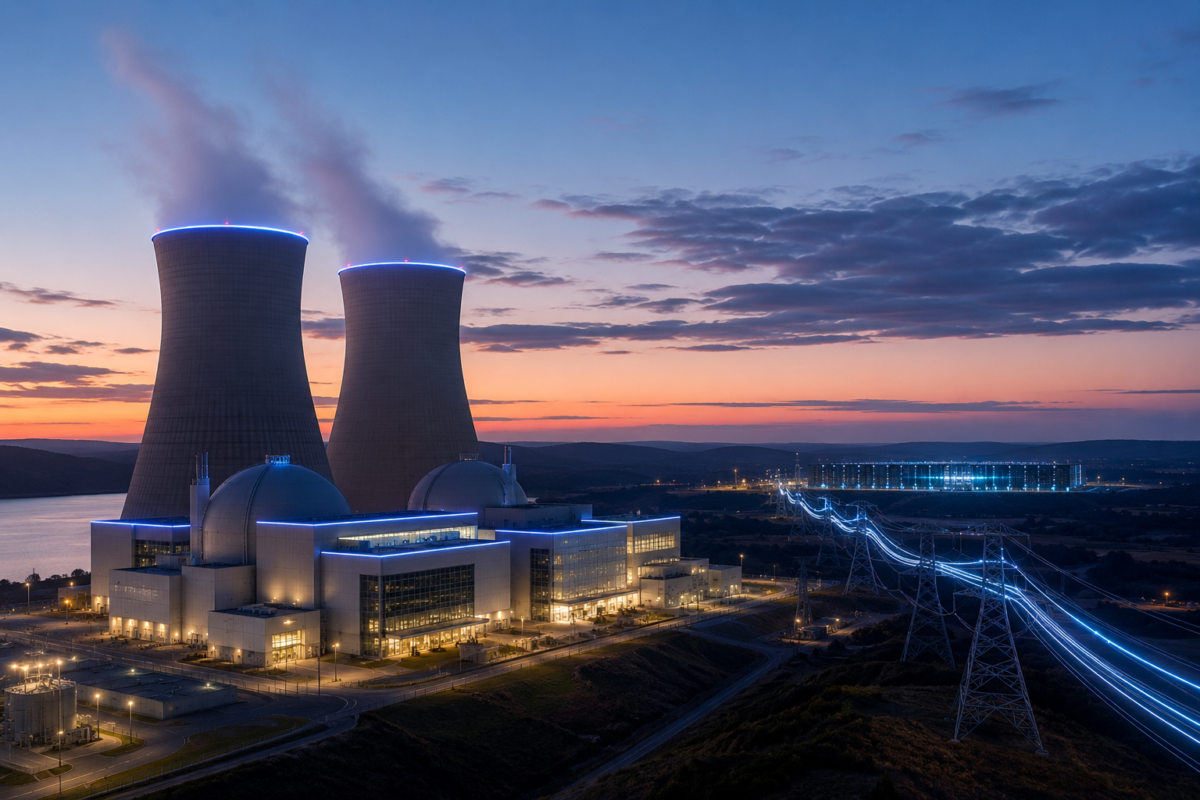
In the spring of 2025, Google announced plans to invest in three conventional nuclear power developments with at least 650 megawatts (MW) of capacity each. The project was planned to be developed with Elementl Power, a nuclear company founded in 2022 that aims to deploy over 10 gigawatts (GW) of nuclear power in the U.S. by 2035.
At the time, Elementl Power’s CEO Chris Colbert said, “Innovative partnerships like this are necessary to mobilize the capital required to build new nuclear projects, which are critical to deliver safe, affordable and clean baseload power and help companies advance their long-term net-zero goals. We look forward to working with Google to execute these projects and bring safe, carbon-free, baseload electricity to the grid.”
SMR Development
Even earlier, in 2024, Google signed a power purchase agreement with the nuclear energy firm Kairos Power and the Tennessee Valley Authority. Google aims to purchase power generated by Kairos’s SMR starting in 2030.
Small modular reactors (SMRs) are advanced nuclear reactors with a power capacity of up to 300 MW(e) per unit, equivalent to about one-third the generating capacity of a conventional nuclear reactor. They are far smaller than traditional reactors and are modular, making it easier to assemble them in factories and transport them to the site. They are also cheaper and faster to build than conventional nuclear reactors and can be constructed incrementally to meet the growing energy demand of a site.
Google and Kairos have not yet announced the size of the investment or the planned locations of the SMR development, although Google said it has agreed to buy a total of 500 MW of power from six to seven reactors.
The senior director for energy and climate at Google, Michael Terrell, told reporters, “We feel like nuclear can play an important role in helping to meet our demand… cleanly in a way that’s more around the clock.”
To develop its SMRs, Kairos will need to attain construction and design permits from the U.S. Nuclear Regulatory Commission (NRC) and permits from local agencies. The firm has already been granted a construction permit from the NRC to develop a demonstration reactor in Tennessee.
Fusion Ambitions
In addition to more conventional nuclear operations, Google also has plans to invest in innovative fusion projects. In July, the tech giant announced it would be investing in Germany-based start-up Proxima Fusion as part of the firm’s $468 million funding round, which was led by XTX Ventures and East X Ventures. German utility RWE, one of the largest electricity and gas suppliers in Europe, also invested in the funding round.
Nuclear fusion is the process that powers the sun and stars. Fusion takes place when two atomic nuclei – typically composed of hydrogen – are combined to form a heavier nucleus, releasing a large amount of energy. The difficulty in achieving this process is that scientists must recreate extreme temperatures and pressures that cause fusion in stars on Earth.
By contrast, nuclear fission – the method currently used to produce nuclear power – occurs when the central core of an atom, known as the nucleus, of uranium or plutonium, splits into two smaller nuclei. Splitting the core releases a large quantity of energy and creates additional neutrons, which can go on to split more atoms in a chain reaction, allowing nuclear reactors to produce a stable supply of energy.
Google’s investment announcement demonstrates the firm’s dedication to innovative nuclear technologies. Nuclear fusion could provide abundant clean energy, but the technology has not yet been commercially deployed as several hurdles remain to be overcome. Google acknowledged the immense challenge of achieving the commercial deployment of fusion technology and noted that success is not guaranteed.
Proxima Fusion’s CEO, Francesco Sciortino, stated, “Europe is racing with the United States and China to get to the first fusion power plant.” Sciortino added, “Investors recognise both the urgency and the opportunity of what we’re doing and are backing us to develop a generational energy technology company.”
In addition to using conventional energies to power its data centers, such as gas and renewable energy, Google has committed to a wide range of nuclear power projects to power its artificial intelligence and other advanced technologies.
As several countries race to achieve nuclear fusion, private financing, such as Google’s investment in Proxima Fusion, could help accelerate the development of the technology to support commercial deployment.