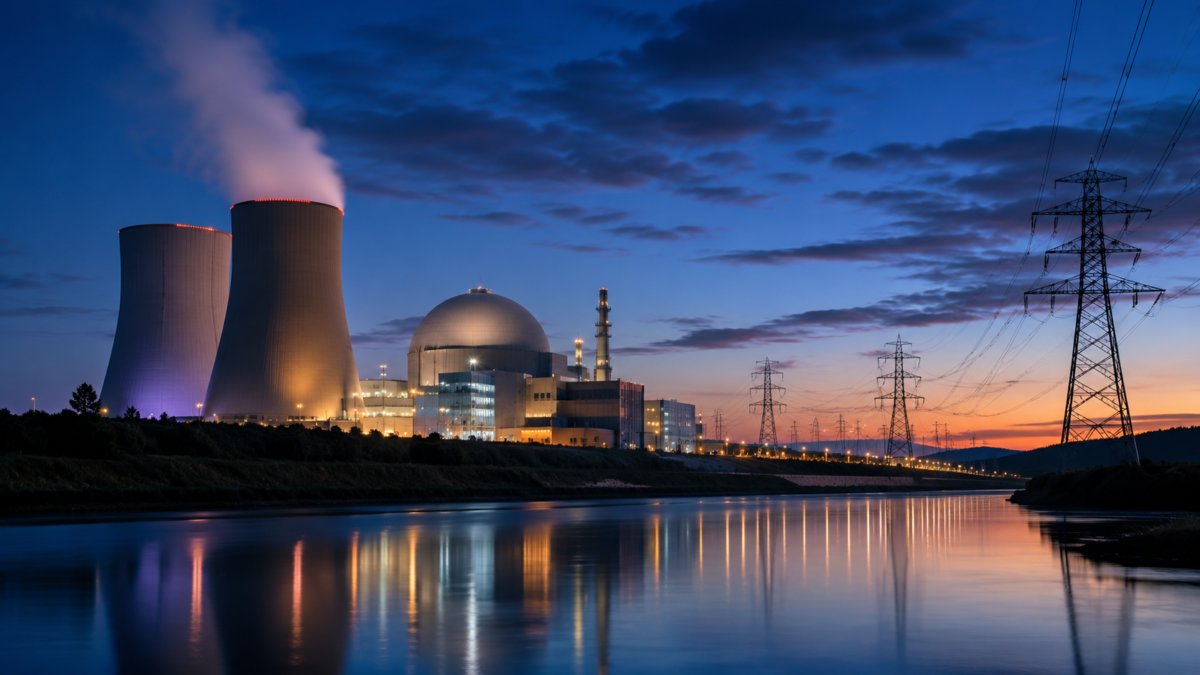
The Trump administration is strongly backing nuclear power, aiming to accelerate the deployment of new projects alongside fossil fuel expansion ambitions. President Trump has repeatedly stated his strong opposition to renewable energy and his support for oil, gas, and coal; however, Trump also has major ambitions for a U.S. nuclear renaissance.
Trump Administration Nuclear Power Plans
In May 2025, President Trump issued four executive orders aiming to revitalize the U.S. nuclear energy industry. Over the last year, the government has made strides in achieving its nuclear ambitions.
In response to Trump’s executive order, Reforming Nuclear Reactor Testing at the Department of Energy, which focused on accelerating advanced reactor deployment, the U.S. Department of Energy (DoE) created the Reactor Pilot Program.
The program established a new pathway for advanced reactor demonstration to fast-track commercial licensing, encouraging private investment in the sector. It aimed to have at least three reactor designs reach criticality by July 4, 2026, having selected 11 projects to pilot their designs.
President Trump announced the aim of expanding the United States’ nuclear power capacity from 100 GW in 2025 to 400 GW by 2050. To achieve this aim, developers would need to construct roughly a hundred times as much nuclear capacity in the next 25 years as they did in the past 25.
To help achieve this target, the DoE selected the Tennessee Valley Authority and Holtec Government Services to support early deployments of advanced light-water small modular reactors (SMRs), providing them with a combined $800 million in federal cost-shared funding.
The DoE is also providing a loan of up to $1.52 billion, through the Office of Energy Dominance Financing, to Holtec to help fund the restart of the Palisades Nuclear Plant in Michigan.
Meanwhile, the Nuclear Regulatory Commission (NRC) approved the construction permit for TerraPower’s Natrium fast reactor project in Kemmerer, Wyoming in March 2026, making it the first ever issued by the NRC for a commercial non-light-water power reactor.
To support the deployment of nuclear energy and reduce reliance on Russia, the DoE also created the Fuel Line Pilot Program in July 2025, aimed at supporting the production of the nuclear fuel needed for advanced reactors.
What Does This Mean?
The Trump administration has been very vocal about its nuclear power achievements over the last year, but many question what these announcements actually mean. While nuclear power has broad bipartisan support in Congress, many have voiced concerns over the high costs and long timeframe associated with developing conventional nuclear reactors.
The only two large U.S. reactors to be built recently took 15 years to complete and cost a combined $35 billion, double the initial estimates.
The senior vice president for energy and climate at the research organization Third Way, Josh Freed, explained, “The challenge is that there’s a big gap between these announcements and putting one foot in front of the other, taking steps to actually get new reactors built.”
The complexities associated with developing conventional nuclear reactors have led many companies to pursue smaller-scale SMRs. However, the only countries to achieve commercial SMR technology to date are Russia and China, according to the World Nuclear Association.
While several companies are pursuing SMR development, several hurdles stand in the way of commercial rollout, not least the ongoing reliance on Russia for High-Assay Low-Enriched Uranium nuclear fuel. Although the U.S. government is focusing on increasing domestic output, it could take several years to fulfil the required demand.
No One’s Biting
In October, the Trump administration announced it has signed a deal with the Canadian owners of Westinghouse Electric to develop a fleet of nuclear reactors with an investment of at least $80 billion. At the time, Trump said that Japan will provide up to $332 billion to support infrastructure in the U.S., including the building of Westinghouse AP1000 reactors and small modular reactors.
The Japanese firms Mitsubishi Heavy Industries, Toshiba, and IHI may be involved in the construction of up to $100 billion in Westinghouse reactors, according to a fact sheet issued by the two countries.
U.S. taxpayers were told that the partnership would create a windfall for them, as the federal government would take an ownership stake in Westinghouse so that it could cash it in for billions if the company were eventually to go public.
However, to date, Japan has not yet provided funds for a single reactor, and no utility is known to have ordered an AP1000. The Trump administration has not publicly identified any customers for the planned reactors. The lack of signed agreements has made those in the energy industry skeptical about whether Trump can achieve his ambitious nuclear power targets.
The Trump administration recently published information on some of its major nuclear power achievements from the last year. While these help lay the foundations for a potential nuclear renaissance, Trump must seek higher levels of private investment in the sector, and fast, if he hopes to achieve his nuclear power goals.
Keep In Touch with Shale Magazine
As the new era of energy unfolds, you can bet we’ll be the boots on the ground to keep you informed. Subscribe to Shale Magazine for sharp insight into the arenas that matter most to your life. And don’t forget to listen to our riveting podcast, The Energy Mixx Radio Show, where our very own Kym Bolado interviews the most extraordinary thought leaders, business innovators, and industry experts of our time.
Subscribe to get more posts from Felicity Bradstock