
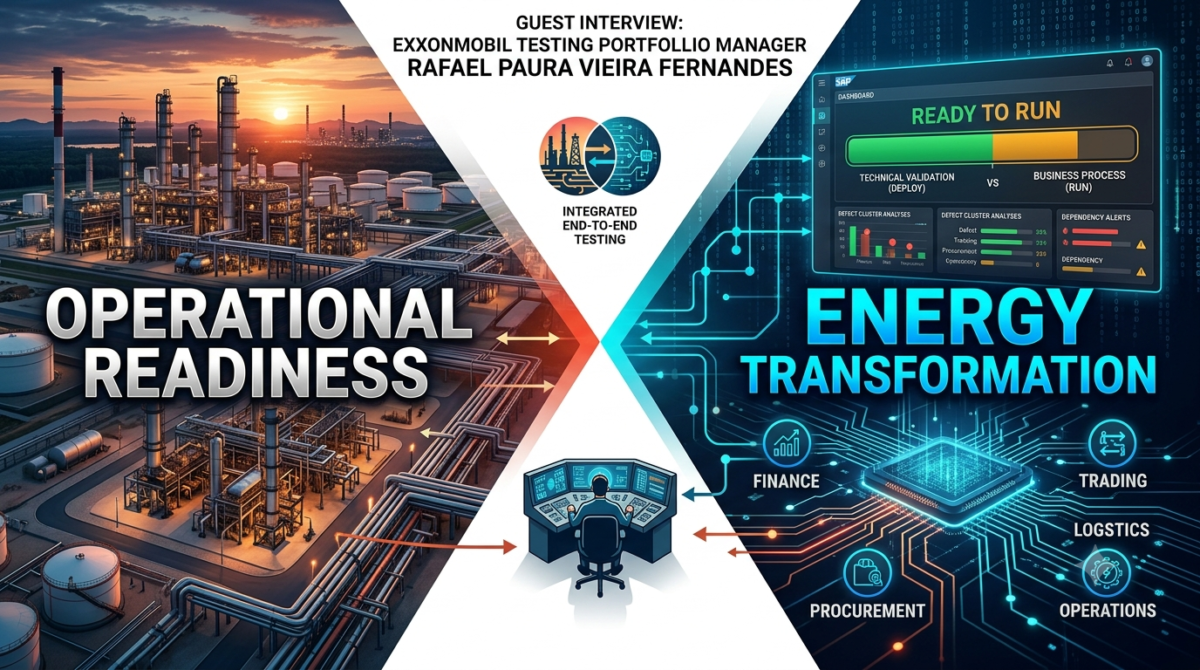
Program and testing governance leader Rafael Paura Vieira Fernandes discusses integrated testing, operational readiness, enterprise coordination, and the operational risks that emerge during large-scale energy transformations.
A Shale Exclusive By Ellen F. Warren

Rafael Paura Vieira Fernandes is Testing Portfolio Manager at ExxonMobil. Based in Houston, Texas, he oversees enterprise-scale testing strategy and operational coordination for one of the company’s largest digital transformation initiatives. Over more than two decades in technology and enterprise delivery, he has worked across infrastructure modernization, trading and risk platforms, ERP transformation, portfolio governance, and large-scale operational readiness programs supporting global energy operations.
Before assuming his current role supporting ExxonMobil’s large-scale SAP transformation efforts, Rafael managed major trading and risk portfolios involving ION-Endur ETRM implementation, enterprise automation initiatives, agile delivery governance, and cross-functional operational coordination across multiple global teams. His experience includes overseeing multimillion-dollar portfolios, coordinating enterprise testing and deployment activities, leading major incident response efforts, and developing governance frameworks designed to strengthen execution visibility, delivery discipline, and organizational alignment throughout highly complex transformation programs.
In this interview, Rafael discusses the operational realities of managing enterprise transformation programs inside the energy sector, including integrated testing, cross-functional coordination, AI-assisted delivery orchestration, operational readiness, governance visibility, and the execution risks that frequently emerge during large-scale implementations.
ELLEN WARREN: Rafael, you’ve worked in this field for nearly 25 years. During this time, enterprise transformation programs inside the energy sector have become significantly larger, faster, and more interconnected across business functions and technologies. What changes have most altered the way organizations manage operational coordination and execution risk during major transformation efforts?
RAFAEL PAURA VIEIRA FERNANDES: The biggest change has been the sheer scale of enterprise transformation programs and the degree to which business processes, systems, and teams have become interconnected. Twenty years ago, most transformation efforts were concentrated within a specific business function. Finance might implement a new ledger platform, a trading organization might deploy a new risk-management system, and the dependencies between those initiatives were relatively manageable because the underlying environments operated more independently. Today, a single SAP transformation touches procurement, finance, trading, logistics, HR, and operations simultaneously, and those workstreams are deeply interdependent in ways that aren’t always visible until you’re deep into execution. The other major change is speed. Programs that used to run on multi-year timelines with generous stabilization periods are now expected to deliver in compressed windows, often with overlapping waves running in parallel. That combination means execution risk no longer sits inside individual workstreams. Risk now lives in the white space between them, and that’s exactly where it’s hardest to see.
EW: Managing enterprise transformation programs at today’s scale requires a very different leadership approach than it did earlier in your career. How have your own methods for coordination, governance, communication, and operational decision-making evolved as these environments have become more complex and globally interconnected?
RPVF: Early in my career, I managed coordination the way most people did, through detailed plans, status reports, and meetings where each team reported progress against their own tracks. That model breaks down at enterprise scale because everyone can report green while the integrated picture is red. My approach has shifted toward building visibility that cuts across workstreams rather than within them. That means creating frameworks that show how a delay or defect in one area actually propagates into others, making dependencies and risks visible before they become operational problems. I’ve also become much more deliberate about communication cadence with senior stakeholders. Executives don’t need every detail, but they do need to understand where the real risk sits and what decisions require their attention. I spend a significant amount of time translating technical and operational findings into business terms—financial exposure, operational continuity, and customer impact—so leadership can make informed decisions rather than simply receive information.
EW: Enterprise transformation programs share many common challenges across industries. What aspects of the energy sector create the greatest execution complexity during large-scale transformations?
RPVF: Oil and gas operations run continuously, and many of the processes underlying financial and operational systems are tied to physical realities such as shipments, inventory movements, contractual nominations, and regulatory reporting windows. Those business activities don’t stop because an organization is executing a major system cutover. You can’t simply schedule downtime the way you might in other industries. Regulatory obligations add another layer of complexity. Reporting requirements to regulators and exchanges continue regardless of where a transformation program happens to be in its timeline. Organizations also depend on a broad network of external participants such as trading partners, logistics providers, terminals, refineries, and customers, each operating on their own schedules and systems. As a result, a go-live is rarely a single event. It is the point at which multiple operational processes, many of them outside the organization’s direct control, must continue functioning while the underlying systems supporting them are fundamentally changing.
EW: Large transformation programs often appear stable at the workstream level while still carrying substantial operational risk across the broader enterprise environment. How do those disconnects begin developing during complex implementations, particularly inside oil and gas organizations with tightly interconnected operational processes?
RPVF: The disconnect usually begins at the boundaries between workstreams. Each team defines its own scope, test scenarios, and acceptance criteria, and in many cases those definitions are perfectly reasonable. Problems emerge when no one takes ownership of how those processes connect across the broader business. A finance team may validate that an invoice can be created and posted correctly, while a trading team confirms that a deal flows into settlement. What often goes untested is the full business process connecting those activities. When a trade originates in trading, moves through logistics, generates an invoice, and ultimately has to reconcile against a contract, that end-to-end process frequently falls between organizational boundaries. Each team reports success because it has met its own objectives, while risk accumulates in the cross-functional workflows that have never been exercised as a whole. Those gaps typically become visible only when the business attempts to run a real transaction through the full process, often during integrated testing.
EW: Organizations often spend months validating individual applications, interfaces, and workflows before discovering much later that the broader business environment still cannot execute reliably end-to-end. When do transformation teams typically realize that technical validation alone is not enough to support live operational execution?
RPVF: Individual applications and interfaces can perform exactly as expected while important operational gaps remain hidden. Those gaps often become apparent during late-stage rehearsals or, worse, shortly after go-live, when the business attempts to execute a real end-to-end process and something that worked perfectly in isolated testing breaks down across a handoff.
EW: Enterprise transformation efforts inside the energy sector typically involve multiple delivery teams, business functions, vendors, and operational dependencies moving simultaneously across the same program environment. What kinds of coordination challenges become most difficult to manage once those activities begin converging under real execution timelines?
RPVF: Sequencing and dependency management become the dominant challenge. When you have multiple delivery teams, vendors, and business functions all converging toward the same milestones, a delay or change in one track has ripple effects that aren’t always immediately obvious to the teams downstream. Defect management also becomes far more complex. A single issue might touch code owned by one team, configuration owned by another, and a business process owned by a third, and resolving it requires all three to align on root cause and fix ownership simultaneously. There is also a human dimension, in that as pressure increases, teams naturally focus on their own deliverables, and this is exactly the moment when cross-team communication tends to degrade, even though that’s when it matters most.
EW: You have written extensively about the risks that emerge when organizations structure testing around isolated workstreams rather than end-to-end business execution. Why does integrated testing frequently become compressed or deprioritized during large transformation programs even when the operational consequences remain significant?
RPVF: Integrated testing tends to sit at the end of the timeline, and end-of-timeline activities are the first to absorb schedule pressure when earlier phases run long, which they almost always do. There is also the structural issue that integrated testing doesn’t belong to any single workstream, so it doesn’t have a natural advocate fighting for its time and resources the way individual workstream testing does. Furthermore, because the value of integrated testing is preventive—it surfaces risks that haven’t happened yet—it is easy to deprioritize relative to activities that feel more concretely tied to the go-live date. Integrated testing is often the activity most predictive of whether go-live will actually succeed, but because it’s the last thing scheduled and the hardest thing to defend when time runs short, it’s frequently the first thing cut or compressed.
EW: Testing is often treated as a technical milestone within a transformation program. How does the conversation change once leadership begins treating integrated testing as an operational discipline tied directly to business continuity, financial exposure, and enterprise readiness?
RPVF: When integrated testing becomes an operational discipline, leadership changes the key question from “Are we ready to deploy?” to “Are we ready to run our business?” Those may sound similar, but they are fundamentally different questions. Deployment readiness asks whether the technical components work. Operational readiness asks whether the business can run its day-to-day, week-to-week, and month-to-month activities, including the exceptions, the workarounds, and the periodic processes, without interruption. When leadership frames integrated testing in terms of financial exposure and continuity, it stops being a checkbox at the end of the project and starts being treated as a risk-management activity with the same seriousness as, for example, a financial controls review. That reframing tends to unlock the resources, time, and cross-functional cooperation that integrated testing needs to actually be effective.
EW: Your experience spans infrastructure programs, trading and risk systems, portfolio governance, agile orchestration, and enterprise testing leadership. How has the relationship between delivery governance and operational decision-making changed as transformation programs have expanded across more systems, business functions, and global teams?
RPVF: Governance used to be largely about tracking progress: whether programs were on schedule, on budget, and meeting key milestones. As programs have grown more complex, governance has had to become more about surfacing operational risk early enough that leadership can actually act on it. This requires governance forums to have access to information that goes beyond status, such as the health of cross-functional dependencies, the maturity of end-to-end scenarios, and early signals from defect trends that point to systemic issues rather than isolated bugs. The most effective governance structures I’ve worked with treat operational readiness as a thread that runs through every governance conversation, not as a separate workstream that gets its own update near the end.
EW: AI-assisted testing and automation tools are becoming increasingly common inside enterprise transformation environments. Where have you seen these technologies provide the greatest operational value, particularly in areas such as scenario generation, regression testing, execution visibility, or risk identification?
RPVF: The clearest value I’ve seen is in scenario generation and regression testing. AI tools can help identify combinations of test conditions that human teams might not think to combine, and they can dramatically reduce the time needed to re-run regression suites after configuration changes, which happen constantly during a transformation. There is also growing value in using AI to analyze defect patterns across large volumes of test results, surfacing clusters of related issues that might indicate a systemic root cause rather than isolated problems. Where I urge caution is in assuming these tools replace the judgment needed to design genuinely end-to-end, business-realistic scenarios. AI is excellent at scaling execution and pattern recognition, but it is still people who need to define what realistic looks like for the business process.
EW: Leadership dashboards inside major transformation programs can show steady progress across testing, delivery, and deployment activities while critical operational dependencies are still evolving underneath the environment. How do experienced program leaders evaluate whether the organization is actually prepared to operate reliably after go-live?
RPVF: I look beyond dashboard metrics such as test execution and pass rates and focus on whether the scenarios being tested actually reflect how the business operates, including its exception cases and periodic cycles. I also look at how defects are trending in the final weeks: are they declining and becoming more minor, or are new, more significant issues still surfacing? Another signal is whether the business users who will actually operate the new environment have had meaningful exposure to it—not just in training, but with hands-on experience running real scenarios. If the people who’ll be doing the work on day one have not yet done anything close to that work in the new environment, that’s a readiness gap no dashboard will show you.
EW: Your work has involved coordinating global teams across multiple business domains, technologies, and operational functions simultaneously. What organizational behaviors or governance practices tend to improve alignment and execution consistency across environments operating at that level of complexity?
RPVF: The most effective environments create shared visibility across teams. When every team can see how their work connects to the broader picture, they make better decisions about their own priorities. Regular cross-functional meetings where teams surface issues early, before they become urgent, matter enormously; the cost of a problem grows the longer it goes unaddressed. I’ve also found that clearly defining ownership for cross-functional processes, not just individual systems, is critical, because those cross-functional threads are exactly where things tend to fall through the cracks. Additionally, consistency in how issues are escalated and resolved builds trust across teams, which makes people more willing to surface problems early instead of trying to absorb them quietly.
EW: Large energy transformations frequently involve pressure to accelerate deployment timelines while major operational dependencies are still evolving underneath the program. How do organizations balance delivery urgency against the need to evaluate whether the transformed environment can actually function reliably under live operational conditions?
RPVF: This is one of the most persistent tensions in transformation work, and I don’t think it ever fully resolves. It’s a tension that has to be actively managed. The organizations that handle it well tend to make the trade-offs explicit rather than implicit. Instead of quietly compressing testing to protect a date, they have an honest conversation about what risk that compression introduces and who’s accepting that risk. Sometimes the right answer genuinely is to accept some risk and have a strong post-go-live support plan in place. The problem arises when that decision gets made by default, through schedule pressure, rather than deliberately, with leadership fully understanding what they’re accepting.
EW: Alongside your transformation and governance work, you have also invested heavily in mentoring, internal training programs, and leadership development initiatives across global teams. How important does organizational learning become in environments where transformation programs are evolving continuously while operational expectations remain high?
RPVF: Continuous learning is essential, yet often undervalued. Transformation programs are, by nature, environments where the rules are constantly changing with new configurations, new processes, and new tools. People can’t operate effectively in that kind of environment without continuous support. I’ve found that investing in mentoring and structured knowledge-sharing pays for itself many times over, because it reduces the number of times the same lesson has to be relearned across different teams or program phases. It also helps build a bench of people who can step into more senior coordination roles as the program grows, which matters tremendously, because these programs tend to need more experienced operational thinking exactly as they’re scaling, not less.
EW: AI, automation, and enterprise orchestration capabilities are continuing to reshape large transformation programs across the energy sector. As organizations expand these capabilities further, what leadership, governance, or operational disciplines become most important for maintaining transparency, accountability, and long-term execution stability?
RPVF: As these tools take on more of the execution workload, the discipline that becomes more important is human judgment about what to test and why. Automation can run more scenarios faster, but someone still needs to ensure those scenarios reflect real business risk. Transparency also becomes more important as automation scales, because it’s easier for issues to be masked by sheer volume of activity: a dashboard showing thousands of automated tests passing can look very reassuring while still missing the handful of scenarios that actually matter most. The organizations that will do this well are the ones that use AI and automation to handle scale and repetition, while keeping experienced people firmly in charge of defining what good looks like and interpreting what the results actually mean for operational readiness.

About the Author
Ellen F. Warren writes about industry leaders and trends in various sectors, including energy, fintech, IT innovation, healthcare, business, logistics, supply chain, commercial real estate, and entrepreneurship. As a former Independent Director, she served for more than a decade on the Boards of multiple E&P companies in the oil and gas industry.
Keep In Touch with Shale Magazine
As the new era of energy unfolds, you can bet we’ll be the boots on the ground to keep you informed. Subscribe to Shale Magazine for sharp insight into the arenas that matter most to your life. And don’t forget to listen to our riveting podcast, The Energy Mixx Radio Show, where our very own Kym Bolado interviews the most extraordinary thought leaders, business innovators, and industry experts of our time.