From Energy Importer to Energy Superpower
In 1995, I moved to Corpus Christi for my first job out of Texas A&M. I was a newly graduated chemical engineer headed to work at the Celanese Technical Center, and every morning I drove down Interstate 37 past refineries, tank farms, and flare stacks that signaled the industrial backbone of the region.
Corpus Christi was already an energy town then. Heavy industry shaped the local economy, and the port was an important regional asset. But nobody viewed it as the center of America’s energy export system. In fact, at the time, the entire idea would have sounded absurd.
The United States was widely viewed as a country in long-term energy decline. Domestic oil production had been falling for years, policymakers were still operating under the mindset created by the oil shocks of the 1970s, and exporting crude oil from the United States was largely prohibited. The assumption across much of the industry was that America would become increasingly dependent on foreign energy supplies over time, not emerge as one of the world’s dominant exporters. Nobody was talking about Corpus Christi as a geopolitical asset.
Today, that reality has completely changed.
The Port of Corpus Christi now sits at the center of global energy flows. Roughly half of all U.S. crude oil exports move through the port. LNG infrastructure continues expanding along the Gulf Coast. Tankers leaving South Texas now help supply allies in Europe, customers in Asia, and global markets increasingly dependent on American energy production.
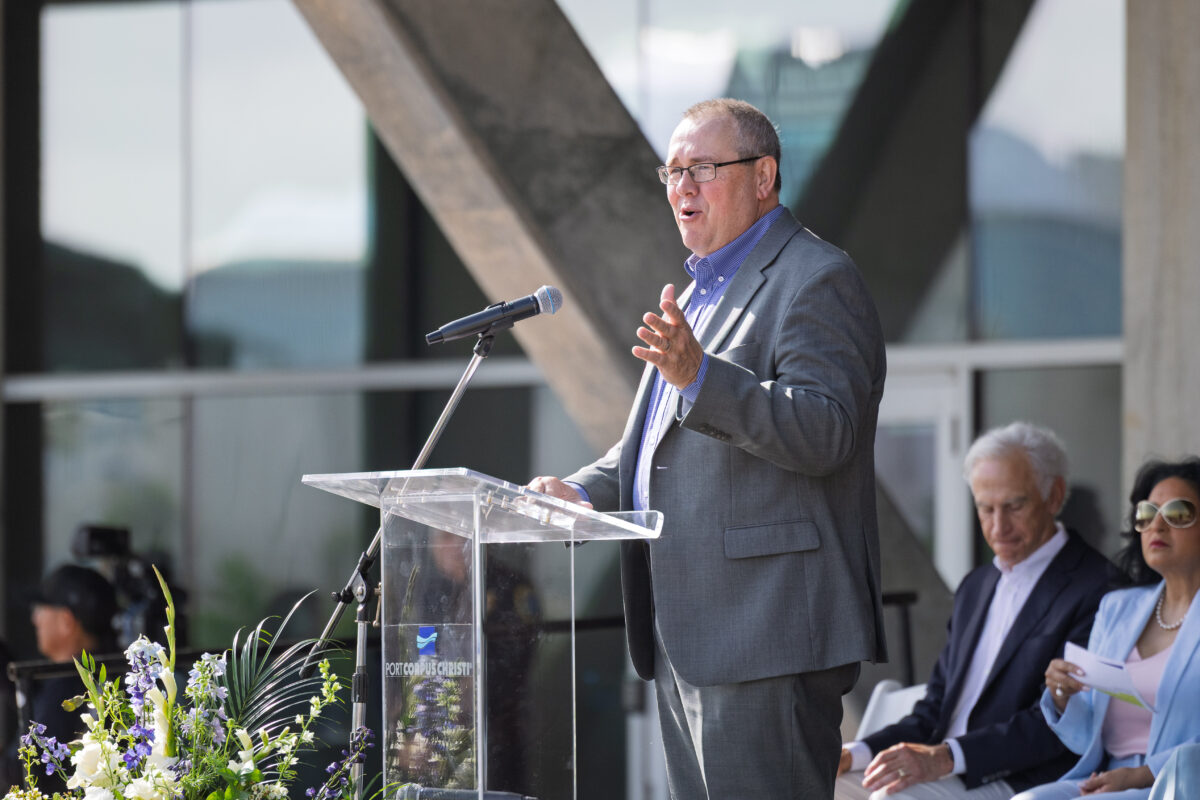
At the center of that transformation is Kent Britton, CEO of the Port of Corpus Christi.
After speaking with Britton, what struck me most was not some larger-than-life executive persona. He is not flashy, theatrical, or overly promotional. He comes across as deeply operationally focused, which makes sense given the scale and complexity of what the Port of Corpus Christi has become. Colleagues also describe him as someone who keeps a strong balance with family life, something that seems to shape his steady, measured approach.
Throughout our discussion, he repeatedly returned to the same themes: efficiency, maneuverability, coordination, infrastructure planning, and long-term logistics. Whether discussing crude exports, LNG traffic, dredging projects, water constraints, or security concerns, his focus consistently came back to reducing friction in the system.
“Our responsibility is to make our customers more efficient,” Britton told me.
That may sound simple, but when your customers collectively move millions of barrels of oil and enormous volumes of liquefied natural gas into global markets, small improvements in efficiency translate into massive economic consequences.
Building the Infrastructure Behind the Boom
To understand the significance of Britton’s role, it helps to understand how dramatically the industry changed around Corpus Christi over the past fifteen years.
The shale revolution fundamentally rewrote America’s energy future. Horizontal drilling and hydraulic fracturing unlocked enormous oil production from formations like the Eagle Ford and Permian Basin. Production surged far faster than most analysts predicted. By the early 2010s, the United States was producing so much light sweet crude that parts of the domestic refining system struggled to absorb it efficiently.
Then came the defining policy shift. In 2015, Congress repealed the decades-old crude oil export ban. That single decision transformed the trajectory of the American energy industry almost overnight.
Suddenly, U.S. producers could compete directly in global markets. But exporting millions of barrels of crude oil per day required far more than increasing production. It required pipelines, storage systems, marine terminals, dredging projects, vessel coordination, and large-scale logistical integration.
Corpus Christi was uniquely positioned to capitalize because of its proximity to both the Permian Basin and the Eagle Ford Shale, but geography alone does not create a world-class export hub. Plenty of ports sit near producing regions. What separates Corpus Christi is the scale of infrastructure investment that followed the shale boom, combined with the operational focus required to move those barrels efficiently into global markets.
“There was way more oil coming out of the ground than anybody expected,” Britton said. “Once exports were allowed, the market needed a place to move those barrels efficiently to international customers.”
One thing that became very clear during our discussion is that Britton views the port as a fully integrated logistics system, not simply a collection of docks and ship traffic. Everything affects everything else. Pipeline constraints affect storage capacity. Storage limitations affect vessel scheduling. Marine congestion affects loading efficiency. Delays in one part of the system ripple throughout the chain.
“One delay can affect the entire chain,” Britton said. “Everything is connected.”
That systems-level perspective runs throughout the port’s development strategy. Over the past several years, the Port of Corpus Christi has undertaken one of the largest infrastructure expansions in its history. The ship channel has been widened and deepened to improve traffic flow, accommodate larger vessels, and increase operational efficiency.
“We widened the channel, deepened the channel, and improved maneuverability throughout the system,” Britton explained.
To people outside the industry, dredging projects and turning basins may sound mundane. Inside global energy markets, they are transformational. Every hour saved loading a tanker lowers transportation costs. Every improvement in vessel movement increases throughput. Every reduction in congestion improves competitiveness.
Managing a Complex Energy Ecosystem
Unlike Houston, which manages a highly diversified mix of container traffic, petrochemicals, manufacturing cargo, and energy shipments, Corpus Christi evolved into a highly specialized energy export platform centered heavily around crude oil and LNG.
That specialization created advantages, but it also introduced operational complexity that requires constant coordination between pipelines, terminals, storage operators, marine traffic controllers, tug services, and port authorities.
“Building docks is one thing,” Britton told me. “Building an integrated logistics system is something very different.”
The scale of Corpus Christi’s growth is difficult to overstate. In 2016, the port exported roughly 70,000 barrels of crude oil per day. Today, exports exceed 2 million barrels per day. That type of growth would strain almost any infrastructure system in the world.
One of the more enlightening moments in our discussion came when Britton clarified a common misconception about Very Large Crude Carriers, or VLCCs. Many people assume the giant tankers navigate deep into the Inner Harbor beneath the new Harbor Bridge. In reality, most VLCC loading occurs closer to Ingleside near the mouth of the ship channel, where navigation is more manageable.
“The VLCCs are loading outside the Inner Harbor,” Britton explained. “People sometimes misunderstand how that process works.”
That may sound like a technical detail, but it highlights the level of operational precision required to manage one of the largest energy shipping corridors in the world.
And Britton’s responsibilities now extend far beyond traditional port management. The Port of Corpus Christi sits at the intersection of global energy markets, environmental policy, marine logistics, federal regulation, international trade, and national security.
LNG and the Next Growth Phase
At the same time, the port is preparing for what Britton believes will become its next major growth phase: LNG.
“The true growth story over the next five years is LNG,” he told me.
That reflects broader changes taking place across global energy markets. Russia’s invasion of Ukraine dramatically reshaped global natural gas trade flows. Europe suddenly needed alternatives to Russian pipeline gas, and the United States emerged as one of the world’s most important LNG suppliers. Meanwhile, Asia continues transitioning from coal to cleaner fuels, and developing nations still struggle to achieve reliable electricity access.
Britton also pointed to another rapidly emerging driver of future natural gas demand: artificial intelligence.
“AI is going to require enormous amounts of electricity,” he said. “When you start talking about gigawatt-scale power demand, it becomes very difficult to build enough wind and solar quickly enough to satisfy all of it.”
That comment reflects an issue increasingly being discussed throughout the energy industry. Massive data centers require around-the-clock power reliability. While renewable energy will continue growing rapidly, the scale and speed of projected electricity demand growth has pushed utilities and grid operators back toward natural gas as the most practical near-term solution for reliable baseload generation.
Importantly, Britton does not frame the future energy system as a simplistic competition between hydrocarbons and renewables. Texas already leads the nation in both wind and solar generation. But from his perspective, future energy growth is likely to be additive rather than replacement-based.
“New energy sources are additive,” he said. “The world’s energy demand continues growing.”
That broader perspective is one reason Corpus Christi has increasingly positioned itself not just as an oil export hub, but as a long-term energy platform capable of supporting multiple energy pathways simultaneously. In addition to crude and LNG expansion, the port has also explored carbon capture opportunities and future hydrogen infrastructure.
“Companies are increasingly looking for lower-carbon solutions,” Britton said. “We want to make sure the infrastructure exists to support those opportunities as well.”
Water, Security, and Long-Term Planning
One of the more revealing parts of our conversation involved issues most people outside the industry rarely think about. For example: water.
South Texas has long managed its water resources in a region defined by variable rainfall, and recent industrial growth has brought greater attention to how those resources are planned and sustained over time. Petrochemical plants, refineries, and emerging hydrogen projects all have significant water needs, prompting continued focus on strategies such as groundwater development, desalination, wastewater reuse, and comprehensive regional water planning to support future economic expansion.
Britton clearly recognizes that energy infrastructure and water infrastructure are becoming increasingly interconnected. Long-term growth along the Gulf Coast will depend not only on pipelines and marine terminals, but also on securing reliable water supplies capable of supporting industrial expansion.
Security has also become a dramatically larger concern than it was twenty years ago. Critical energy infrastructure is now viewed through the lens of cybersecurity threats, geopolitical tensions, terrorism concerns, and global instability.
While Britton noted that some operational details can’t be disclosed for security reasons, he emphasized the extensive coordination between the port and state and federal agencies.
“It’s a major area of focus,” he said. “We’re constantly evaluating risks and working with our partners to improve security.”
Again, what stood out to me was Britton’s systems-oriented approach to these challenges. He does not speak like someone chasing headlines or trying to score political points. He speaks like someone responsible for managing an enormously complicated infrastructure network whose strategic importance continues increasing every year.
One thing I came away appreciating after our discussion is that Britton’s leadership role is probably more difficult than many people realize. It is easy to celebrate growth after the fact. It is much harder to manage explosive growth while balancing industry demands, environmental concerns, marine logistics, federal oversight, infrastructure constraints, and long-term planning simultaneously.
Port infrastructure operates on timelines very different from most corporate planning cycles. These are multidecade investments involving dredging, channel expansion, terminal construction, traffic management systems, environmental permitting, and coordination across numerous public and private stakeholders. Decisions made today may not fully play out for ten or twenty years.
Britton consistently focused on positioning Corpus Christi not simply for current demand, but for whatever the next generation of energy markets may require. That adaptability may ultimately become one of the port’s greatest competitive strengths.
A Transformation Few Could Have Predicted
As I drove through Corpus Christi in the 1990s as a young engineer, I never imagined the city would one day sit at the center of global energy trade.
At the time, America was still viewed as a nation facing long-term energy decline. The prevailing assumption was increasing dependence on foreign imports, not emergence as an energy export superpower.
Yet over the following decades, the shale revolution reshaped global energy markets. Congress lifted the crude export ban. Pipeline companies expanded transportation networks. Marine terminals scaled aggressively. Global markets responded. And leaders like Kent Britton helped build the infrastructure necessary to move American energy onto the world stage.
Today, tankers departing Corpus Christi help supply allies in Europe, customers in Asia, and economies increasingly dependent on reliable energy access. What was once viewed primarily as a regional industrial port has become one of the most strategically important energy gateways in the world.
And after speaking with Britton, one thing became especially clear to me: the growth story surrounding Corpus Christi is far from over. If anything, the next chapter may prove even larger than the last.
Subscribe to get more posts from Robert Rapier