Governments have long used sanctions to pressure other countries to change by restricting their economic development. Placing sanctions on oil and gas trade has been an effective way to hit a country’s revenues hard. This has led sanctioned governments to seek ways to circumvent the restrictions in order to support economic growth.
Shadow fleets carrying crude and other fuels are often used to circumvent sanctions, thereby undermining international law. This has been the case with several countries in recent years, including Venezuela, Iran, and Russia.
Shadow Fleets
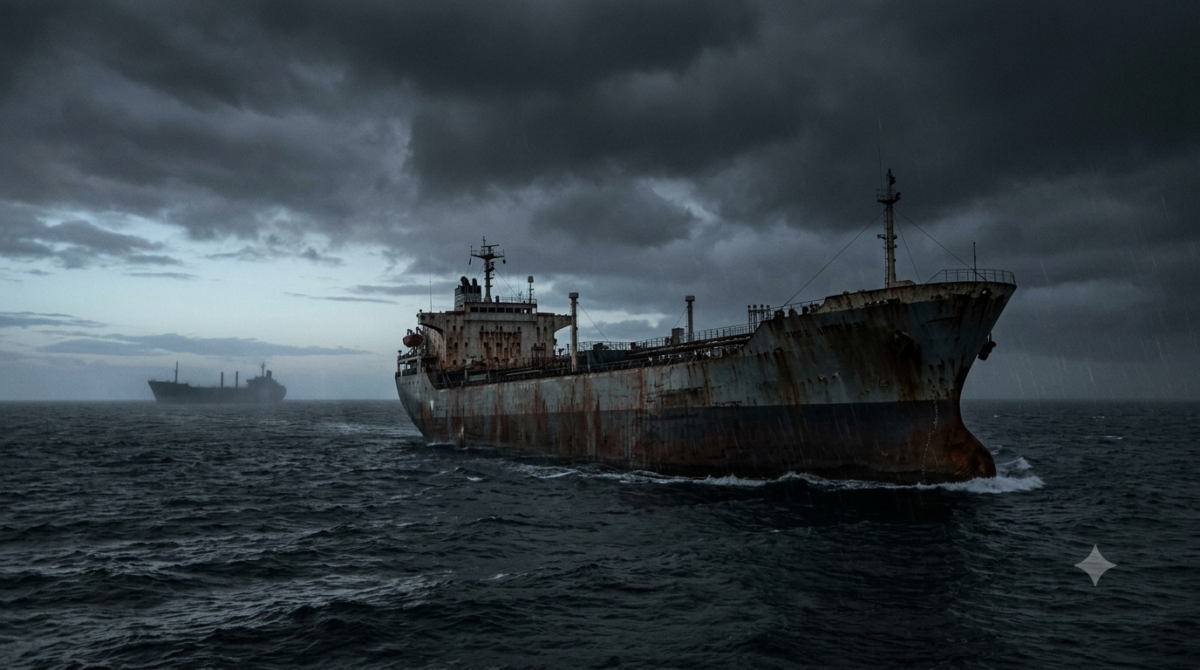
Shadow fleets, also known as dark fleets or ghost ships, are groups of tankers that rely on deceptive shipping practices to move sanctioned or high-risk commodities while concealing their true origin, ownership, or destination.
These ships use a range of practices to avoid detection. Oil companies often use old tankers without up-to-date detection technologies to stay off the radar. Some ships have their automatic identification systems disabled to avoid tracking. Meanwhile, other vessels operate in a legal grey area, using tactics such as spoofed GPS, false flags, and fake insurance documents. The use of old, untrackable ships has often raised concerns about their seaworthiness.
Shadow fleets account for around 17% of all in-service oil tankers in the ocean today, according to the research firm S&P Global Market Intelligence. The average age of a shadow vessel is around 20 years, compared with 13 years for the overall global oil fleet.
Venezuela’s Use of Shadow Fleets
Until the Trump administration carried out a unilateral military operation in Venezuela in which the South American country’s President Nicolás Maduro was captured and transported to the United States, effectively bringing an end to his 13-year dictatorship, the U.S. was upholding strict sanctions on Venezuela’s energy industry.
A lack of legitimate trade partners, due to the sanctions, led to years of underinvestment in Venezuela’s oil industry, resulting in many facilities falling into disrepair.
To circumvent sanctions, Venezuela came to rely on shadow fleets to transport the state-run oil company’s (PDVSA) heavy crude, most of which it shipped to China, with some supplies also heading to Iran.
The use of such fleets allowed Venezuela to invest in boosting its oil production despite sanctions. Venezuela’s crude exports decreased from around 1.1 million barrels per day (bpd) at the beginning of 2019 to 495,000 bpd by the end of the year, after sanctions were introduced, according to the U.S. Energy Information Administration. However, by December 2025, this figure had climbed to 920,000 bpd.
This growth in output reflected improvements in Venezuela’s ability to export crude clandestinely via shadow fleets, as well as the willingness of other countries to circumvent U.S. sanctions by purchasing it.
Russian Ghost Ships
Since the Russian invasion of Ukraine in 2022 and the subsequent United States and European sanctions placed on Russian energy, Moscow has increasingly been using shadow fleets to transport oil clandestinely to trade partners.
Russia has been forced to use so-called ghost ships to transport its crude to countries that are willing to purchase sanctioned oil at a discounted rate. Over the last three years, Russian crude exports to China, India, and Turkey have increased significantly, despite the heavy sanctions on Russian energy.
Certain Russian tankers were blacklisted under U.S.-EU sanctions; however, new ships have quickly replaced them, while tankers that lost coverage have sought alternative insurers.
While President Trump and EU leaders have repeatedly discussed the possibility of imposing sanctions or cracking down on shadow fleets, doing so is no easy task. In addition, the recent oil shortages caused by the U.S.-Israeli war on Iran, and the resulting closure of the critical trade corridor, the Strait of Hormuz, have demonstrated the need for alternative European oil supplies.
Russian tankers have been traversing a narrow passage in the Baltic on a daily basis, often accompanied by Russian military vessels or planes. One of the main challenges to stopping their passage is the inability of authorities to act outside national waters.
Cracking Down on Shadow Fleets
In June, British armed forces intercepted a Russian shadow tanker after the U.K. Prime Minister, Kier Starmer, directed authorities to stop its attempt to pass through the English Channel. The U.K.’s Ministry of Defense said that the ship would be held off the U.K.’s south coast while investigations continue.
“This successful operation delivers yet another blow to Russia and reminds those fueling [Russian President Vladimir] Putin’s war in Ukraine that we will not let them hide,” Starmer said in a post on X.
The U.K. has, so far, sanctioned over 500 vessels as part of its crackdown on Russia’s shadow fleets. This is part of a broader move by European countries to introduce tougher restrictions on Russian ships attempting to traverse their waters in violation of international sanctions.
Despite attempts by several governments to stop the movement of sanctioned energy products via shadow fleets, some sanctioned countries continue to use dark fleets to transport fuel and maintain vital energy revenues.
Keep In Touch with Shale Magazine
As the new era of energy unfolds, you can bet we’ll be the boots on the ground to keep you informed. Subscribe to Shale Magazine for sharp insight into the arenas that matter most to your life. And don’t forget to listen to our riveting podcast, The Energy Mixx Radio Show, where our very own Kym Bolado interviews the most extraordinary thought leaders, business innovators, and industry experts of our time.
Subscribe to get more posts from Felicity Bradstock