Over the last year, United States President Trump has fought to rapidly shift the national energy agenda to refocus attention on fossil fuel production. Trump has signed executive orders and launched new policies aimed at limiting the deployment of renewable energy capacity and, instead, focusing on the expansion of the oil, gas, coal and nuclear power industries.
However, while the U.S. oil and gas sector is going from strength to strength, reinvigorating the coal industry has not been so simple due to high costs, aging infrastructure, and widespread political opposition.
Trump’s Coal Agenda
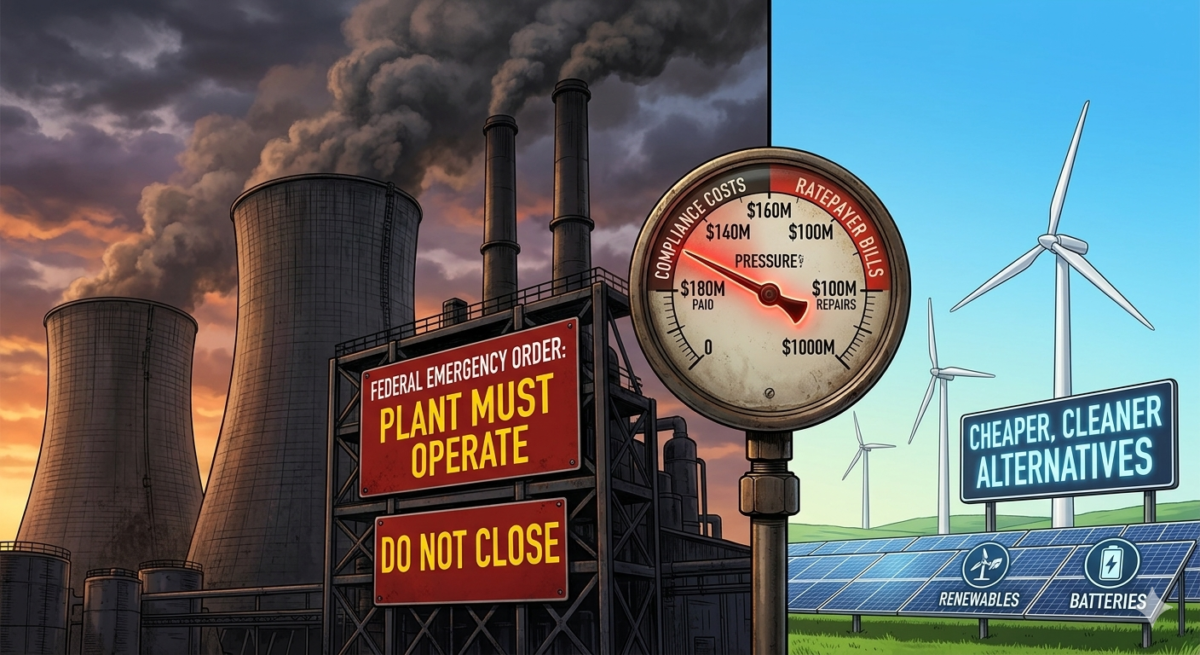
In 2025, the Trump administration issued orders to keep five aging coal plants in four states open beyond their scheduled closures in response to Trump’s declaration of a “National Energy Emergency.”
The U.S. Department of Energy (DoE) has since renewed the 90-day directives to stop these coal facilities from closing, even though one plant has not burned coal in that time, and another asked that its order be allowed to expire.
The efforts to keep coal plants running led to a 13% increase in the amount of electricity produced by coal in 2025, after years of decline. As coal emits around twice as much CO2 as natural gas when burned for energy, its rebound last year contributed to a countrywide rise in emissions of around 2.4%.
President Trump has repeatedly stated his intention to keep the coal industry alive, despite its reputation as the “dirtiest fossil fuel”. This has been made possible through the rollback of regulations on emissions and financial support for infrastructure upgrades.
The High Cost of Coal
There are several reasons for coal’s decline in recent years, from the high cost of keeping plants running to environmental and health concerns. While coal was once vital for power production, a wide range of cleaner alternatives are now available at a lower cost, which is why many countries are rapidly transitioning away from coal.
In early 2025, plant operators planned to retire 8.5 gigawatts of coal plant capacity, yet less than a third of those retirements proceeded as planned. These retirements had been deemed necessary by operators due to the rising cost of operations and the rapid increase in the capacity of cheaper alternatives, such as gas and renewable energy.
In the United States, keeping the five aging plants open over the last year has cost hundreds of millions of dollars, with consumers expected to foot the bill.
Consumers Energy, the operator of the J.H. Campbell plant in Michigan, has reportedly spent $180 million to keep the facility running since last May. “We are focused on complying with the federal orders,” Consumers Energy said in a statement.
Meanwhile, in Washington, TransAlta’s Centralia plant reported almost $20 million in costs during the first three months of the emergency order, despite the fact that it did not burn coal. TransAlta estimates that it would be extremely costly to restart operations, suggesting that it would take around 75,000 gallons of diesel, plus $200,000 worth of electricity to begin producing energy, as well as $7 million for waste disposal.
In March, U.S. Secretary of Energy Chris Wright issued an emergency order directing TransAlta to keep Unit 2 of the Centralia Generating Station available to operate. Unit 2 of the coal plant was scheduled to shut down at the end of 2025.
At the Northern Indiana Public Service Company’s R.M. Schahfer plant, one unit has been broken since last summer, which the company’s president, Vince Parisi, believes could cost as much as $100 million to fix.
Courts Rule Against Trump
In May, the U.S. Court of Appeals for the D.C. Circuit heard arguments over the Trump administration’s focus on keeping coal plants across the country running, even as costs rise. The case was brought by the states of Michigan, Minnesota, Illinois and nine non-profit groups, which argued that the DoE’s actions were illegal as there is no “energy emergency”, as the government has stated.
The case focuses on operations at the J.H. Campbell plant in Michigan, although the outcome could be applied to several coal plants across the United States.
Cleaner and Cheaper Alternatives
The investment bank Lazard published an annual report in June 2025 on electricity generation costs, which demonstrated just how much cheaper it would be to retire coal plants and instead develop more renewable energy operations for power production.
Lazard calculated an energy resource’s levelized cost by dividing a project’s lifetime energy production by its cost. Lazard found that renewables were the “most cost-competitive form of generation,” even without subsidies. It added that “Renewables stand out as both the lowest-cost and quickest-to-deploy generation resource.”
Meanwhile, the International Renewable Energy Agency (IRENA) published a report in July 2025 in which it stated: “the majority of newly commissioned renewable energy is more cost-effective for electricity generation than most fossil fuels worldwide.”
This is not new information. A 2023 study stressed that coal in the U.S. was being economically outmatched by renewables to such an extent that it was more expensive for 99% of the country’s coal-fired power plants to keep running than it was to build an entirely new solar or wind energy operation nearby.
While President Trump has doubled down on his support for aging coal operations, it is getting harder to argue against the evidence, as gas plants and renewable energy operations are becoming increasingly more efficient and cheaper to run than coal plants.
Keep In Touch with Shale Magazine
As the new era of energy unfolds, you can bet we’ll be the boots on the ground to keep you informed. Subscribe to Shale Magazine for sharp insight into the arenas that matter most to your life. And don’t forget to listen to our riveting podcast, The Energy Mixx Radio Show, where our very own Kym Bolado interviews the most extraordinary thought leaders, business innovators, and industry experts of our time.